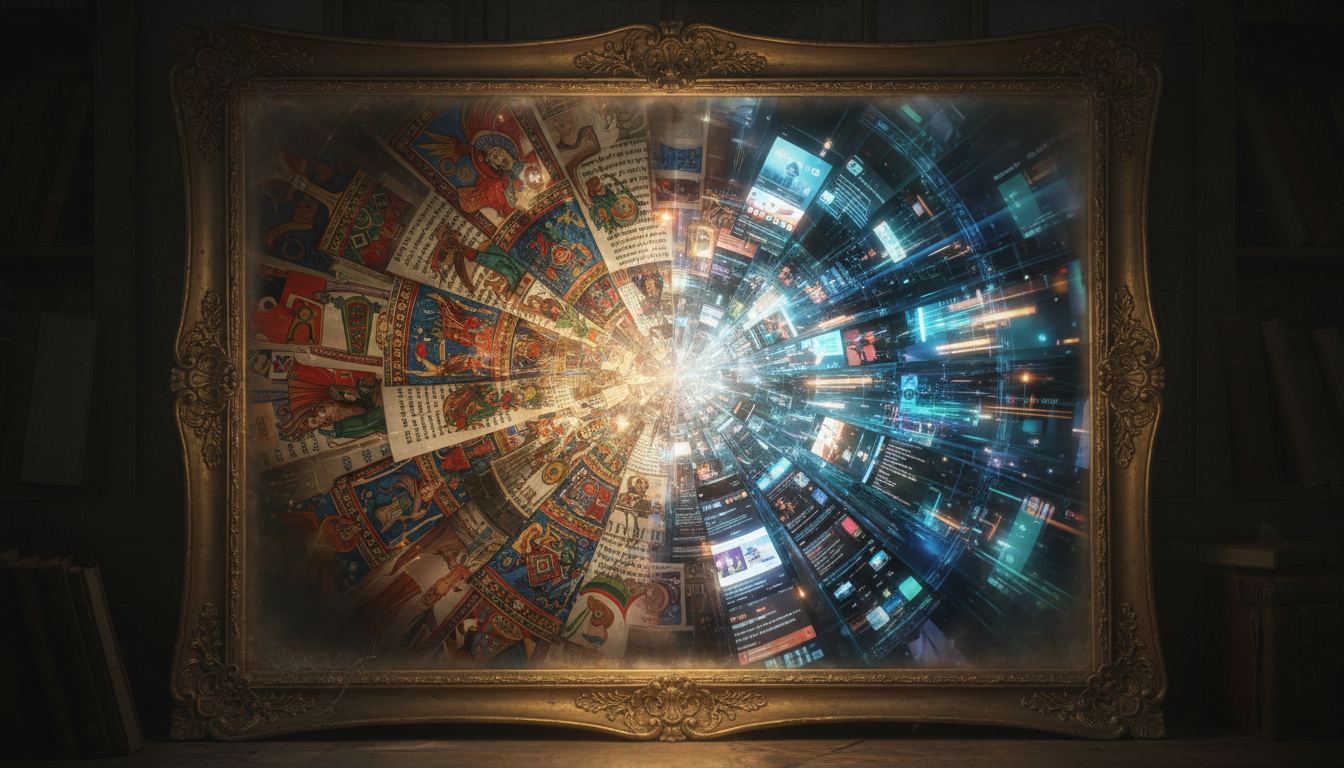
The phrase “we become what we behold” captures a disquieting truth about modern existence. Coined by Marshall McLuhan in his 1964 work Understanding Media: The Extensions of Man, the statement suggests that the technologies we use to perceive the world ultimately reshape our minds, our senses, and our social structures.
McLuhan did not intend this as casual observation. He proposed that media function as extensions of human biology—technological prosthetics that reverse their influence back upon us, altering the ratios of human perception. The implications extend far beyond television or radio, reaching into the algorithmic feeds that dominate contemporary attention economies.
Understanding this concept requires examining its origins in mid-20th century media theory, its theological echoes, and its uncanny predictive power regarding digital culture. The phrase remains a critical lens for analyzing how platforms, devices, and networks reconfigure what it means to be human.
What Does ‘We Become What We Behold’ Mean?
- Media are extensions of man: Technologies extend physical senses and nervous systems into the environment, from the wheel extending the foot to television extending the eyes and ears.
- Form over content: The structural characteristics of a medium alter society more profoundly than any specific message it carries.
- Beholding transforms the beholder: The act of perceiving through a technological medium unconsciously reconfigures the observer’s sensory ratios.
- Hot vs. cool media: “Hot” media like print provide high-definition, complete information requiring low participation, while “cool” media like television provide low-definition information requiring high user completion.
- Total involvement: Electronic media creates what McLuhan called “total involvement in all-inclusive nowness,” collapsing linear thinking into simultaneous awareness.
- Experience exceeds understanding: Users experience far more than they consciously understand, with behavior driven by these unperceived effects.
- Media narcosis: Immersion in media environments induces a trance-like state where users become numb to the medium’s transformative effects.
| Fact | Details |
|---|---|
| Quote | We become what we behold |
| Author | Marshall McLuhan |
| Year | 1964 |
| Book | Understanding Media: The Extensions of Man |
| Theme | Media ecology |
| Concept | Media as extensions of man |
| Related Term | Global Village |
| Theological Echo | 2 Corinthians 3:18 |
| Media Types | Hot vs. Cool media |
| Psychological Effect | Media narcosis |
| Modern Application | Social media algorithms |
| Theoretical Framework | Tetrad of media effects |
Who Said ‘We Become What We Behold’ and Where Is It From?
The Prophet of the Electronic Age
Marshall McLuhan emerged from the Toronto School of communication theory during the 1950s and 1960s. A literary scholar by training, he applied methods of close reading to technological environments rather than texts, treating media as invisible architectures that condition human experience. His Catholic faith and modernist literary sensibilities shaped his aphoristic style—probing observations designed to illuminate rather than exhaustively prove.
Understanding Media: The Extensions of Man
The phrase appears within McLuhan’s discussion of media as “extensions of man,” where he argues that technologies like television extend the central nervous system, creating “auto-amplifications” that objectify and reconfigure human experience. He draws on the idea that all media lead to “self-objectification,” where humans adapt to the medium’s form, not just its content. The book represents his most systematic exploration of how media environments alter sensory ratios and patterns of awareness.
Theological Underpinnings and Biblical Echoes
McLuhan, a deeply religious scholar, alluded to 2 Corinthians 3:18—”But we all, with open face beholding as in a glass the glory of the Lord, are changed into the same image from glory to glory”—to frame media transformation as a spiritual mirroring process. This biblical echo underscores beholding as metamorphic, paralleling media’s psychic reconfiguration.
While McLuhan’s phrasing mirrors scriptural language regarding transformation through contemplation, the exact quote “we become what we behold” appears in Understanding Media, not the Bible. The parallel reflects McLuhan’s view of media as environments that spiritually and psychologically remake their inhabitants.
What Is the Context of ‘We Become What We Behold’ in Marshall McLuhan’s Work?
Self-Objectification Through Technology
McLuhan posits that media induce “self-objectification”—a process where humans unconsciously mold themselves to match the structural demands of their technological extensions. The effects of technology do not occur at the level of opinions or concepts, but alter sense ratios or patterns of perception steadily and without any resistance. This passive absorption means users transform even when they believe they are merely consuming content.
Hot Media and Cool Media: A Sensory Taxonomy
McLuhan distinguishes between “hot” and “cool” media based on definition and participation. Hot media like radio or print offer high-definition data that requires little completion by the audience. Cool media like telephone or television offer low-definition data requiring high sensory participation to fill in gaps. This classification explains why different technologies produce different psychological and social effects—the medium’s temperature determines whether users remain passive consumers or active participants.
The Global Village and Collective Consciousness
Electronic media creates what McLuhan termed the “global village”—a simultaneous, instantaneous environment where all events affect all people regardless of geographical distance. This collapse of space and time transforms private individuals into “publicly exposed beings,” amplifying emotional complexity over the detached rationality fostered by print culture. The village represents not harmony but rather the intense emotional engagement and shared trauma of pre-literate tribal existence, now extended worldwide through electronic neural nets.
How Does ‘We Become What We Behold’ Apply Today?
Social Media as Extensions of the Central Nervous System
Platforms like Instagram or TikTok exemplify “cool” media, demanding constant participation through scrolling, liking, and algorithmic curation. These environments function as literal extensions of the central nervous system, creating feedback loops where users unconsciously adapt their identities to suit engagement metrics. The mosaic, non-linear pattern of social media feeds creates the “all-inclusive nowness” McLuhan associated with mythic consciousness.
Contemporary social media platforms operate as immersive “cool media” requiring continuous partial attention, creating conditions where users become products of feeds that prioritize engagement over content quality, effectively “beholding” themselves into algorithmic personas.
From Global Village to Algorithmic Tribes
The global village has fragmented into algorithmic tribes, where information overload and echo chambers illustrate sensory distortion on a mass scale. McLuhan’s framework explains how these environments retrieve tribal patterns of existence—immediate, emotionally charged, and mythic—while obsolescing the detached individualism of print literacy.
The Tetrad of Media Effects in Digital Culture
Contemporary analysts apply McLuhan’s tetrad to social media: What does the medium enhance? Connectivity and simultaneity. What does it obsolesce? Depth of attention and linear reasoning. What does it retrieve? Oral tribalism and gossip networks. What does it flip into when pushed to extremes? Surveillance capitalism and algorithmic governance. This analytical model demonstrates how thoroughly users become what they behold—the medium does not merely carry messages but actively constitutes the social and psychological reality of its users.
Recognizing that the medium shapes perception allows users to deliberately alternate between high-participation “cool” media and high-definition “hot” media, potentially mitigating the passive sensory reconfiguration McLuhan identified.
When Did Marshall McLuhan Develop These Theories?
- : McLuhan publishes The Gutenberg Galaxy, establishing his analysis of how print technology created linear thinking, individualism, and the detached observer—intellectual foundations for his later work on media as sensory environments.
- : Understanding Media: The Extensions of Man appears, containing the phrase “we become what we behold” within the context of media acting as extensions of human senses and nervous systems.
- : McLuhan collaborates with graphic designer Quentin Fiore on The Medium is the Massage, popularizing his theories through experimental visual layouts that embodied his ideas about simultaneous, non-linear communication.
- : Publication of From Cliché to Archetype and The Interior Landscape, further developing his theories of media as environments that reshape consciousness.
- : McLuhan’s The Global Village co-authored with Bruce Powers, formalizing the tetrad of media effects as a tool for analyzing technological transformation.
- : Contemporary media theorists apply McLuhan’s framework to artificial intelligence, virtual reality, and social media platforms, confirming his predictions regarding the collision of private and public spheres in electronic culture.
What Is Fact and What Is Fiction About This Quote?
| Established Information | Common Misunderstandings |
|---|---|
| McLuhan published the phrase in Understanding Media (1964) | The quote originates directly from the Bible (it alludes to 2 Corinthians 3:18 but uses McLuhan’s specific phrasing) |
| The concept concerns media form and sensory ratios, not content | It refers only to visual media or television specifically (it applies to all media from wheels to computers) |
| Describes “extensions of man” altering the psychic and social complex | Implies media are neutral tools without psychological impact |
| McLuhan analyzed effects neutrally as an ecological observer | McLuhan was anti-technology or advocated for a return to oral culture (he was Catholic but neutral regarding technological determinism) |
| Includes the concept of “global village” as simultaneous electronic space | Predicted the internet with perfect technical accuracy (he described the sensory and social effects, not specific technologies) |
| Applies to both “hot” and “cool” media classifications | Only relevant to immersive or electronic media (applies to print, speech, and all technological extensions) |
What Shaped McLuhan’s Theory of Media?
McLuhan’s formulation emerged from the Toronto School of communication theory, particularly building upon Harold Innis’s work on media bias—the idea that different communication technologies favor either temporal continuity or spatial extension. His training at Cambridge under literary critics F.R. Leavis and I.A. Richards informed his method of “probing”—exploratory, aphoristic investigation rather than linear argumentation. This literary background sensitized him to how print technology had created the very linear, logical, detached mindset that characterized Western modernity.
His Catholic faith provided the theological framework for understanding transformation through contemplation. The concept of beholding as metamorphic activity—where the observer changes through the act of perception—derives from patristic traditions. McLuhan secularized this mechanism, applying it to electronic rather than sacred images. La Gazzetta Dello Sport History demonstrates how print media similarly conditioned European collective consciousness through specific technological forms.
Modernist art and literature, particularly the vorticism of Wyndham Lewis and the poetry of T.S. Eliot, shaped McLuhan’s understanding of how mechanical reproduction and electronic speed collapsed traditional perspectives into simultaneous, mythic awareness. These influences coalesced into a theory where media are not additions to human experience but environments that fundamentally restructure cognition.
What Are the Primary Source Materials for This Quote?
“The effects of technology do not occur at the level of opinions or concepts, but alter sense ratios or patterns of perception steadily and without any resistance.”
— Marshall McLuhan, Understanding Media
“Any extension… affects the whole psychic and social complex.”
— Marshall McLuhan, Understanding Media, Understanding Media
“Everybody experiences far more than he understands. Yet it is experience… that influences behavior.”
— Marshall McLuhan, Understanding Media
McLuhan’s most famous aphorism, “the medium is the message,” appears throughout his work to emphasize that the personal and social consequences of any medium result from the new scale introduced into human affairs by each extension of ourselves. These primary texts establish that “we become what we behold” is not merely metaphorical but describes actual neurological and psychological adaptation to technological environments.
Why Does This Quote Matter in the Digital Age?
McLuhan’s observation serves as a diagnostic tool for navigating algorithmic culture. As users inhabit platforms that extend their nervous systems into continuous global embrace, the mechanism of becoming what we behold operates with unprecedented granularity. The quote warns that immersion in any medium silently reconfigures the human sensorium, making critical awareness of media environments essential for psychological autonomy. Those examining how environments shape individuals might find complementary perspectives in the Come As You Are Book Summary.
Frequently Asked Questions
Is ‘we become what we behold’ from the Bible?
No. While McLuhan alluded to 2 Corinthians 3:18 regarding transformation through beholding, the exact phrasing appears in his 1964 book Understanding Media.
What did McLuhan mean by ‘the medium is the message’?
McLuhan meant that the form of a medium—the specific way it extends human senses—shapes society more profoundly than any content it carries.
What is the difference between hot and cool media?
Hot media like print provide high-definition, complete information requiring low participation. Cool media like television or social media provide low-definition information requiring high user completion and involvement.
How does this quote apply to social media?
Social media function as “cool” media and extensions of the central nervous system, creating feedback loops where users unconsciously adapt their identities to algorithmic structures and engagement metrics.
What is media ecology?
Media ecology studies how media environments affect human perception, understanding, and social organization—the field McLuhan helped establish with his analysis of media as environments rather than tools.
What is the tetrad of media effects?
McLuhan’s tetrad asks four questions about any technology: What does it enhance? What does it obsolesce? What does it retrieve? What does it flip into when pushed to extremes?
Did McLuhan predict the internet?
McLuhan described the “global village” created by electronic media where information moves simultaneously worldwide, anticipating the internet’s collapse of spatial and temporal distance in communication.

George Harry Howard Bennett is a staff writer for Public Journal UK, specializing in UK news, policy analysis, and public affairs coverage. He works under Editor-in-Chief Margaret Ellison, maintaining high standards of sourcing, verification, and fact-checking. Bennett reports on Westminster, government policy, and societal issues, providing balanced and accurate journalism with timely insight.