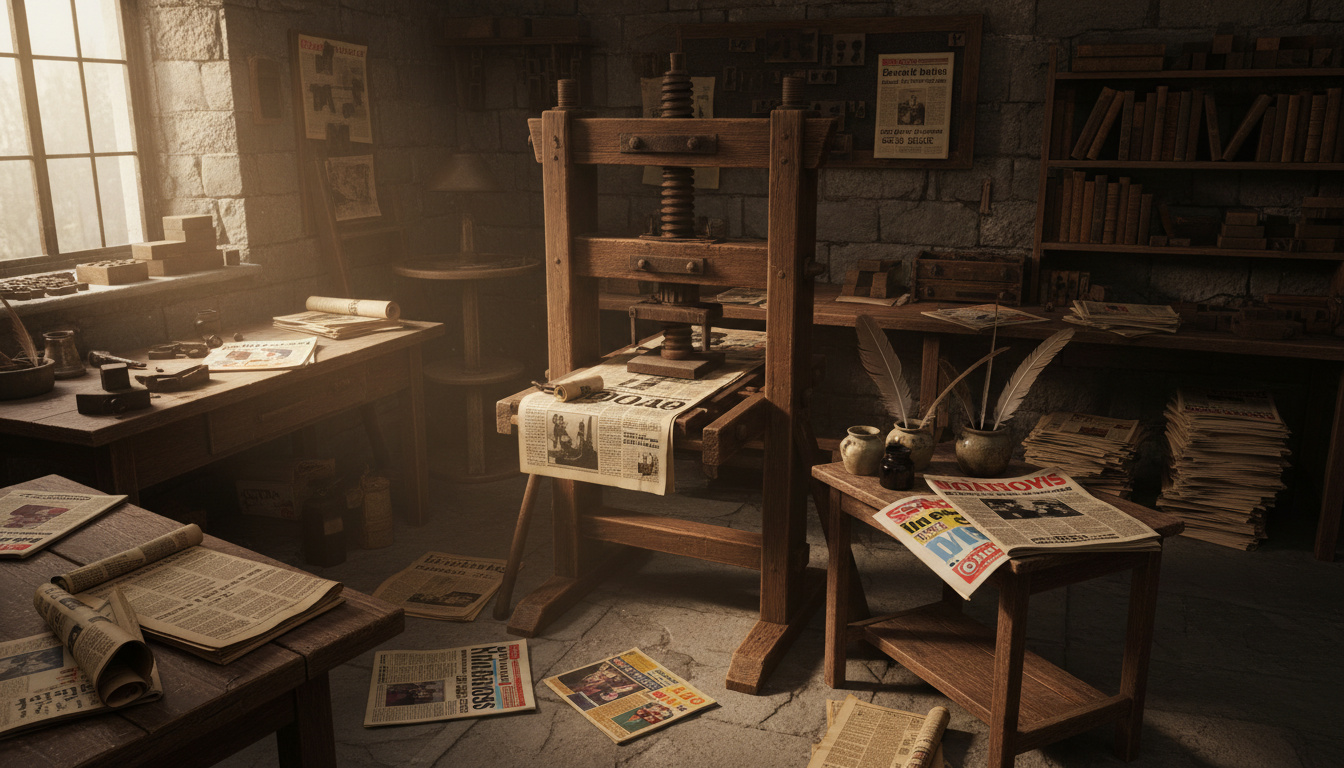
A newspaper is a periodically published print or digital medium, typically issued daily or weekly. It delivers current news, views, features, articles of public interest, correspondence, and advertisements on folded sheets. This format has long served as a key source of information.
Newspapers cover events from the past 24 hours. Before digital media, they dominated as primary information sources. Today, they face competition from TV, radio, and the internet but remain widely accessible.
Categories focus on format, frequency, and content, shaping how readers engage with daily updates.
What is a newspaper?
| Aspect | Core Details |
|---|---|
| Publication Medium | Print or digital, folded sheets |
| Frequency | Daily, weekly, or other regular intervals |
| Content Focus | News, views, features, public interest, ads |
| Distribution | Periodic issues for broad audiences |
- Originated in ancient public notices.
- Enabled by Gutenberg’s printing press.
- Classified by broadsheet or tabloid formats.
- Covers recent events, typically 24 hours old.
- Includes serious analysis or sensational stories.
- Published daily, weekly, semi-weekly, bi-weekly, or monthly.
| Fact | Detail |
|---|---|
| Primary Role | Delivers current news and advertisements |
| Historical Start | Acta Diurna in 59 BCE |
| First Modern Paper | Germany’s Relation in 1605 |
| England’s First Daily | The Daily Courant in 1702 |
| North America Debut | Publick Occurrences in 1690, soon banned |
| Broadsheet Traits | Large format, in-depth coverage |
| Tabloid Traits | Compact, bold headlines |
| Pre-Digital Dominance | Main info source before TV/internet |
What are the origins of newspapers?
Early forms appeared in ancient Rome with Acta Diurna in 59 BCE. These posted daily announcements of political and social events. Source
Medieval developments
Manuscript newsletters circulated among traders, such as the Fugger family.
Handwritten newsletters by traders like the Fuggers spread news before printing.
Modern emergence
Johannes Gutenberg’s mid-1400s printing press allowed mass production. Germany’s Relation in 1605 became the first true newspaper with regular schedules on current events. Source
What are the key types of newspapers?
Newspapers divide by format, frequency, and content focus. Broadsheets use large pages for serious, in-depth coverage aimed at educated readers. Examples include The New York Times, The Wall Street Journal, and Chicago Tribune. Source
Tabloids feature compact half-size formats with sensational stories, celebrity news, and bold headlines. Notable ones are New York Daily News (1919), UK Daily Mail (1896), New York Post, and The Sun. Source
Broadsheets prioritise depth; tabloids seek broad appeal through visuals and brevity.
Options span daily to monthly; select based on local needs and audience habits.
Frequencies cover daily, weekly, semi-weekly, bi-weekly, or monthly issues. For more on various types of newspapers, see detailed classifications.
What is the timeline of newspaper milestones?
- : Acta Diurna posts daily Roman announcements.Britannica
- Mid-1400s: Gutenberg’s press enables mass printing.Pressbooks
- 1605: Germany’s Relation launches as first regular newspaper.Fiveable
- 1621: Corantos appear in England.Britannica
- 1640s: News books evolve in England.
- 1690: North America’s Publick Occurrences Both Foreign and Domestick published, then banned.Pressbooks
- 1702: The Daily Courant, England’s first daily.
- 1785: The Times establishes quality standards.
What facts on newspapers are clearly established?
| Established Information | Unclear or Debated Aspects |
|---|---|
| Core definition as periodic medium | – |
| Formats: broadsheet and tabloid traits | – |
| Frequencies from daily to monthly | – |
| Historical timeline from Acta Diurna | Precise role of medieval newsletters |
| First modern paper as Relation (1605) | Exact “first” boundaries |
| Pre-digital dominance as info source | – |
What context surrounds newspapers?
Newspapers evolved from public notices to mass media staples. Printing technology transformed scattered news into structured publications. They shaped public discourse for centuries.
Digital shifts challenged print, yet core functions persist in informing on recent events.
What sources support newspaper facts?
A newspaper is a periodically published print or digital medium, typically issued daily or weekly.
Multiple academic and library guides confirm origins, types, and roles. Key references include Britannica and university pressbooks, along with Australia Insight.
What summarises the newspaper?
Newspapers blend history, formats, and timely content into enduring media. From ancient origins to modern types like broadsheets and tabloids, they deliver essential updates despite digital rivals. See Britannica’s newspaper entry for more.
What covers a typical newspaper?
Current news, views, features, public interest articles, letters, and ads on folded sheets.
Was Acta Diurna a newspaper?
It posted daily Roman events, serving as an early precursor.
What started tabloids?
Compact formats like UK Daily Mail (1896) and New York Daily News (1919).
How often are newspapers issued?
Daily, weekly, semi-weekly, bi-weekly, or monthly.
Why was North America’s first paper banned?
Publick Occurrences (1690) faced quick suppression.
Do newspapers still matter?
Yes, they remain accessible amid TV and online competition.
What sets The Times apart?
Launched 1785, it set quality standards in England.

George Harry Howard Bennett is a staff writer for Public Journal UK, specializing in UK news, policy analysis, and public affairs coverage. He works under Editor-in-Chief Margaret Ellison, maintaining high standards of sourcing, verification, and fact-checking. Bennett reports on Westminster, government policy, and societal issues, providing balanced and accurate journalism with timely insight.