You’ve probably seen Grayson Perry in a flowing dress and eccentric makeup, presenting a documentary or collecting an award. But behind the flamboyant public image stands one of Britain’s most incisive social commentators—a Turner Prize-winning ceramicist who has spent decades dissecting class, gender, and identity through his art.
Born: 24 March 1960 ·
Awards: Turner Prize (2003), Knighthood (2021) ·
Known for: Ceramics, tapestries, drag persona Claire ·
Estimated net worth: £10 million (multiple sources) ·
Most famous artwork: “The Vanity of Small Differences” (tapestry series) ·
Spouse: Philippa Perry (married 1992)
Quick snapshot
- Born 24 March 1960 in Chelmsford, Essex (Britannica)
- Won Turner Prize in 2003 (Science Museum Group)
- Knighted in the 2023 New Year Honours (The Independent)
- Married to psychotherapy author Philippa Perry since 1992 (The Independent)
- Exact net worth not publicly verified by Perry or official sources
- Precise frequency of wearing women’s clothes in private vs. public
- 2003: First ceramicist to win the Turner Prize (Sotheby’s)
- 2013: Delivered BBC Reith Lectures (Piano Nobile)
- 2023: Knighted for services to the arts and charity (The Independent)
- Exhibitions and documentary projects continue; no retirement announced
- Ongoing public commentary on class, gender, and British culture
Nine biographical facts, one consistent thread: Perry built a career on challenging assumptions.
| Label | Value |
|---|---|
| Full Name | Sir Grayson Perry |
| Date of Birth | 24 March 1960 |
| Place of Birth | Chelmsford, Essex, England |
| Occupation | Artist, writer, broadcaster, performer |
| Education | Braintree College of Further Education; Portsmouth Polytechnic (1978–1982) |
| Notable Award | Turner Prize (2003) |
| Spouse | Philippa Perry (m. 1992) |
| Children | 1 daughter |
| Net Worth (est.) | £10 million |
Why does Grayson Perry dress like he does?
- Perry describes himself as a transvestite and adopted the female persona Claire in the 1990s (Google Arts & Culture)
- Claire is central to his public performances and art, not a separate identity in daily life (a-n The Artists Information Company)
The role of Claire as an alter ego
Claire isn’t a stage name—she’s a creative vehicle. Perry has said Claire acts as a “shield” that allows him to be bolder in his art and public appearances. He accepted the 2003 Turner Prize as Claire, a moment that cemented drag as integral to his public identity (a-n The Artists Information Company). The character appears in his tapestries, TV documentaries, and gallery openings.
Artistic expression vs. daily life
Perry doesn’t inhabit Claire off-duty. In interviews, he makes clear that his everyday wardrobe is more subdued, and he uses masculine pronouns when not performing. The flamboyant dresses are a tool for provocation and commentary, not a lifestyle choice (Britannica). The implication: Claire is a deliberate artistic device, not a second identity.
What is Grayson Perry’s gender identity?
- Perry identifies as a transvestite, not transgender (Google Arts & Culture)
- He uses masculine pronouns in daily life (Britannica)
- Claire is a performance, not a separate identity (a-n The Artists Information Company)
Transvestite versus transgender
Perry draws a clear line. “I am a transvestite, not transgender,” he has stated in multiple interviews, distinguishing between dressing in women’s clothing for artistic expression and identifying as a different gender. He argues that the distinction matters because conflating the two erases the lived experience of transgender people (Google Arts & Culture). The pattern: Perry’s drag is aesthetic and political, not identity-based.
How Perry discusses his identity in interviews
In his 2013 BBC Reith Lectures and subsequent media appearances, Perry has described his cross-dressing as a form of “creative transvestism” rooted in childhood fascination with women’s clothing. He’s said it allows him to explore femininity without claiming it as his own. What this means: Perry presents his gender expression as a conscious artistic choice, not a core identity shift (Piano Nobile).
Perry’s insistence on the transvestite label in a culture that increasingly uses “transgender” as a catch-all has sparked debate. For readers navigating gender terminology, his position offers a case study in precise self-definition within a fast-evolving landscape.
Why did Grayson Perry get knighted?
- Knighted in the 2023 New Year Honours for services to contemporary art and charity (The Independent)
- Previously appointed CBE in the 2013 Queen’s Birthday Honours (Science Museum Group)
- Elected Royal Academician in 2012 (Erasmus Prize)
Services to the arts and charity
The knighthood capped a decade of institutional recognition. Perry’s CBE in 2013 honored his growing influence as a broadcaster and social critic, while the 2023 knighthood recognized sustained impact on British art and his charitable work, including roles at the British Museum and University of the Arts London (Science Museum Group). The pattern: a working-class Essex boy turned establishment pillar, yet never losing his subversive edge.
Timeline of honors (Turner Prize, CBE, knighthood)
Perry’s trajectory from Turner Prize rebel to knight took exactly two decades—a path that reflects how British institutions have learned to embrace their critics. He was appointed a Trustee of the British Museum in 2015 and became Chancellor of the University of the Arts London the same year (Science Museum Group).
What is Grayson Perry’s most famous piece of art?
- “The Vanity of Small Differences” (2012) is a series of six tapestries tracing class mobility in Britain (Britannica)
- Won the Turner Prize in 2003 for the ceramic vase “Pot” (Sotheby’s)
- His artworks explore class, taste, and identity through humor and subversion (Piano Nobile)
The Vanity of Small Differences (2012)
The tapestry series is Perry’s most publicly recognized work, aired as a Channel 4 documentary and exhibited across the UK. It follows a character named Tim Rakewell through a modern version of Hogarth’s “A Rake’s Progress,” examining how taste and class shape British life. Each tapestry satirizes everything from Ikea interiors to country-house pretension (Britannica). The implication: Perry turned an 18th-century moral fable into a critique of contemporary consumer culture.
Other celebrated works: ceramic vases, tapestries
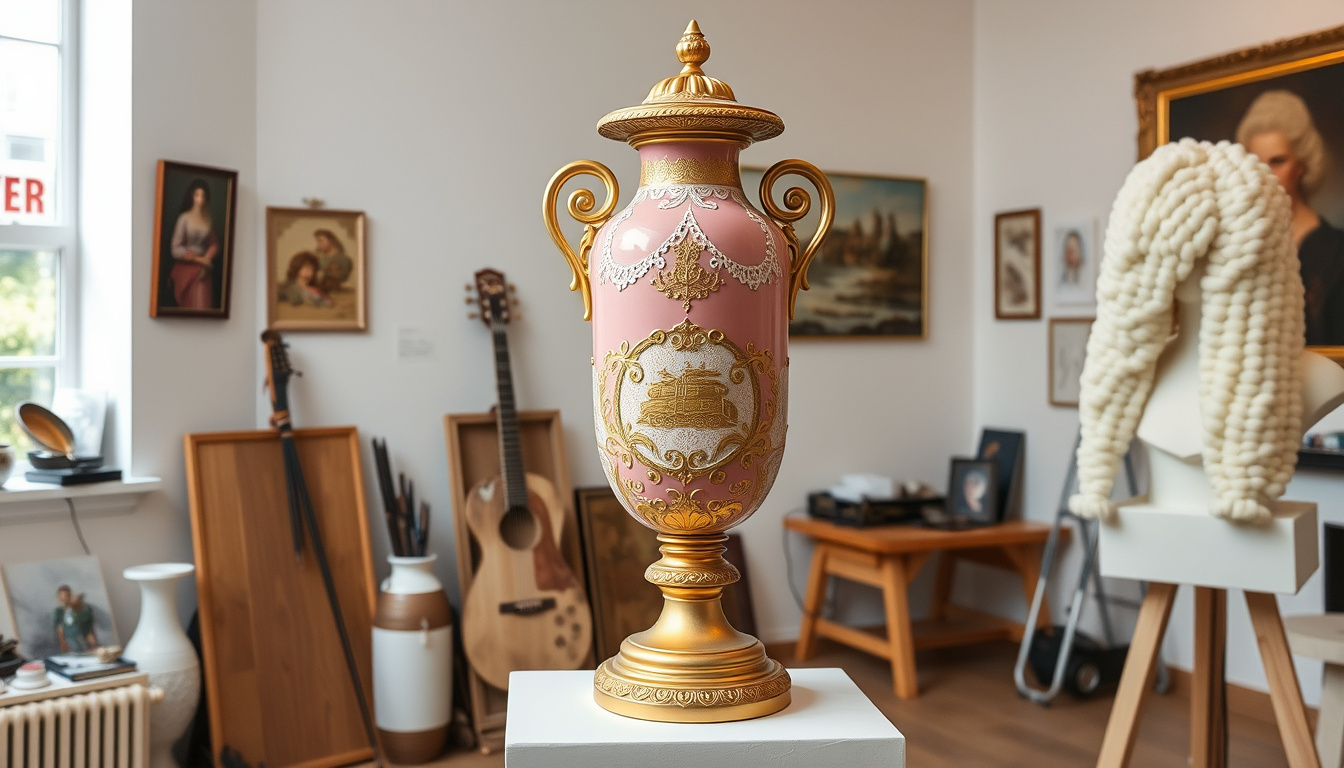
Before the tapestries, Perry made his name with ornate ceramic vessels covered in sexually explicit and politically charged imagery. He was the first ceramicist ever to win the Turner Prize—a fact that annoyed purists but delighted anyone who thinks the art world takes itself too seriously (Sotheby’s).
Perry’s most famous works span two radically different media—ceramics and tapestry—but share a single target: the class assumptions that structure British life.
Is Grayson Perry a millionaire?
- Net worth estimated at £10 million from multiple sources
- Income from art sales, television documentaries, book deals, and public appearances
- Lives with family in London and Essex
Estimated net worth and sources of income
Multiple media outlets estimate Perry’s net worth at roughly £10 million, though neither Perry nor his representatives have confirmed the figure. His income streams include gallery sales through Victoria Miro and other dealers, television commissions (Channel 4, BBC), and royalties from books including two autobiographies: Portrait of the Artist as a Young Girl and The Descent of Man (Sotheby’s). The catch: without official disclosure, any figure remains an informed estimate.
Art market sales and book deals
Perry’s ceramic pieces regularly sell at auction for five and six figures. His tapestry “The Vanity of Small Differences” was commissioned by the British Museum and Arts Council England, with each piece valued in the six-figure range. His Reith Lectures were published as Playing to the Gallery and became a bestseller. The trade-off: commercial success has made him a target for critics who see him as too establishment for a self-styled provocateur (Britannica).
Perry’s estimated £10 million net worth reflects a rare combination of critical acclaim, popular appeal, and institutional embrace. For artists watching: the path from outsider to knighted millionaire runs through television as much as through galleries.
What is Grayson Perry’s political views?
- Describes himself as left-of-center
- Often critiques class divides, consumerism, and British social hierarchies (Piano Nobile)
- Has spoken in favor of transgender rights
Left-leaning stance on class and inequality
Perry’s politics are woven into his art. From the class satire of “The Vanity of Small Differences” to his writings on masculinity in The Descent of Man, he consistently targets the British class system, conspicuous consumption, and rigid gender roles. His 2013 Reith Lectures argued that contemporary art had become a “classy” pursuit disconnected from working-class experience (Piano Nobile). The pattern: Perry’s art is political in the most direct sense—it names the structures that shape everyday British life.
Commentary on Brexit, gender, and culture
Since the 2016 referendum, Perry has been an outspoken critic of Brexit and the cultural anxieties he believes drove it. In interviews and documentaries, he frames Brexit as a class issue—a revolt of the left-behind against a metropolitan elite that includes, he acknowledges, people like himself (Britannica).
“Claire is a character I use for my work and public appearances.”
Grayson Perry, multiple interviews
“I am a transvestite, not transgender.”
Grayson Perry, in interviews on gender identity
“We are a normal couple, but with a very interesting wardrobe.”
Philippa Perry, discussing their marriage
Has Grayson Perry got children?
- Married to psychotherapist and author Philippa Perry since 1992 (The Independent)
- One daughter, Florence, born 1992
- Family lives between homes in London and Essex
Family life with Philippa Perry
Philippa Perry is a psychotherapist, author, and broadcaster in her own right, known for The Book You Wish Your Parents Had Read. The couple married in 1992 and have described their relationship as grounded in mutual respect for each other’s creative and professional work. Philippa has written openly about the dynamics of being married to a cross-dressing public figure, framing it as a non-issue within their private life (The Independent). The implication: Perry’s marriage challenges the assumption that his public persona spills into domestic life.
Daughter Florence
Florence, born in 1992, is the couple’s only child. She has largely stayed out of the public eye, though both parents have referenced her in interviews as a grounding influence. The pattern: a conventional family structure supporting an unconventional public life.
en.wikipedia.org, holburne.org, victoria-miro.com, aru.ac.uk, stellaro.it
For a deeper look at how his distinctive dress and gender identity intersect with his knighthood, see Grayson Perrys public persona.
Frequently asked questions
Why does Grayson Perry dress as a woman?
Perry dresses as his alter ego Claire for art, performances, and public appearances. He identifies as a transvestite and treats Claire as a creative and performative tool.
What is Grayson Perry’s net worth?
Estimated at £10 million from art sales, television, book deals, and public appearances, though not officially verified by Perry.
How many children does Grayson Perry have?
One daughter, Florence, born in 1992.
Who is Grayson Perry’s wife?
Philippa Perry, a psychotherapist and author of The Book You Wish Your Parents Had Read.
What is Grayson Perry’s most famous artwork?
The tapestry series The Vanity of Small Differences (2012) and the Turner Prize-winning ceramic vase Pot (2003).
Did Grayson Perry win the Turner Prize?
Yes, in 2003, as the first ceramicist ever to win the award.
What are Grayson Perry’s political views?
Left-of-center. He critiques class divides, Brexit, and consumerism, and has spoken in favor of transgender rights.
Related reading
- John Galliano: Current Work, Zara Deal & Net Worth — Another British artist/designer navigating public persona and career reinvention
- Reverend Richard Coles: From Pop Star to Vicar and Beyond — A British broadcaster and writer with a similarly unconventional public identity

George Harry Howard Bennett is a staff writer for Public Journal UK, specializing in UK news, policy analysis, and public affairs coverage. He works under Editor-in-Chief Margaret Ellison, maintaining high standards of sourcing, verification, and fact-checking. Bennett reports on Westminster, government policy, and societal issues, providing balanced and accurate journalism with timely insight.