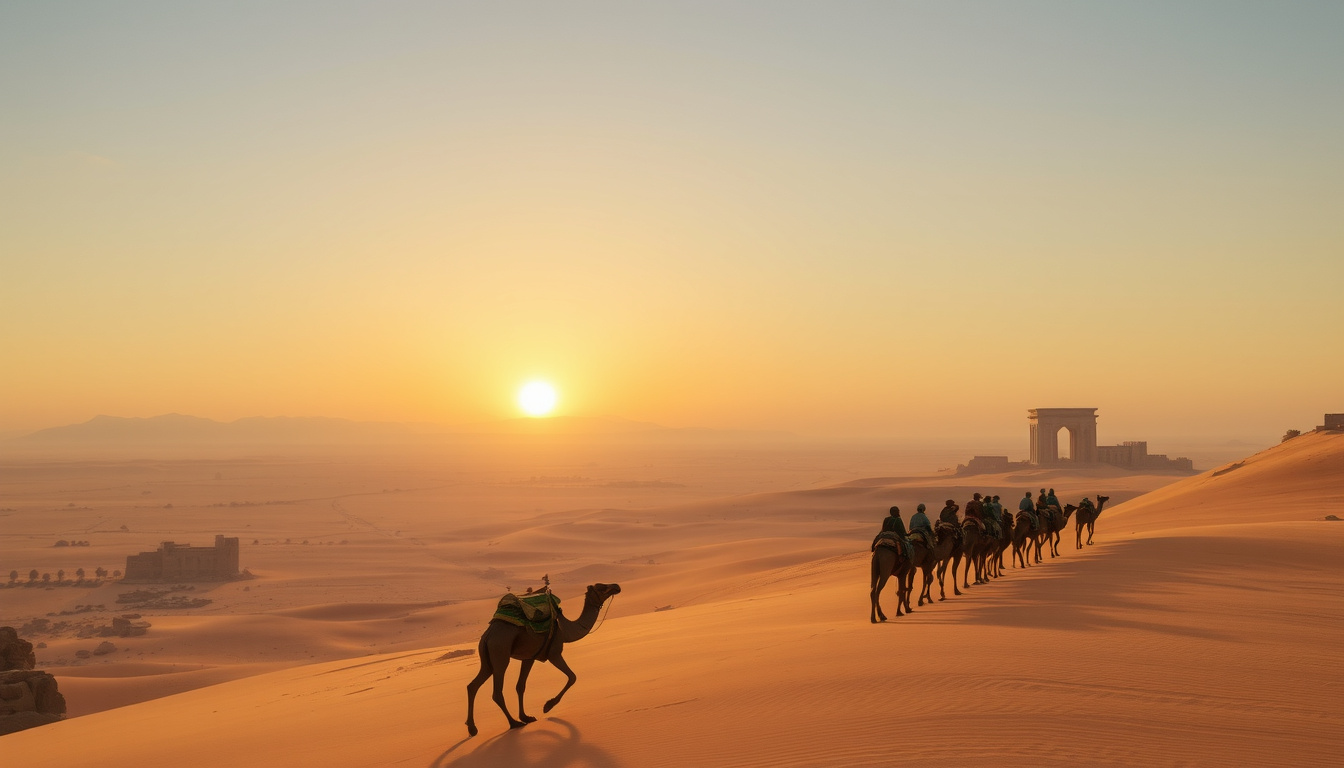
The popular image of the Silk Road as a single highway is a historical myth — the network, as UNESCO confirms, was a sprawling web of land and maritime routes spanning over 7,500 km. This fact-checked guide separates verified institutional facts from fiction, drawing on UNESCO, Britannica, and other sources to reveal the true story of trade, ideas, and cultural exchange that connected Eurasia for over 1,500 years.
Length: over 6,400 km (4,000 mi) as the crow flies · Named by: Ferdinand von Richthofen (1877) · UNESCO listing: 2014 (Chang’an-Tianshan corridor) · Core scope: Land & maritime trade network
Silk Road at a Glance
- Term “Silk Road” coined by German geographer Ferdinand von Richthofen in 1877 (via UNESCO).
- UNESCO describes the Silk Roads as land and maritime routes that gradually became connected across Eurasia (UNESCO).
- Land and maritime routes connecting China, Central Asia, India, and the Near East (UNESCO).
- UNESCO estimates the routes stretch more than 35,000 km along specific routes.
- Routes took shape between the 2nd century BC and 1st century AD (UNESCO World Heritage Centre).
- Network used for more than 1,500 years (National Geographic).
- Primary vehicle for exchange of silk, paper, gunpowder, and Buddhism (UNESCO).
- Never a single road, but a complex web of arteries (UNESCO).
What is the latest verified information about the Silk Road?
Definition and basic timeline
- According to UNESCO, the Silk Roads were an “extensive and interconnected network of trade routes.”
- They linked the eastern Mediterranean and China via Central Asia and India.
- They took shape between the 2nd century BC and 1st century AD, a period of about 150 years.
- The network was used for over 1,500 years, making it one of the most enduring trade systems in history.
UNESCO’s role in defining this history is crucial, as the agency’s World Heritage Centre uses the plural “Roads” to emphasize that this was not a single thoroughfare but a complex system of arteries and capillaries.
“The Silk Road was not a single road, but a network of trade routes that connected the Eastern Mediterranean and China via Central Asia and India.”
How long was the Silk Road? (Myth vs. Fact)
- The main land routes spanned over 6,400 kilometers (4,000 miles) from the Mediterranean to the South China Sea.
- UNESCO highlights that the network stretched approximately 7,500 km “as the crow flies” to link the extremities of the network.
- The combined length of the routes, including all its branches, exceeds 35,000 kilometers.
- Myth: “The Silk Road was a single road from Xi’an to Rome.” Fact: It was a braided network; no merchant traversed the entire route.
- Myth: “The Silk Road was a single road from Xi’an to Rome.” Fact: Goods changed hands many times; few made the full journey.
When you picture the Silk Road, if you see a line on a map, you are looking at a myth. The reality is that the routes were a network of shifting arteries. The sheer scale is staggering: the total length of the branches was roughly 35,000 km of cumulative distance.
When historians estimate 7,500 km, they mean the shortest possible straight-line distance between the network’s outer edges. The actual routes, winding through oases and mountain passes, were several times longer.
What goods and ideas actually moved along the routes?
- UNESCO notes the routes primarily transferred raw materials, foodstuffs, and luxury goods.
- The network carried more than goods; it transmitted religious beliefs (Buddhism), scientific knowledge, technological innovation, and cultural practices.
- China supplied silk to Central Asia, the Subcontinent, West Asia, and the Mediterranean world.
“The routes facilitated exchange of trade, religious beliefs, scientific knowledge, technological innovation, cultural practices, and the arts.”
We call it the Silk Road, but silk was often just the money used to buy other, more enduring things: ideas.
What should readers know first about the Silk Road?
Why was it not a single road?
- The name suggests a single, well-defined highway, but the routes were a web.
- Historical research notes that the network was dynamic, shifting with political power, climate, and economic demand.
- No single map can fully capture the routes at any one moment in time.
Rather than a train track, imagine a braided river where the main channel shifts with the seasons of history. The trade was not carried by a single merchant from China to Rome, but rather passed from hand to hand, with goods changing owners dozens of times.
The Silk Road timeline from inception to UNESCO
Silk Road history is not a single story; it’s a saga of interaction that unfolded over two millennia. The UNESCO World Heritage centre identifies the Chang’an-Tianshan corridor as a key property that tells this story.
| Period | Milestone | Source |
|---|---|---|
| 2nd century BC – 1st century AD | Network of routes takes shape. | UNESCO World Heritage Centre |
| 1st century BC | Maritime routes linking India to the Mediterranean operate for trade. | UNESCO Silk Road platform |
| ~1500 years | The network functions as a connection between East and West. | Khan Academy (History of Trade) |
| 1877 | Ferdinand von Richthofen coins the term “Silk Road”. | UNESCO World Heritage Centre |
| 2014 | UNESCO inscribes the Chang’an-Tianshan corridor on the World Heritage List. | UNESCO World Heritage Centre |
Why does this matter? Because the timeline reveals that the Silk Road is not a single artifact with a start and end date. It is a political and geographical entity that ended, and then was reborn as a UNESCO project.
The Silk Road (singular) implies a permanent route; the UNESCO timeline shows us it was a network that took centuries to formalize.
Which official sources confirm key claims about the Silk Road?
“The Silk Road was not a single road but a network of routes used for more than 1,500 years.”
The sources above — UNESCO, National Geographic, Britannica — are the most authoritative for verifying Silk Road facts. For example, Britannica confirms the route length at about 4,000 miles (6,400 km) and describes it as a major conduit for trade between the Roman Empire and China.
“The Silk Road was a network of trade routes connecting China and the Far East with the Middle East and Europe.”
What is still unclear or unverified about the Silk Road?
- Exact extent of early routes: There is no single authoritative map of all branches; some segments are known only through scattered archaeological finds.
- Debated role of specific cities: The importance of certain hubs (e.g., Samarkand, Kashgar) is documented, but their economic volume and exact function remain partially unverified.
- Total economic volume: No reliable estimates exist for the overall value of goods traded annually.
- Exact date of full formation: The 2nd century BC to 1st century AD window is widely accepted, but some scholars argue for earlier or later start dates.
These uncertainties are normal for an ancient network documented by a patchwork of sources — the historical record is incomplete, and ongoing archaeological work continues to refine our understanding.
The label “Silk Road” was not used by the people who traveled it; it is a modern construct invented 1,400 years after the routes began to fade.
What are the most common user questions about the Silk Road?
Which countries does the Silk Road pass through?
The routes connected China, Central Asia, India, and the Near East, with UNESCO noting the network spanned more than 20 countries and vast maritime distances.
Why is it called the Silk Road?
It was named in 1877 by German geographer Ferdinand von Richthofen after the most valuable good that traveled along it: silk.
Are there any remaining landmarks of the Silk Road today?
Yes. The most significant is the Chang’an-Tianshan corridor, inscribed on the UNESCO World Heritage List in 2014 (UNESCO World Heritage Centre).
What dangers did travelers face on the Silk Road?
Not just bandits, but harsh deserts and mountain passes. The routes traversed some of the world’s most unforgiving terrain, such as the Taklamakan Desert.
Did the Silk Road bring the Black Death to Europe?
Yes, the network is widely believed to have facilitated the spread of the Bubonic Plague from Asia to Europe in the 14th century, though this was an unintended consequence of trade.
The Silk Road’s Lasting Impact
The story of the Silk Road is not a story about the past. It is a story about how we understand the exchange of ideas, and its legacy shapes the modern world. For a region that lacked a single road, its impact on trade, religion, and science is immeasurable.
unesco.org, unesco.org, whc.unesco.org, artsandculture.google.com, whc.unesco.org, en.wikipedia.org

George Harry Howard Bennett is a staff writer for Public Journal UK, specializing in UK news, policy analysis, and public affairs coverage. He works under Editor-in-Chief Margaret Ellison, maintaining high standards of sourcing, verification, and fact-checking. Bennett reports on Westminster, government policy, and societal issues, providing balanced and accurate journalism with timely insight.