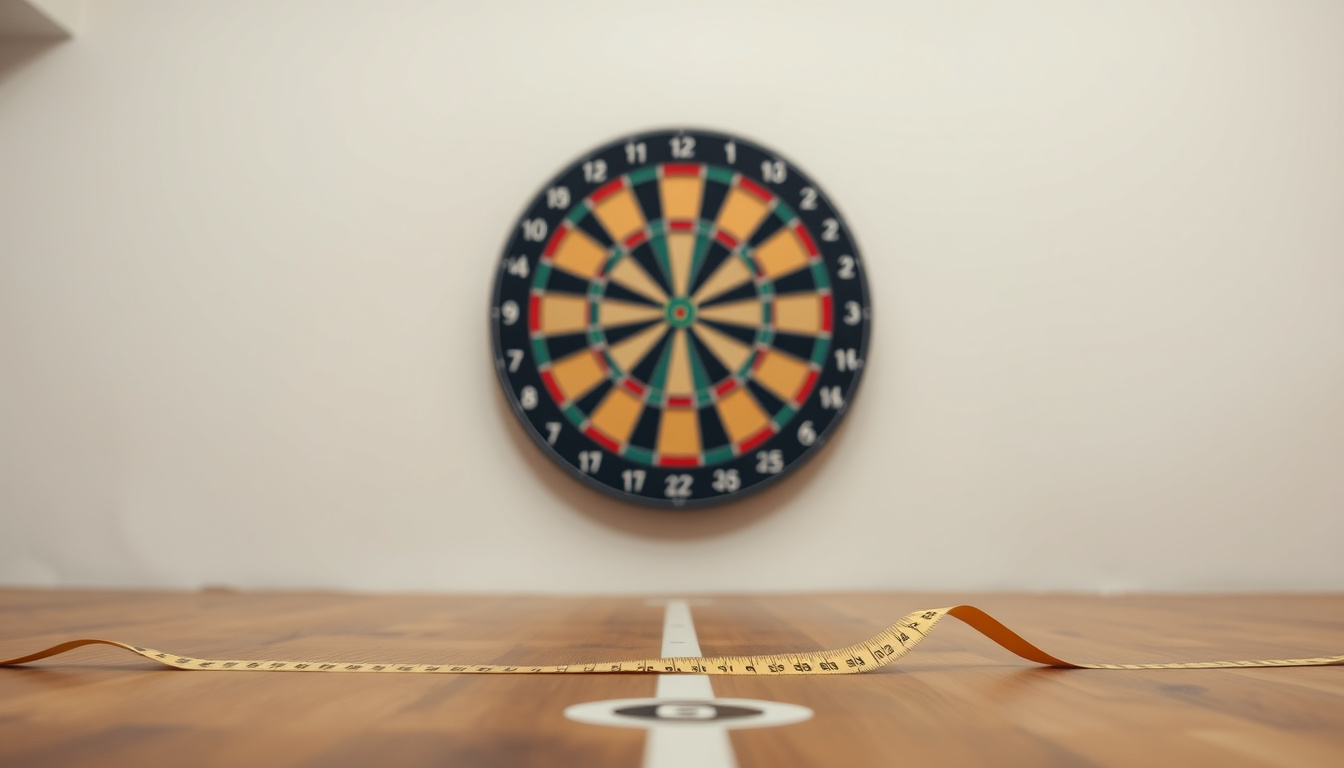
Anyone who’s ever hung a dartboard knows the temptation: measure once, throw a few practice darts, and adjust on the fly. But tournament play leaves no room for guesswork — the bullseye has to sit exactly 1.73 meters above the floor, and the oche has to be precisely 2.37 meters from the face of the board.
Official throwing distance: 7 feet 9.25 inches (2.37 m) from the face of the dartboard to the oche ·
Bullseye height: 5 feet 8 inches (1.73 m) from the floor to the center of the bullseye ·
Minimum room depth: 11 feet 8 inches (3.56 m) for steel-tip darts ·
Standard board width: 17.75 inches (45.1 cm) diameter
Quick snapshot
- Steel-tip oche: 7 ft 9.25 in (2.37 m) from the board face (SportsMonkie (darts equipment guide))
- Bullseye height: 5 ft 8 in (1.73 m) to the center of the bull (Clever Darts (equipment guide))
- Why a score of 26 is called “bed and breakfast”
- Whether a universal “best” dart length exists
- Whether soft-tip distances are standardized across manufacturers
- Board diameter: 17.75 in (45.1 cm) (GLD Products (dartboard manufacturer))
- Throw line: measure from the face of the board, not the wall (Throwcade (darts setup guide))
- Uneven floor? Check the diagonal measurement in the key facts table below
- Leave space behind the oche for a relaxed stance and follow-through
Six numbers, one pattern: the bullseye height never changes, the steel-tip distance is fixed, and every other spec supports those two anchors.
| Measurement | Regulation value | Source |
|---|---|---|
| Official distance (steel-tip) | 7 ft 9.25 in (2.37 m) | SportsMonkie (darts equipment guide) |
| Bullseye height | 5 ft 8 in (1.73 m) | Clever Darts (equipment guide) |
| Oche length (min) | 24 in (61 cm) | Net World Sports (equipment guide) |
| Board diameter | 17.75 in (45.1 cm) | GLD Products (dartboard manufacturer) |
| Soft-tip distance (common) | 8 ft (2.44 m) — varies by manufacturer | Dartshopper (darts retailer) |
| Diagonal check (uneven floors) | 9 ft 7.5 in (2.93 m) from oche to bullseye center | Net World Sports (equipment guide) |
What’s the height and distance of a dartboard?
The number that anchors every setup is the bullseye height: 5 ft 8 in (1.73 m) from the floor to the center of the bull, a standard shared by steel-tip and soft-tip boards (DartsAim (darts setup guide)). From there, the throw distance splits by format. Steel-tip darts use an oche 7 ft 9.25 in (2.37 m) from the face of the board (Net World Sports (equipment guide)). Soft-tip electronic boards are less uniform — Dartshopper lists 8 ft (2.44 m) as a common distance, but the manufacturer’s manual is the final authority (Dartshopper (darts retailer)).
Official measurements for steel-tip and soft-tip darts
- Steel-tip: 2.37 m (7 ft 9.25 in) from the board face to the oche.
- Soft-tip: commonly 2.44 m (8 ft), but verify with your board’s manual.
- Bullseye height: identical 1.73 m (5 ft 8 in) for both formats.
How to measure from the board to the oche correctly
Measure from the board’s face. A cabinet, surround, or backboard can add several centimeters of depth, and each one quietly pulls the oche closer to the board than regulation allows.
The reference point is the face of the board — not the wall, not the surround, not the back of a cabinet. Run the tape measure horizontally along the floor from the board’s front surface to the back edge of the oche (Throwcade (darts setup guide)). If your floor is uneven, the diagonal method in the key facts table above gives you a reliable backup.
The pattern: height unifies the sport, distance divides it by format. Players who memorize the steel-tip numbers and assume soft-tip is identical are the ones who show up to a tournament with a badly calibrated throw.
Why is 26 called bed and breakfast?
“Bed and breakfast” is one of the best-known slang terms in darts, and it refers to a score of 26. The score usually comes from hitting 20, 5, and 1 with three darts — a meandering round that adds up to the price of a budget stay. The most common explanation ties the nickname to the cost of a cheap bed-and-breakfast stay in an era when a room with morning toast was a modest sum. No governing body has recorded an official etymology, so the phrase lives in the unofficial side of the sport’s vocabulary.
Origins of darts slang
- 26 typically appears as 20 + 5 + 1 across three darts.
- The phrase is widely recognized in UK pub darts culture.
- The “cheap stay” origin is a common explanation, not a documented fact.
How the term applies to scoring
When someone at the oche scores 26, the standard line is “bed and breakfast” — the round was cheap, basic, and instantly forgettable.
A player who scores 26 has usually scattered the darts across the top of the board — a missed treble 20, a 5, a 1. The nickname turns a frustrating round into a joke: you didn’t play badly, you just checked in for the night. It’s the kind of phrase that keeps pub darts feeling like pub darts.
Understanding the slang won’t change how you measure the board, but it will keep you in the conversation. Darts culture is half rules, half folklore — and this nickname is solidly folklore.
The catch: the lore around “bed and breakfast” is part of what makes darts social, but it has no bearing on the regulation setup. Learn the phrase, keep the measurements straight.
Do longer darts fly straighter?
There’s no universal answer, and anyone who says otherwise is selling a preference, not a fact. Longer barrels put more weight forward of the grip, which helps some players stabilize the dart in flight. Shorter barrels come off the hand faster and reward a quicker, wrist-led throw. The best length depends on your grip, hand size, and release point, not on a spec sheet.
How dart length affects flight stability
- Longer barrel: more forward weight, earlier stabilization, slower release.
- Shorter barrel: faster hand speed, more wrist control required.
- Flight shape: larger flights add drag and calm the dart; small flights travel faster but show more wobble.
Trade-offs between control and speed
- Forgiveness vs. speed: long darts forgive a loose release; short darts punish it.
- Weight distribution matters as much as raw barrel length.
The real trade-off is forgiveness versus speed. A long dart forgives an imperfect release but takes longer to reach the board. A short dart gets there quickly and amplifies flaws in grip and follow-through. Neither is objectively better — the right answer is the length that repeats most consistently from your oche.
For a player starting out, consistency at the oche beats any barrel upgrade. Set the board to the regulation distance first, then experiment with one equipment change at a time.
The takeaway: get the board distance right, then experiment with equipment. The dimensions give you a stable baseline; dart length is personal.
What is an illegal throw in darts?
The throwing rule is strict: any part of your foot that crosses the oche line before the dart leaves your hand makes that throw illegal. The oche exists to keep every player anchored at the same 2.37 m distance — the line is the physical edge of the rule (DartsAim (darts setup guide)).
Rules about foot placement and throwing action
- Feet must remain behind the oche until the dart is released.
- Leaning past the line is a violation if any part of the foot touches the floor beyond it.
- Throwing multiple darts at once is not allowed — each dart is a separate throw.
Consequences of an illegal throw
- Foot-faulted dart: no score, re-throw from behind the line.
- Casual play: often tolerated, but it trains bad habits.
In tournament play, a foot-faulted dart does not count. The player steps back behind the line and throws again. In casual games, most groups are lenient, but the rule protects the sport’s core premise: everyone competes from the same distance, measured the same way.
The implication: the illegal-throw rule is a distance rule in disguise. Every measurement in this guide exists so that a legal throw means the same thing in every pub, hall, and living room.
How to always hit a bullseye in darts?
No honest player hits the bullseye every time. What separates consistent hitters is repeatable mechanics: a stable stance behind the oche, a smooth arm swing, and a follow-through that ends at the target rather than dropping sideways.
Aiming techniques and practice drills
- Keep your throwing-side foot planted on the oche and your weight slightly forward.
- Focus on the specific segment you’re targeting, not the whole board.
- Keep the elbow high and the forearm vertical through release.
- Drill: hit single 20 ten times in a row before you move to bullseye practice.
Common mistakes that prevent accuracy
The oche distance is the one variable you can eliminate. Once the board is at 1.73 m and the line is at 2.37 m, your misses are mechanical, not dimensional.
The biggest accuracy killers are a shifting stance and a tight grip. Move your feet between throws and the board’s angle changes in your head, not on the wall. Grip too hard and the dart picks up unwanted spin. Both are fixable once you know they’re the cause.
The underlying truth: at the regulation distance, consistency beats talent. A boring, repeatable throw from a correctly measured oche will outscore a flashy arm that has to adjust every time.
Dartboard distance specifications at a glance
The same dimensions, organized for quick reference: height first, then your throw distance, then the practical checks for floors and clearance.
| Measurement | Regulation value | Practical note |
|---|---|---|
| Bullseye height | 5 ft 8 in (1.73 m) | The same height for every board type. |
| Steel-tip oche distance | 7 ft 9.25 in (2.37 m) | Measured horizontally from the board’s face. |
| Soft-tip oche distance | 8 ft (2.44 m) | Common value; always check your manual. |
| Minimum oche length | 24 in (61 cm) | Enough room for a legal stance. |
| Board diameter | 17.75 in (45.1 cm) | Standard for tournament bristle boards. |
| Diagonal check | 9 ft 7.5 in (2.93 m) | For uneven floors; bullseye center to oche. |
The pattern: bullseye height first, throw distance second, and every other number supports those two. Nail those and the rest of the setup falls into place.
How to set up your dartboard in five steps
The process is the same for steel-tip and soft-tip boards — the only difference is the distance you mark in step 3.
- Mark the bullseye height. Measure 5 ft 8 in (1.73 m) from the finished floor to the center point where the bullseye will sit.
- Mount the board. Fix the bracket so the center of the bullseye lands exactly on your mark, and use a spirit level to check the board isn’t tilted.
- Confirm your format’s distance. Steel-tip: 7 ft 9.25 in (2.37 m). Soft-tip: 8 ft (2.44 m) or whatever your manufacturer specifies.
- Measure from the face of the board. Run the tape measure horizontally along the floor from the board’s front surface, and mark the oche at the correct distance (DartsAim (darts setup guide)).
- Draw the oche line. Mark a straight line at least 24 in (61 cm) long, perpendicular to the board. If the floor is uneven, double-check with the diagonal measurement from the key facts table.
The habit worth building: measure once, mark the line in permanent paint or tape, and never trust your eye again. A fixed oche turns practice into a reliable measurement of progress.
Use a laser level or a plumb bob when mounting the bracket. The bullseye height is unforgiving — a 0.5 cm error at the wall becomes a visible difference in your throw.
The pattern: lock in the height and distance with tools, not guesswork, and your practice sessions build consistent muscle memory for every match.
Confirmed facts vs. what’s still unclear
Confirmed facts
- Steel-tip throwing distance: 2.37 m (7 ft 9.25 in) from the board face (SportsMonkie (darts equipment guide))
- Bullseye height: 1.73 m (5 ft 8 in) (Clever Darts (equipment guide))
- Soft-tip boards commonly spec 8 ft (2.44 m) (Dartshopper (darts retailer))
What’s unclear
- Why a score of 26 is called “bed and breakfast”
- Whether one dart length suits every player
- Whether soft-tip distances will be standardized across all electronic boards
The pattern: the dimensions you can verify are solid; the folklore and equipment preferences are not. That’s a healthy split — the rules side of darts gives you certainty, and the culture side gives you conversation.
What the sources say
Two independent sources, one consistent set of numbers:
“The bullseye height is measured vertically from the finished floor to the exact center of the bull.”
“The regulation dartboard height is 5 feet 8 inches (1.73 meters), recognized internationally and the same for both electronic and steel-tip dartboards.”
What this means: the official numbers are consistent across independent equipment guides. The measurements aren’t contested — only the folklore around them is.
Setting up the right distance
A regulation darts setup isn’t complicated, but it is exact: bullseye at 1.73 m, steel-tip oche at 2.37 m, and a soft-tip board that asks you to check the manual before measuring. The players who improve fastest lock in those dimensions once and then practice against the same distance every night. For home players, the choice is clear: measure once from the face of the board and paint a permanent oche line, or accept that every casual throw is quietly training your muscle memory to miss in competition.
Related reading: Jonny Clayton: Plasterer Turned Full-Time Darts Champion · Zack Polanski: Biography, Name Change, Ethnicity & Politics
dartscorer.club, cswdarts.co.uk, dartsva.com, fgbradleys.com, dartscorner.co.uk
Frequently asked questions
What is the official dartboard height?
The center of the bullseye must be 5 ft 8 in (1.73 m) from the floor — the same height for steel-tip and soft-tip boards, as verified in the key facts table above.
How far should I stand from a dartboard?
For steel-tip darts, stand 7 ft 9.25 in (2.37 m) from the face of the board. For soft-tip electronic boards, the distance is commonly 8 ft (2.44 m) — confirm with your manufacturer’s manual.
What is the difference between steel-tip and soft-tip dartboard distances?
The bullseye height is identical. The throw distance differs: steel-tip uses 2.37 m (7 ft 9.25 in), while soft-tip boards often list 2.44 m (8 ft) — see the key facts table above.
Can I use a dartboard mat to measure the distance?
Yes — many mats include printed distance markings. Lay the mat so its board-end sits flush with the face of the board, then check that the oche marker lands at your format’s official distance.
What if my room is too small for the official distance?
You can play at a shorter distance, but your practice won’t carry over to tournament play. If space is tight, place the board where you can get closest to the full 2.37 m throw, and keep a permanent marker on the floor for the shortened line.
How do I measure the distance from the board to the oche correctly?
Measure horizontally along the floor from the face of the board to the oche — not from the wall. On uneven floors, use the diagonal method: 9 ft 7.5 in (2.93 m) from the center of the bullseye to the oche.
Related reading

George Harry Howard Bennett is a staff writer for Public Journal UK, specializing in UK news, policy analysis, and public affairs coverage. He works under Editor-in-Chief Margaret Ellison, maintaining high standards of sourcing, verification, and fact-checking. Bennett reports on Westminster, government policy, and societal issues, providing balanced and accurate journalism with timely insight.