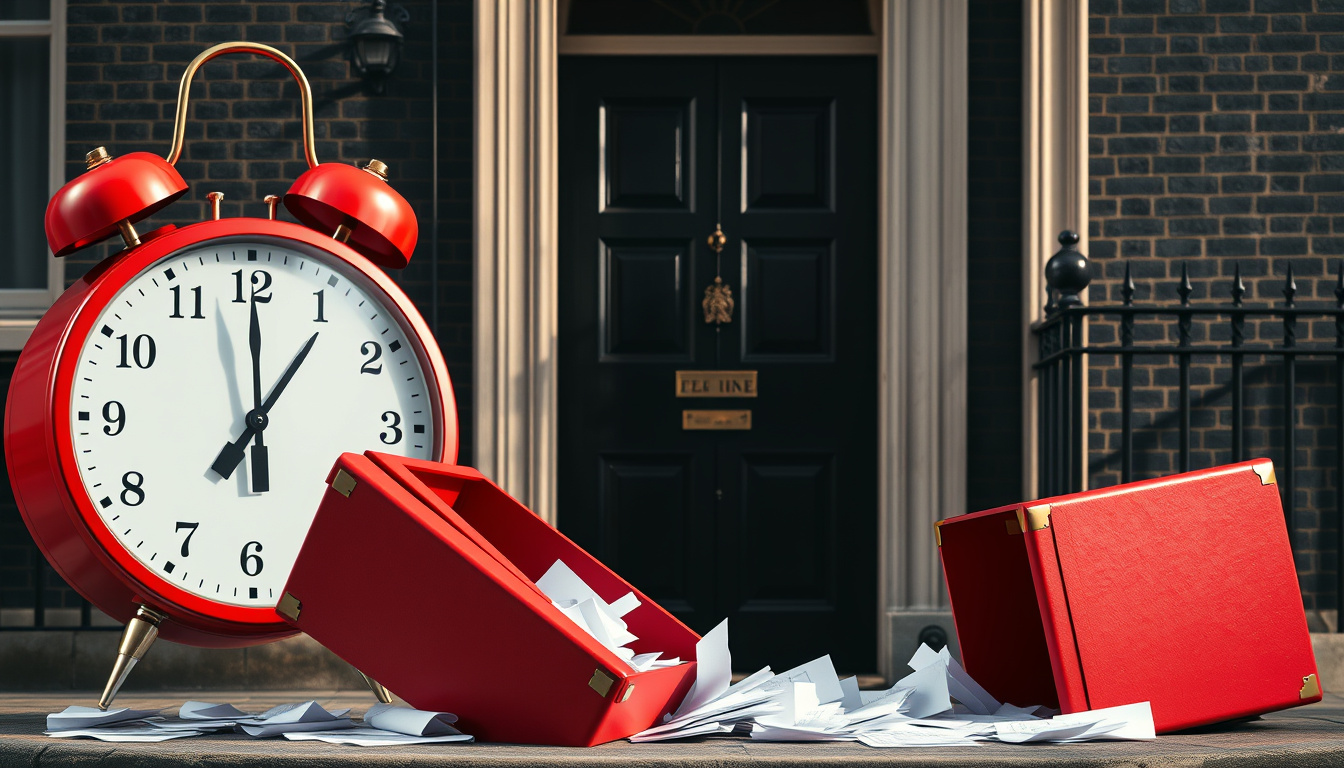
Few political stories move fast enough to be measured against a head of lettuce, but Liz Truss’s premiership did. She took office on 6 September 2022 and resigned 49 days later, after a mini-budget that rattled financial markets (CBC News (Canadian public broadcaster)).
Tenure: 49 days · Prime Minister from: 6 September 2022 · Prime Minister to: 25 October 2022 · Age at appointment: 47 · Parliamentary seat held: South West Norfolk, 2010–2024
Quick snapshot
- Truss was prime minister for 49 days, the shortest tenure of any UK prime minister (Associated Press (news agency)).
- She announced her resignation on 20 October 2022 (UK Government (official record of her statement)).
- Rishi Sunak replaced her on 25 October 2022 (Deutsche Welle (international broadcaster)).
- Truss’s own account, in Ten Years to Save the West, differs from many retrospective reports.
- The “what lasted longer” comparisons rest on a newspaper stunt, not an official historical measure. (Ten Years to Save the West)
- 23 September 2022: the mini-budget is delivered (CBC News).
- 28 September 2022: the Bank of England begins emergency gilt-buying (The New York Times).
- 3 October 2022: the 45% tax-rate abolition is reversed (CNN).
- 20 October 2022: Truss announces her resignation. (CBC News)
- Truss hosts The Liz Truss Show.
- She continues publishing and public speaking around her “saving the West” message.
- Her official website describes her as a former prime minister.
Key facts
Eight lines anchor the official record, and one pattern stands out: the dates of her premiership are the story.
| Label | Detail |
|---|---|
| Full name | Mary Elizabeth Truss |
| Born | 26 July 1975 |
| Prime minister | 6 September 2022 – 25 October 2022 |
| Duration | 49 days |
| Party | Conservative |
| Constituency | South West Norfolk, 2010–2024 |
| Predecessor | Boris Johnson |
| Successor | Rishi Sunak |
What happened to Liz Truss?
From leadership victory to resignation
- 5 September 2022: Truss wins the Conservative leadership contest.
- 6 September 2022: she becomes prime minister (ABC News (US broadcaster covering Westminster)).
- 20 October 2022: she announces her resignation.
- 25 October 2022: Rishi Sunak becomes prime minister.
Truss reached Downing Street after a summer leadership contest triggered by Boris Johnson’s exit. She took office on 6 September 2022, then spent her first weeks trying to move quickly on tax and energy policy.
The end came just over six weeks later. On 20 October 2022, Truss announced she was resigning as Conservative Party leader and said a leadership election would be completed within the following week.
How her premiership ended
A prime minister who frames her own resignation as an inability to deliver her mandate is telling her party she is finished. The parliamentary machinery moved within days.
Her statement was brief and direct: she recognised that she could not deliver the mandate on which she was elected by the Conservative Party. She stayed on as prime minister until a successor was chosen.
The implication: Truss entered Downing Street with a fresh mandate and lost it in less than two months. The speed of the collapse, not just the fact of it, is what made the episode historic.
Why did Liz Truss only last 49 days?
The mini-budget and market response
- 23 September 2022: Chancellor Kwasi Kwarteng delivers the mini-budget.
- The plan promised a low-tax, high-growth programme requiring substantial additional borrowing.
- Markets reacted negatively: the pound fell and government borrowing costs rose.
- The fiscal statement was not accompanied by a full Office for Budget Responsibility forecast (The New York Times (live coverage of the fiscal U-turn)).
The mini-budget was designed as a growth package, but the market read it as an unfunded spending programme. Within days, gilt yields rose sharply and the pound fell to a record low against the dollar — the moment that turned a political debate into a financial event. For Truss and Kwarteng, the policy was the plan; for the bond market, it was a warning signal.
Counting strictly from the day she became prime minister to the day she announced her resignation, the interval was 44 days. The familiar 49-day figure runs from her appointment as Conservative leader on 5 September to the end of her premiership on 25 October.
Loss of Conservative Party confidence
- 14 October 2022: Truss dismisses Kwarteng.
- 19 October 2022: Home Secretary Suella Braverman resigns; Conservative MPs report chaos over a fracking vote.
- 20 October 2022: Truss resigns as Conservative leader.
The parliamentary collapse moved in parallel with the market turmoil. By mid-October, Conservative MPs were publicly questioning whether Truss could survive, and the dismissal of her chancellor removed the person most associated with the mini-budget without calming the situation.
The final 48 hours brought a home secretary’s resignation and chaos over a fracking vote. Truss concluded she had lost the confidence of her own party before she had to face a general election — because she had never needed to fight one.
The bond market moved first, and the party moved second. Gilt yields rose so fast that the Bank of England had to intervene within five days of the mini-budget, and Conservative MPs drew the obvious conclusion: the programme was not sustainable.
Policy reversals
- 3 October 2022: the government reverses the planned abolition of the 45% additional rate of income tax.
- Truss later reverses the planned corporation tax cut.
- Most of the mini-budget’s signature tax-cutting measures are reversed or abandoned before she resigns.
Each reversal bought time and burned authority. The 45% rate climbdown came first, followed by the corporation tax change; with each U-turn, the government looked less like a radical reform project and more like a team reacting to events.
What this means: once the market treated the fiscal plan as unfunded, Truss’s political timetable shrank to weeks. Every reversal slowed the panic and destroyed the authority she needed to govern.
What did Liz Truss actually do?
Energy Price Guarantee
- Truss announced the Energy Price Guarantee to cap typical household energy bills.
The centrepiece of the early weeks was the Energy Price Guarantee, a scheme designed to cap typical household energy bills at a moment when energy costs were the dominant political worry.
Mini-budget tax cuts
- The mini-budget proposed cuts to National Insurance and corporation tax.
- It also proposed scrapping the 45% additional rate of income tax.
The tax package was the identity of the government: lower taxes, less regulation, faster growth. The problem was that the numbers did not add up in a way markets could see, partly because the proposals came without a full OBR forecast to certify them.
Fiscal event reversals
- The 45% rate reversal was announced on 3 October 2022.
- Truss later reversed the planned corporation tax cut.
- Most of the mini-budget’s signature measures were reversed or abandoned before she resigned.
The reversals came in a specific order: the 45% rate first, then corporation tax. By the time Truss resigned, the fiscal programme that defined her leadership had been largely dismantled.
Truss’s own account in Ten Years to Save the West
Truss spent her short premiership promising to speed up the economy. The market reaction slowed everything down: borrowing costs rose, the policy was reversed, and the fastest-moving part of the government became its own retreat.
In her 2024 book, Ten Years to Save the West, Truss presents the episode as a story of institutional resistance to her agenda rather than a verdict delivered by the markets. That framing is central to her public campaign since leaving office.
Why this matters: Truss’s policy programme was real, but its most distinctive parts did not survive the market’s verdict. Her book defends the intentions; the financial record documents the outcome.
Who replaced Liz Truss?
Rishi Sunak’s path to Number 10
- Rishi Sunak became Conservative leader and prime minister on 25 October 2022.
- Sunak had been Truss’s rival in the summer 2022 leadership election.
Sunak’s route back to Downing Street was unusually fast. The party that had chosen Truss over him in the summer turned to him again once the Truss experiment collapsed, and he entered Number 10 with a message built around stability.
Immediate continuity and aftermath
- Sunak’s government reversed more of the mini-budget measures.
- His first public remarks as prime minister emphasised stability.
The new government’s first task was to restore credibility. Sunak’s early message was about stability, not transformation — a direct contrast with the Truss approach.
Why this matters: Sunak won the crown by being the candidate who had warned against the mini-budget. His premiership began as a corrective to hers, and the contrast defined the Conservative Party’s internal argument long after she left office.
What caused the downfall of Liz Truss?
Market pressure
- The Bank of England intervened in the gilt market after dysfunction and rapidly rising yields threatened financial stability.
- Pound fell and government borrowing costs rose after the mini-budget.
The market reaction did not simply embarrass the government; it changed its options. When the Bank of England began emergency buying, the political cost of the mini-budget became impossible to contain.
Party arithmetic
- Truss dismissed Kwarteng on 14 October 2022; by 19 October, Suella Braverman had resigned as home secretary and Conservative MPs reported chaos over a fracking vote.
The political arithmetic was brutal. Truss had won the leadership with a mandate from party members, but the parliamentary party held the power to make government impossible. Once MPs concluded she was an electoral liability, the end was only a matter of time.
The immediate trigger was a vote on fracking that became a test of authority. Reports of chaos in the voting lobbies finished the job.
The pattern: market pressure, party panic and policy reversal fed each other. No single event forced the resignation; the combination made it almost inevitable.
What is Liz Truss doing now in 2026?
Media work and The Liz Truss Show
- Truss hosts The Liz Truss Show.
- Her official website describes her as a former prime minister focused on free speech, free enterprise and “saving the West”.
As of 2026, Truss is still firmly inside public life. Her official website describes her as a former prime minister focused on free speech, free enterprise and “saving the West”, and her media schedule reflects that mission.
Writing and public speaking
- She published Ten Years to Save the West in 2024.
- She left the House of Commons on 30 May 2024, when her parliamentary seat ended.
The book is both a memoir of the period and a wider political argument. It gives her a format to press her case beyond the constraints of office.
Political activity outside Parliament
A former prime minister with a show and a bestselling book has a louder platform than most sitting MPs. The question is whether Truss uses it to re-enter frontline politics or to control the historical record of 2022.
Her X profile identifies her as a former prime minister and Sunday Times bestselling writer. Nothing about it suggests a quiet retirement.
What this means: Truss has converted a historic collapse into an active platform. The 2022 crisis is now a resource for her argument, not just a wound.
What lasted longer than Liz Truss?
Lettuce versus prime minister: the Daily Star stunt
- The Daily Star ran a livestream of a lettuce with the question of whether it would outlast Truss.
- In the stunt’s framing, the lettuce outlasted the premiership.
- The comparison is a media joke, not an official historical measure.
The lettuce stunt worked because it captured something true about the speed of the collapse: a supermarket vegetable has a shelf life measured in days, and so did the government. The joke also flattened a serious political event into a meme.
Shortest-serving UK prime ministers before and after
- Truss’s 49 days is the shortest tenure of any UK prime minister.
- By days in office, Truss now sits at the bottom of the list of all British prime ministers.
The 49-day figure is the one that will follow her through history. Whatever happens in her media career, the record of the shortest premiership is secure.
The trade-off: the lettuce made the collapse famous and trivial at the same time. For any serious account of the episode, the task is to keep both truths visible: it was a punchline, and it was a 49-day prime ministerial record.
The fiscal plan versus what happened
Four fiscal moves, one pattern: each was announced, then reversed or abandoned within weeks.
| Fiscal measure | Mini-budget plan | What followed |
|---|---|---|
| Corporation tax | Cut to corporation tax | Reversed by the government before Truss resigned |
| 45% additional-rate income tax | Abolition of the 45% rate | Reversal announced on 3 October 2022 |
| National Insurance | Planned cut in National Insurance | Part of a mini-budget whose signature measures were later reversed or abandoned |
| Office for Budget Responsibility | No full OBR forecast accompanied the statement | The absence became a focus of criticism as markets reacted |
The pattern: the same three-week sequence repeated across the fiscal agenda — announce, react, reverse. By the time Truss resigned, the government’s economic identity had been dismantled from within.
Timeline of the 49-day premiership
- — Truss is appointed prime minister after winning the Conservative leadership contest.
- — Chancellor Kwasi Kwarteng delivers the mini-budget with planned tax cuts.
- — Market turmoil: the pound falls, gilt yields rise, and the Bank of England intervenes.
- — Truss dismisses Kwarteng and reverses parts of the mini-budget.
- — Home Secretary Suella Braverman resigns; Conservative MPs report chaos over a fracking vote.
- — Truss announces her resignation as Conservative Party leader.
- — Rishi Sunak becomes prime minister.
- — Truss leaves the House of Commons as her parliamentary seat ends.
- — Truss publishes Ten Years to Save the West.
- — Truss continues media work, including hosting The Liz Truss Show.
Why the dates matter: the premiership lasted from a September appointment to an October handover — two autumn months that reshaped British politics and left a permanent footnote in the record.
Confirmed facts and what’s unclear
Confirmed facts
- Truss was prime minister for 49 days, the shortest UK premiership on record.
- The mini-budget of 23 September 2022 produced a severe financial market reaction.
- Rishi Sunak replaced Truss on 25 October 2022.
- Truss left Parliament on 30 May 2024.
- Truss published Ten Years to Save the West in 2024.
What’s unclear
- Why exactly the party moved when it did: market forces and internal politics were intertwined, and their relative weight is still debated.
- Truss’s own account differs from many retrospective reports; she emphasises institutional resistance rather than fiscal error.
- The count itself depends on the dates you choose: 44 days from becoming prime minister to announcing resignation, or 49 days from becoming Conservative leader to leaving office.
- What the “what lasted longer” comparisons really prove: the lettuce is a stunt, not an official historical measure.
- Whether the Bank of England’s emergency intervention averted a larger crisis is not precisely quantifiable from public records.
- Whether Kwarteng’s dismissal was a decision Truss made freely or one forced by events is reported differently across accounts.
The honest summary: the facts of the collapse are not in dispute. The interpretation — who was to blame, and what would have happened if the markets had not reacted — remains open.
In their own words
I recognise though, given the situation, I cannot deliver the mandate on which I was elected by the Conservative Party.
Liz Truss, resignation statement outside Downing Street, 20 October 2022
I will place economic stability and confidence at the heart of this government’s agenda.
Rishi Sunak, first address as prime minister, 25 October 2022
Why these two voices matter: Truss’s resignation statement set the official frame for the collapse, and Sunak’s first address set the corrective one. The two speeches, five days apart, mark the exact distance between the two premierships.
What to make of the 49 days
The Truss premiership is the clearest modern case of a government losing market confidence faster than it could adjust its own programme. The mini-budget was the trigger; the bond market response was the mechanism; the parliamentary party supplied the final push. Truss’s own version of events blames hostile institutions rather than fiscal arithmetic, but the timeline is unforgiving: the market moved in days, the policy reversed in weeks, and the resignation came before the autumn was over. For the Conservative Party, the choice is clear: close the 2022 chapter with a credible fiscal doctrine, or keep being defined by the shortest premiership in British history.
Related reading: What Happened to Matt Hancock? · Laura Kuenssberg
Frequently asked questions
Who is Liz Truss?
Mary Elizabeth Truss is a British Conservative politician who served as prime minister from 6 September to 25 October 2022 — the shortest premiership in UK history. She represented South West Norfolk in the House of Commons from 2010 to 2024.
How old was Liz Truss when she became prime minister?
She was 47. Born on 26 July 1975, Truss took office on 6 September 2022.
What was the Liz Truss lettuce stunt?
The Daily Star, a British tabloid, set up a live stream of a lettuce and asked whether it would outlast the prime minister. In the stunt’s framing, the lettuce outlasted Truss’s premiership.
Is Liz Truss still a Member of Parliament?
No. Truss left the House of Commons on 30 May 2024, when her parliamentary seat ended.
What was Liz Truss’s previous government experience?
Before becoming prime minister, Truss served in senior cabinet roles in Boris Johnson’s government, including as foreign secretary, and she was the Conservative candidate who won the summer 2022 leadership election.
What is Liz Truss’s net worth?
No official figure is established in the sources used here. Since leaving office she has earned from media and publishing work, including The Liz Truss Show and Ten Years to Save the West.
Is Liz Truss married and does she have children?
Truss is married; she has generally kept her family out of the public spotlight, and the official record used here focuses on her political career.

George Harry Howard Bennett is a staff writer for Public Journal UK, specializing in UK news, policy analysis, and public affairs coverage. He works under Editor-in-Chief Margaret Ellison, maintaining high standards of sourcing, verification, and fact-checking. Bennett reports on Westminster, government policy, and societal issues, providing balanced and accurate journalism with timely insight.