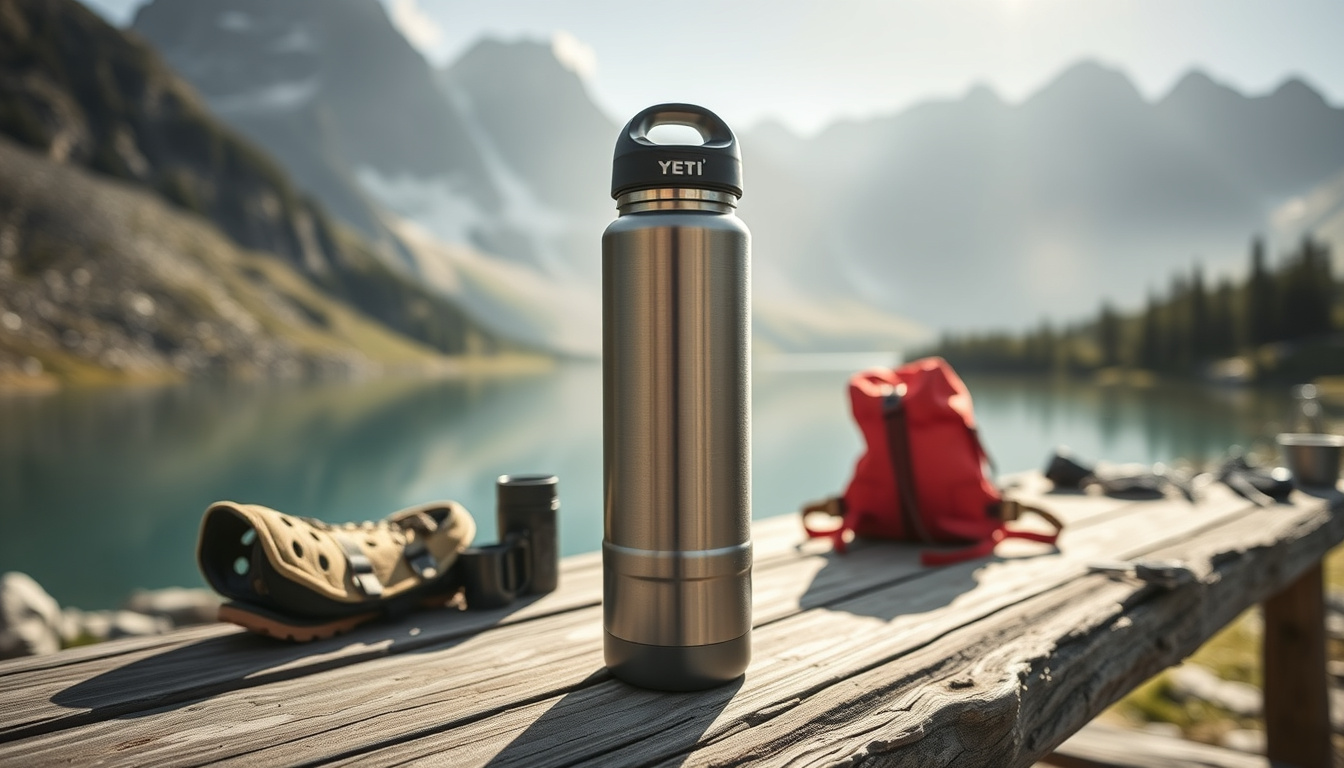
There’s a moment in nearly every water-bottle shopper’s life when they pick up a YETI, wince at the price, and then spend the next three years defending it to friends. The 26-ounce Rambler costs around $40 at most retailers, carries a 5-year warranty, routinely outlives cheaper alternatives by years, and the evidence on whether the premium is justified is more interesting than either side of that argument.
Material: 18/8 stainless steel ·
Insulation: Double-wall vacuum ·
BPA-free: Yes ·
Dishwasher safe: Yes ·
Warranty: 5 years ·
Price range: £27–£40
Quick snapshot
- Leakproof when the lid is tightened correctly — silicone gaskets stop the drips (Food & Wine (food publication)).
- One independent test kept ice water cold for more than 30 hours (TheTestedHub (hands-on testing blog)).
- Double-wall vacuum insulation and a wide-mouth design are the core specs cited across the comparison sources (Prudent Reviews (drinkware testing site)).
- Whether the Chug Cap stays fully drip-free when tipped over in a bag — the verified claim is “leakproof when tightened” (Food & Wine).
- Real-world temperature retention varies by test and model; the same bottle can post 20 or 30+ hours depending on methodology.
- Long-term durability of the magnetic MagSlider lid has no independent long-run data in the sources reviewed.
- 5-year warranty on manufacturing defects; bottles commonly last 5–10+ years with proper care. (Disney Food Blog (theme-park consumer site))
- Cold retention measured past 30 hours in one independent test (TheTestedHub). (Disney Food Blog (theme-park consumer site))
- The 26-ounce Rambler’s removable handle and cap assembly make refilling and cleaning simpler over time (Disney Food Blog (theme-park consumer site)).
- YETI’s rugged build, Owala’s FreeSip lid innovation, and Stanley’s handled-tumbler convenience map to different daily routines (Lemon8 community review platform).
- Stanley Quencher sizes run 24, 32, and 40 ounces with a built-in straw and carrying loop (TODAY NBC consumer team).
- Check the exact model’s positioning before buying: pick the bottle for the routine you actually have, not the one you want.
Seven lines, one pattern: the Rambler is built like a tool rather than a trinket — 18/8 steel, sealed vacuum insulation, and a closing system designed to seal with a firm twist.
| Specification | Value |
|---|---|
| Material | 18/8 stainless steel |
| Insulation | Double-wall vacuum |
| BPA-free | Yes |
| Dishwasher safe | Yes |
| Leakproof | Yes (with Chug Cap) |
| Warranty | 5 years |
| Made in | USA and China |
Is YETI plastic water bottle safe?
No — the bottle itself is stainless steel, not plastic. The plastic you’ll meet is in the lid system, and the seals that stop leaks are silicone gaskets, the same material used across premium food-storage lids.
- The Rambler body is 18/8 stainless steel with double-wall vacuum insulation — the spec that separates it from single-wall bottles.
- Lids and caps are BPA-free, and the brand lists the bottle as dishwasher safe for regular cleaning.
- YETI’s wide-mouth design is rated for hot liquids up to 185°F, according to Prudent Reviews’ comparison (Prudent Reviews (drinkware testing site)) — check the cap before filling with boiling water.
So the “plastic” worry is really a lid worry: metal body, BPA-free caps, silicone gaskets. The reviewed sources found no safety issue with the Rambler’s food-contact materials.
BPA-free and food-contact-safety statements come from YETI’s published specifications; independent lab verification was not located in the sources reviewed for this guide.
The implication: if a plastic-safety headline made you hesitate, you were hesitating on a stainless bottle for a plastic problem it doesn’t have.
Is Yeti really worth the money?
The short answer: for people who keep a bottle for years, yes. The long answer starts with a price check. Prudent Reviews’ comparison lists a 26-ounce YETI at $40, a 24-ounce Owala at $28, and a 30-ounce Stanley at $35 (Prudent Reviews). What the extra $5–$12 buys is measurable, and it shows up in the tests below.
Yeti vs cheaper alternatives
The £27–£40 price buys construction and a 5-year warranty, not magic. Pay it once, carry the bottle for 5–10 years, and the annual cost drops below most single-use coffee runs.
The value lives in the double-wall vacuum body and the leakproof gasket system — the two specs that make a bottle feel engineered rather than extruded. Cheaper rivals share the same basic material; they rarely share the same seal quality.
Durability and warranty
- 5-year warranty covers manufacturing defects; drops and cosmetic wear are not covered.
- With proper care, YETI bottles commonly last 5–10+ years; the double-wall construction prevents condensation and keeps insulation intact.
- The 26-ounce Rambler’s removable handle and cap assembly make routine cleaning easier over time (Disney Food Blog).
That combination — a 5-year warranty and construction designed to survive years of dishwasher cycles — is the durability argument in two lines.
The pattern: YETI’s price stops looking high the moment you divide it by a decade of use. The catch is that the first five years sit inside the warranty window; after that, the value depends on how well you treat the bottle.
Resale value
- YETI’s brand recognition keeps secondary-market prices above generic bottles, a pattern the review-based comparison sources note (Lemon8 community review platform).
- Limited-edition colours cost more at purchase, which reinforces value retention for collectors.
For daily carriers, resale is a bonus, not a reason: the math works because the bottle lasts, not because you’ll sell it.
What’s better, YETI or Owala?
This is the comparison that gets people arguing at work. Both bottles are stainless, both keep drinks cold through a workday, and both have passionate fans. The difference is in the details.
Insulation performance
Bevi’s drinkware comparison notes that Owala’s 24-hour cold claim is “not independently standardized across brands” (Bevi (drinkware industry blog)) — so the spec sheet matters less than the test.
YETI uses double-wall vacuum insulation with a wide-mouth body; Owala’s FreeSip uses triple-layer insulation and advertises up to 24 hours of cold retention (Bevi). In the one head-to-head run available, YETI kept ice water past 30 hours and Owala reached about 20 — the full numbers sit in the comparison table below.
Lid designs
- Owala’s FreeSip lid lets you sip through an integrated spout or drink through the larger opening without changing lids (Lemon8 community review platform).
- YETI’s Chug Cap is leakproof when tightened, with a magnetic top and a silicone gasket (Food & Wine).
- YETI’s interchangeable cap system lets you move between chug, straw, and hot-drink modes without changing the bottle.
Price
YETI 26 oz: $40 · Owala 24 oz: $28 · Gap: $12
The $12 gap buys the longer cold-retention numbers and the 5-year warranty. Whether that’s worth it depends on whether you’re buying for the bottle’s first week or its fifth year.
Durability
- Both bottles use stainless steel with vacuum insulation.
- Review-based comparison: YETI is the stronger choice for ruggedness; Owala wins on drinking innovation and value (Lemon8 community review platform).
- YETI’s gasket-based seal gives it an edge for bags and backpacks, where a drip becomes a wet-rucksack problem.
What this means: this is a trade-off, not a victor. Owala gives you more drinking styles and a lower price; YETI gives you harder cold-retention numbers and a tougher build.
Which is better, a YETI or a Stanley?
If Owala is a spec-sheet rival, Stanley is a cultural one. The Quencher built a following as a lifestyle accessory; YETI built its reputation as rugged equipment. The right choice depends on which kind of daily life the bottle is walking into.
Design and build quality
- Stanley’s Quencher is a handled tumbler designed around straw drinking and everyday carrying; YETI’s Rambler is a wide-mouth bottle with an interchangeable cap ecosystem (Lemon8 community review platform).
- TODAY’s review lists the Quencher with a spout cover, built-in straw, and carrying loop (TODAY NBC consumer team).
- Stanley uses 18/8 steel with a classic hammer-tone finish; YETI opts for a sleeker matte finish.
Temperature retention
YETI (one test): 30+ hrs cold · Stanley (one test): ~24 hrs cold · YETI edge: ~6 hrs
The numbers come from a single outlet-specific run rather than a lab standard: YETI held ice water past 30 hours, Stanley around 24 (TheTestedHub). Treat them as directional, not gospel.
Don’t over-index on one outlet’s numbers: model selection and methodology shift insulated-bottle results by hours. The 30-hour figure is a data point, not a promise.
Price and value
- Indicative prices: $40 for the 26-ounce YETI against $35 for the 30-ounce Stanley — the price ladder appears in the comparison table below.
- Stanley’s Quencher range typically undercuts YETI by £5–10 in the UK.
- Stanley backs its bottles with a lifetime warranty; YETI’s warranty runs 5 years.
Lid compatibility
- Lids are not interchangeable between the two brands.
- YETI’s Chug Cap is designed to be the more leakproof of the two systems, thanks to its gasket seal.
- Stanley’s fixed straw lid suits a car cup-holder; YETI’s cap system covers straw, chug, and hot-drink modes.
How long do Yeti water bottles last?
Nobody buys a £30 bottle expecting to replace it next spring. The good news is that the Rambler’s design is built around a long service life — with two caveats.
Factors affecting lifespan
- Build: 18/8 stainless steel and double-wall vacuum insulation resist dents and condensation.
- Cleaning: the dishwasher-safe body and removable cap assembly make maintenance simple — Disney Food Blog notes the wide-mouth opening facilitates refilling and cleaning (Disney Food Blog).
- Use pattern: drops on concrete and repeated thermal shock shorten the life of any bottle — the Rambler is tougher than most, not indestructible.
Warranty coverage
- 5-year warranty covers manufacturing defects.
- Drops, scratches, and cosmetic wear are excluded.
- The double-wall construction prevents condensation and keeps insulation performance intact over time.
Real-world user reports
Reported lifespan: 5–10+ years · Warranty: 5 years · Tested cold hold: 30+ hrs
The durability picture is consistent across categories: a stainless body that survives the dishwasher, a cap system that can be cleaned, and insulation that doesn’t degrade with age — that’s the combination that gets bottles to year five and beyond. What this means: the bottle doesn’t have a built-in expiry date — the warranty does. After five years you’re relying on materials, which is exactly the bet the premium price is making.
Three bottles, one pattern: the price ladder — $28, $35, $40 — lands almost exactly where the outlet-specific cold-retention testing lands, from shortest hold to longest (Prudent Reviews for prices; TheTestedHub for temperatures).
| Feature | YETI Rambler (26 oz) | Owala FreeSip (24 oz) | Stanley Quencher (30 oz) |
|---|---|---|---|
| Indicative price | $40 | $28 | $35 |
| Insulation | Double-wall vacuum | Triple-layer, 24-hour cold claim (Bevi) | 18/8 steel, straw-tumbler design |
| Cold retention (one test) | 30+ hours | ~20 hours | ~24 hours |
| Hot-liquid rating | Up to 185°F (85°C) | Cold-drink positioning (TODAY) | — |
| Lid system | Chug Cap, leakproof when tightened | FreeSip integrated spout | Built-in straw, spout cover, loop |
| Warranty | 5 years | Not stated in reviewed sources | Lifetime (brand claim) |
Nine options, one system: every Rambler size shares the same cap ecosystem, so picking a size and picking a lid are two independent decisions.
| Option | Spec |
|---|---|
| Rambler 18 oz | 532 ml |
| Rambler 26 oz | 769 ml |
| Rambler 36 oz | 1.06 L |
| Rambler 46 oz | 1.36 L |
| Rambler 64 oz | 1.89 L |
| Chug Cap | Leakproof, magnetic top |
| Straw Cap | Built-in straw |
| Hotshot Cap | For hot beverages |
| MagSlider lid | Magnetic closure |
Upsides
- 18/8 stainless steel with double-wall vacuum insulation
- Leakproof gasket system when the cap is tightened
- Dishwasher-safe body and BPA-free lids (no plastic in the bottle itself)
- 5-year warranty; bottles commonly last 5–10+ years
- Rated for hot liquids up to 185°F
Downsides
- $40 for a 26-ounce bottle vs $28–$35 for Owala and Stanley
- Leakproof only when the lid is tightened correctly
- Stanley’s lifetime warranty outlasts YETI’s 5-year cover
- MagSlider lid durability lacks independent long-term data
- Sales are rare; discounts usually appear on older colours and limited editions
What’s confirmed
- YETI Rambler bottles are stainless steel, not plastic.
- Leakproof when the lid is tightened correctly; silicone gaskets stop drips (Food & Wine).
- 5-year warranty covers manufacturing defects.
- Double-wall vacuum insulation contributes to extended cold retention.
What’s still unverified
- Whether the Chug Cap stays fully drip-free when tipped over in a bag.
- Exact real-world temperature retention, which varies by test and model (outlet-specific results span roughly 20–30+ hours; one test from TheTestedHub measured 30+ hours).
- Long-term durability of the magnetic MagSlider lid.
- Independent verification of the 30+ hour cold retention claim beyond a single test.
The testers’ verdict: three sources, three angles on the same market
“The YETI bottle is leakproof when its lid is tightened correctly, with silicone gaskets helping prevent drips.”
“The Owala FreeSip is primarily positioned as a cold-drink bottle; claims about hot-liquid suitability should be checked against the exact model and manufacturer instructions.”
“Owala uses triple-layer insulation and advertises cold retention for up to 24 hours, though this claim is not independently standardized across brands.”
The case for YETI is straightforward: a stainless bottle with a 5-year warranty, a leakproof gasket system, and a tested cold-retention record past 30 hours is a buy-once product for anyone who carries a bottle daily. The case for Owala and Stanley is just as honest: cheaper upfront, a more flexible lid in Owala’s case, a lifetime warranty in Stanley’s. Across the sources reviewed here, the premium is real but conditional — it pays off only when the bottle stays with you. For UK buyers standing in the aisle, the choice is clear: spend £27–£40 on a Rambler if you’re a keeper, or save £5–£10 with Owala or Stanley if you’ll lose it before you’d break it.
Frequently asked questions
Why is YETI being boycotted?
Most boycott discussion around YETI focuses on the company’s corporate behaviour rather than on product safety or quality. None of the reviewed sources tie the boycott to the Rambler line’s materials, and there’s no safety recall attached to the bottle in that coverage.
How long can water sit in a YETI before it goes bad?
The Rambler keeps water cold, but it doesn’t sterilise it. Treat it like any open bottle: room-temperature water should be finished within a day, and a rinse before refilling is a sensible habit. The wide-mouth opening makes cleaning easier than on narrow rivals, which helps between uses.
Can YETI bottles go in the fridge?
Yes. The stainless body and sealed vacuum layer are fridge-safe, and the bottle is rated dishwasher safe, so cold temperatures won’t bother it. The practical constraint is size: the 64-ounce Rambler needs a tall shelf, so it may not fit where you expect.
What is Yeti’s biggest competitor?
Stanley is the closest rival on lifestyle pull, with Owala close behind on lid innovation and value. The comparison research behind this article places YETI alongside Stanley, Owala, Hydro Flask, Camelbak, Takeya, and Swell in the same premium-insulated tier.
Do Yeti coolers ever go on sale?
Occasionally, and usually on older colours. YETI keeps the core Rambler line at RRP, but discontinued colours and limited editions do appear at a discount through UK retailers. If you’re not colour-loyal, holding out for a discontinued finish is the most common way buyers beat the £27–£40 range.
What are the best water bottles in 2026?
Based on the sources reviewed here: YETI Rambler for ruggedness and cold retention, Owala FreeSip for drinking innovation and value, and Stanley Quencher for handled-straw convenience, with Hydro Flask, Camelbak, Takeya, and Swell also named in the same comparison tier.
Why is YETI more expensive?
Because the extra money goes into construction and warranty, not branding alone. The price table above shows the $40-vs-$28-vs-$35 spread, and the same data shows where that money goes: double-wall vacuum insulation, a leakproof gasket system, and a tested cold-retention edge past 30 hours. The question is whether your daily routine will actually use that headroom.
Related reading:

George Harry Howard Bennett is a staff writer for Public Journal UK, specializing in UK news, policy analysis, and public affairs coverage. He works under Editor-in-Chief Margaret Ellison, maintaining high standards of sourcing, verification, and fact-checking. Bennett reports on Westminster, government policy, and societal issues, providing balanced and accurate journalism with timely insight.