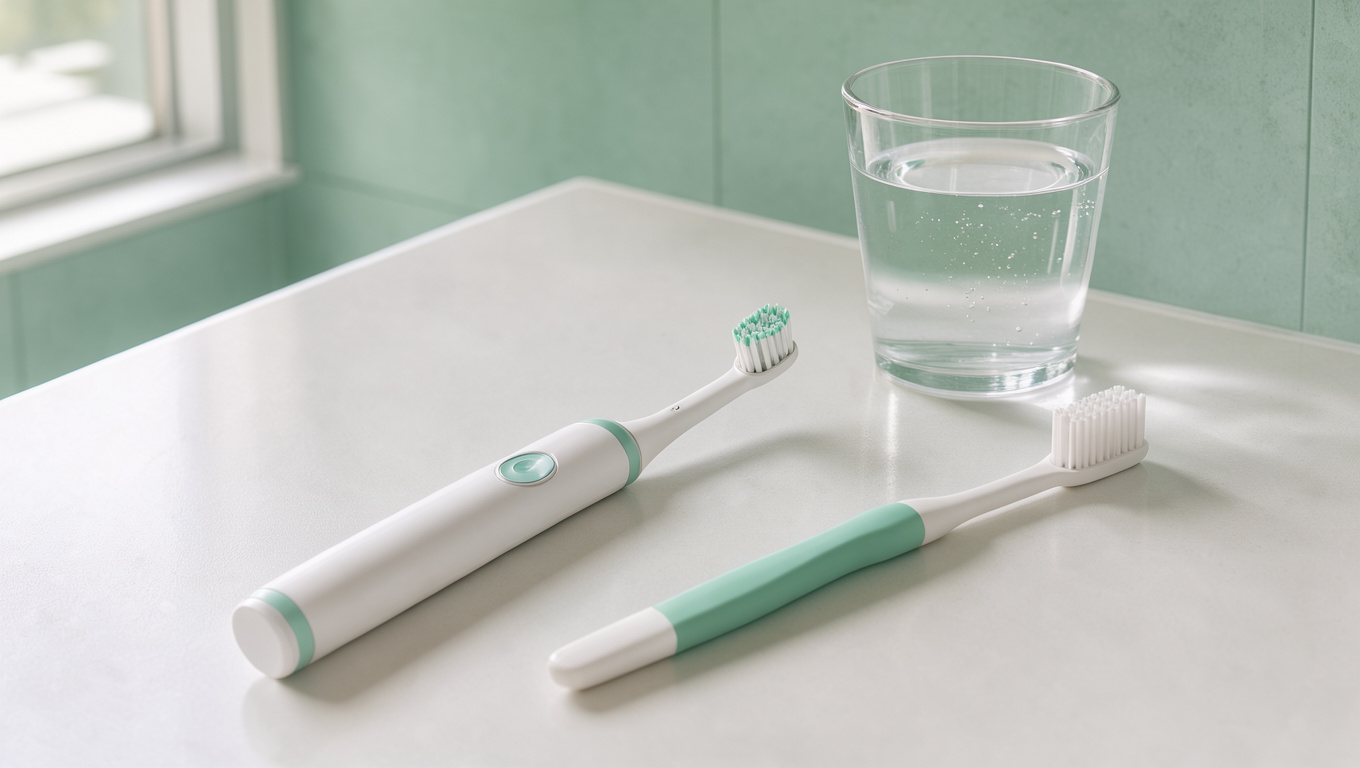
Most of us have wondered whether the buzzing brush on the bathroom shelf is worth the money or just a nicer-looking version of the one we already own. The independent answer starts with a Cochrane Library (independent reviews) review covering 5,068 participants, which found powered brushes left about 11% less plaque than manual brushing at one to three months.
Plaque reduction, powered vs manual: about 11% less plaque at 1 to 3 months (Cochrane Library, independent reviews) · Gingivitis reduction, powered vs manual: about 6% less gingivitis at 1 to 3 months (Cochrane Library, independent reviews) · Oscillating-rotating plaque SUCRA: 89.2% (PubMed Central (2026 meta-analysis)) · Brush head replacement: every three to four months (Oral-B UK (manufacturer guidance)) · Oral-B plaque claim: up to 100% more plaque removed than a manual brush, a manufacturer claim not independently verified, per Oral-B US (manufacturer product page)
Quick snapshot
- Powered brushes reduced plaque more than manual brushes in trials of one to three months (Cochrane Library, independent reviews)
- Oscillating-rotating brushes ranked first for plaque in a 2026 meta-analysis of 19 randomized trials, at SUCRA 89.2% (PubMed Central, 2026 meta-analysis)
- Whether one powered type outperforms another over the long term (Cochrane Library (independent reviews))
- Oral-B’s up to 100% more plaque claim, which has not been independently verified (Oral-B US, manufacturer product page) (Cochrane Library (independent reviews))
- The key Cochrane review is dated (Cochrane Library, independent reviews)
- The newer network meta-analysis is dated (PubMed Central, 2026 meta-analysis)
- Replacement heads are needed every three to four months, which adds an ongoing cost (Oral-B UK, manufacturer guidance)
- US price bands are subject to retailer variation, so check the current figure before buying (Oral-B US, manufacturer product page)
Ten figures, one pattern: the plaque gap is larger than the gum gap, and the price figures depend on model and replacement heads.
| Fact | Value |
|---|---|
| Plaque reduction, powered vs manual | About 11% less at 1 to 3 months (Cochrane Library, independent reviews) |
| Plaque reduction at 3 months | 21% (Cochrane Library, independent reviews) |
| Gingivitis reduction, powered vs manual | About 6% less at 1 to 3 months (Cochrane Library, independent reviews) |
| Gingivitis reduction at 3 months | 11% (Cochrane Library, independent reviews) |
| Cochrane review size | 56 studies, 5,068 participants (Cochrane Library, independent reviews) |
| Oscillating-rotating plaque SUCRA | 89.2% (PubMed Central, 2026 meta-analysis) |
| Oral-B iO Series 2 list price | $64.99 (Southport Dent (dental practice review)) |
| Six-count replacement head pack | $49.99 (Southport Dent, dental practice review) |
| Oral-B iO US price range | $65 to $400 (Oral-B US, manufacturer product page) |
| Brush head replacement interval | Every three to four months (Oral-B UK, manufacturer guidance) |
What is an electric toothbrush and how does it work?
What powers the brush head?
- Oral-B iO uses oscillating-rotating technology with a round head, while Philips Sonicare uses sonic technology with an oval head that vibrates side to side (Southport Dent, dental practice review).
- The iO2 reportedly runs on a battery for about four weeks per charge (Southport Dent, dental practice review).
- The head is the part that contacts teeth, and Oral-B says it needs replacing every three to four months (Oral-B UK, manufacturer guidance).
The motor does the moving, so the job shifts from scrubbing to guiding the head slowly along each tooth.
The pressure sensor is the feature that tells you when to stop pushing. On the iO2, the sensor reportedly slows the motor and glows red when too much force is applied (Southport Dent, dental practice review).
The implication: a powered brush takes over the stroke, so your effort moves from force to placement and angle.
Does an electric toothbrush clean better than a manual one?
How long should you brush with an electric toothbrush?
- The iO2 includes a two-minute timer with 30-second pulses to prompt you through the session (Southport Dent, dental practice review).
- The same Cochrane review found about 21% less plaque after three months and 11% less gingivitis after three months (Cochrane Library, independent reviews).
The Cochrane review, dated , pooled 56 studies with 5,068 participants published between 1964 and 2011, and found powered brushes reduced plaque by about 11% at one to three months and by 21% after three months (Cochrane Library, independent reviews).
Gingivitis moved less, at about 6% over one to three months and 11% after three months. Reviewers also found that cost, reliability and side effects were inconsistently reported (Cochrane Library, independent reviews).
Powered toothbrushes reduce plaque and gingivitis more than manual toothbrushing in the short and long term. The clinical importance of these findings remains unclear.
Cochrane Oral Health Group, review summary (Cochrane Library, independent reviews)
Smaller trials sometimes find nothing: a 2014 trial of 12 patients in the Avicenna Journal of Dental Research (2014 trial) found no significant plaque difference between an Oral-B Professional Care 8500 and a manual Oral-B Pulsar brush (P = 0.374).
The gap is real but narrow, and the Cochrane authors themselves call its clinical importance unclear. A single small trial can show no difference, so the systematic review carries more weight than any one brush comparison.
Manufacturer-sponsored trials report much larger gaps. An Oral-B-sponsored 8-week trial, announced in a press release dated , put healthy gum status at 81.8% for iO users against 23.6% for manual users (Yahoo Finance (Oral-B press release)).
What types of electric toothbrush are there?
Are oscillating-rotating brushes better than sonic brushes?
- Oscillating-rotating brushes ranked first for plaque at SUCRA 89.2%, ahead of sonic brushes at 72.4% (PubMed Central (2026 meta-analysis)).
- For gingivitis, oscillating-rotating scored 86.5% and sonic 70.1% (PubMed Central, 2026 meta-analysis).
- Manual brushes ranked last for plaque at 18.3% (PubMed Central, 2026 meta-analysis).
The principal finding is unequivocal: all electric toothbrushes demonstrate statistically significant superiority over manual toothbrushes in reducing both dental plaque and gingivitis, with oscillating-rotating technology consistently ranking as the most efficacious option.
Authors of the 2026 network meta-analysis (PubMed Central, 2026 meta-analysis)
The 2026 analysis of 19 randomized controlled trials places oscillating-rotating, sonic, ultrasonic, other electric and manual brushes on one scale, with ultrasonic at 54.1% for plaque (PubMed Central, 2026 meta-analysis).
Four powered groups and one manual group, one pattern: the ranking follows drive style, with oscillating-rotating first and manual last on plaque.
| Brush type | Plaque ranking (SUCRA) | Price reference |
|---|---|---|
| Oscillating-rotating (Oral-B iO) | 89.2% (PubMed Central, 2026 meta-analysis) | iO2 lists at $64.99 (Southport Dent, dental practice review) |
| Sonic (Philips Sonicare) | 72.4% (PubMed Central, 2026 meta-analysis) | Sonicare 4100 about $227 over five years (Southport Dent, dental practice review) |
| Manual | 18.3% (PubMed Central, 2026 meta-analysis) | About $48 to $65 over five years (Southport Dent, dental practice review) |
An older Cochrane review of 17 trials, covering 1,369 participants, found rotation-oscillation brushes slightly better than side-to-side brushes in the short term (Cochrane Library (independent reviews)).
Rotation oscillation brushes reduce plaque and gingivitis more than side to side brushes in the short term. This difference is small and its clinical importance is unclear.
Cochrane Oral Health Group, review summary (Cochrane Library, independent reviews)
In a 5-week randomized trial, an Oral-B oscillating-rotating brush reduced bleeding sites 52.2% against 23.6% for a manual brush at week 5, with P < 0.001 (Wiley (peer-reviewed trials)).
How do the Oral-B Pro and iO3 models differ?
Which Oral-B model suits a daily routine?
- The Pro and iO3 are different product lines with different drive systems, according to the manufacturer (Oral-B US, manufacturer product page).
- The Pro line uses oscillating-rotating heads, while the iO line uses a magnetic drive, per the manufacturer (Oral-B US, manufacturer product page).
- The iO3 sits around $90 in the US range (Oral-B US, manufacturer product page).
- Model names and features change, so check specifications on the manufacturer or retailer page when you buy.
- Compare brush modes, sensors and replacement-head types rather than the model name alone.
Run through this check before you choose a model:
- Confirm the drive type first: oscillating-rotating (iO) or the Pro line, per the manufacturer page.
- Price the replacement heads: a six-count pack lists at $49.99, about $8.33 per head (Southport Dent, dental practice review).
- Work out the five-year total: a head every three months puts an iO Series 2 at about $215 to $335 (Southport Dent, dental practice review).
- Use the two-minute timer with 30-second pulses to pace each session.
- Let the pressure sensor set your force, since the iO2 slows the motor and glows red when you press too hard.
- Replace the head every three to four months (Oral-B UK, manufacturer guidance).
One detailed feature list, one pattern: each control changes how the brush is used, not just what it costs.
| Spec | Oral-B iO Series 2 | Source |
|---|---|---|
| Drive type | Oscillating-rotating, round head | Southport Dent (dental practice review) |
| Cleaning modes | Three | Southport Dent (dental practice review) |
| Timer | Two minutes, with 30-second pulses | Southport Dent (dental practice review) |
| Pressure sensor | Slows the motor and glows red at too much force | Southport Dent (dental practice review) |
| Battery | About four weeks per charge | Southport Dent (dental practice review) |
| Box contents | Two brush heads, a charger and a two-year warranty | Southport Dent (dental practice review) |
| List price | $64.99 | Southport Dent (dental practice review) |
| Two-count replacement pack | $29.99, about $15 per head | Southport Dent (dental practice review) |
| Six-count replacement pack | $49.99, about $8.33 per head | Southport Dent (dental practice review) |
| Five-year cost with a head every three months | About $215 to $335 | Southport Dent (dental practice review) |
The Pro and iO3 differ in drive system, so the drive type on the manufacturer page is the first check (Oral-B US, manufacturer product page).
How much does an Oral-B electric toothbrush cost?
Where can you buy an Oral-B electric toothbrush?
- Prices vary by model, bundle and retailer, and Oral-B says its US figures are subject to retailer variation (Oral-B US, manufacturer product page).
- Oral-B UK puts its electric toothbrushes at roughly £50 to £300 depending on model, while manual brushes are usually under £8 (Oral-B UK, manufacturer guidance).
- According to Platon Dental, entry-level Oral-B oscillation-rotation models cost €30–60 in Spain (Platon Dental (Spanish clinic)).
In the US, the iO range runs from about $65 to $400, with the iO2 near $65 and the top iO9 and iO10 models between $330 and $400 (Oral-B US, manufacturer product page). Treat these as starting points, since retailers vary them.
Over five years, according to Southport Dent, a manual brush costs about $48 to $65, a Sonicare 4100 about $227 and an iO Series 2 about $215 to $335, assuming a replacement head every three months at list price (Southport Dent, dental practice review).
Oral-B’s up to 100% more plaque removal figure is a manufacturer claim, and independent verification of it is listed as unclear in this review (Oral-B US (manufacturer product page)).
The trade-off: once replacement heads are counted, the purchase price is the smaller number, so compare five-year totals rather than list prices.
Upsides
- About 11% less plaque than manual brushing at one to three months (Cochrane Library, independent reviews)
- Timers and pressure sensors give direct feedback on brushing time and force (Southport Dent, dental practice review)
- Oscillating-rotating brushes ranked first for plaque at SUCRA 89.2% (PubMed Central, 2026 meta-analysis)
Downsides
- Replacement heads cost about $8.33 to $15 each (Southport Dent, dental practice review)
- The clinical importance of the plaque and gingivitis gains is unclear (Cochrane Library, independent reviews)
- US list prices run from about $65 for an iO2 to about $400 at the top of the range (Oral-B US, manufacturer product page)
Confirmed facts
- Powered brushes reduced plaque more than manual brushes in trials of one to three months (Cochrane Library, independent reviews)
- Brush heads should be replaced every three to four months (Oral-B UK, manufacturer guidance)
- Oscillating-rotating brushes ranked first for plaque in the 2026 meta-analysis (PubMed Central, 2026 meta-analysis)
What’s unclear
- Whether one powered type outperforms another over the long term (Cochrane Library, independent reviews)
- Who funded the 2026 analysis, which cannot be verified from the evidence supplied (PubMed Central, 2026 meta-analysis)
- Current retail prices for any Oral-B model, since no independent retailer price survey is available (Oral-B US, manufacturer product page)
- Independent verification of Oral-B’s up to 100% plaque claim (Oral-B US, manufacturer product page)
For buyers in the US and UK, the choice is clear: pay for an oscillating-rotating model and budget for replacement heads from day one, or keep a manual brush and spend the difference on technique. The five-year gap between an iO2 at about $215 to $335 and a manual brush at about $48 to $65 (Southport Dent, dental practice review) is the figure to weigh.
Related reading: Yeti water bottle safety, durability and worth guide · DNA testing costs and access in the UK
Frequently asked questions
How often should you replace an electric toothbrush head?
Every three to four months, according to Oral-B UK’s manufacturer guidance (Oral-B UK, manufacturer guidance).
Do electric toothbrushes need charging?
Yes, and the routine is light: the iO2 runs about four weeks per charge (Southport Dent, dental practice review).
Is an electric toothbrush safe for gums?
In a 2019 Mirza et al. trial, both Sonicare DiamondClean Smart and Oral-B Genius 8000 were found safe, and the Sonicare reduced gingival inflammation more (Dentalcare.com (continuing-education summary)).
Is an electric toothbrush worth it?
It depends on budget and on replacing heads on schedule. The Cochrane review found about 11% less plaque at one to three months (Cochrane Library, independent reviews).
Do replacement heads add to the cost?
Yes. A six-count pack lists at $49.99, about $8.33 per head (Southport Dent, dental practice review).

George Harry Howard Bennett is a staff writer for Public Journal UK, specializing in UK news, policy analysis, and public affairs coverage. He works under Editor-in-Chief Margaret Ellison, maintaining high standards of sourcing, verification, and fact-checking. Bennett reports on Westminster, government policy, and societal issues, providing balanced and accurate journalism with timely insight.