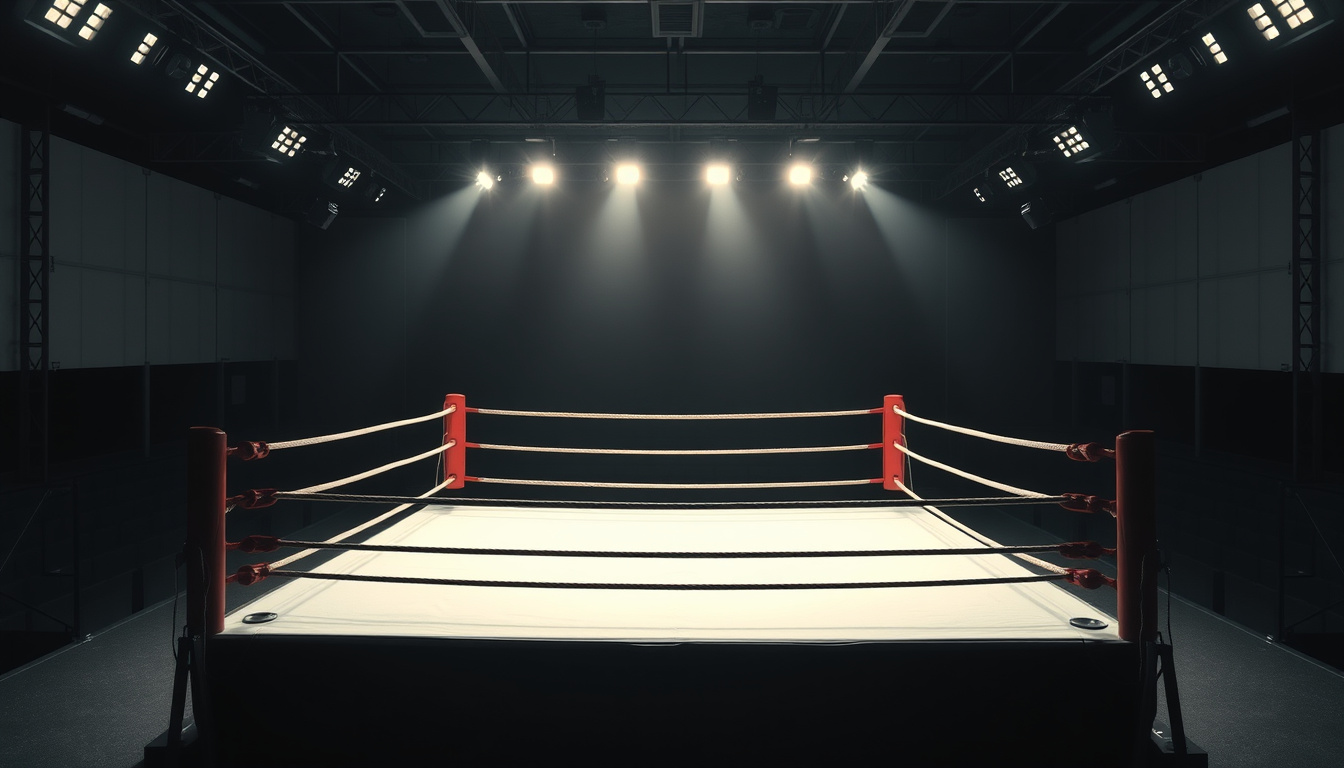
A square platform called a ring: boxing’s defining contradiction isn’t a mistake, it’s a 300-year-old relic. This guide untangles why the name stuck, delivers the official dimensions, and settles the ring-versus-rink debate with sourced facts.
Standard competition size: 20 ft x 20 ft (6.1 m x 6.1 m) ·
Number of ropes: 4 ropes, each 1-2 inches thick ·
Ring platform height: 3-4 ft above ground ·
Corner post material: Steel or wood, padded ·
First recorded boxing ring: 1743, London, England
Quick snapshot
- A square platform for boxing matches (Wikipedia’s boxing ring entry)
- Also called the “squared circle” (Wikipedia)
- Originated from a circle drawn on the ground (World Boxing Association’s history explainer)
- Professional: 20 ft x 20 ft (BoxingInsider’s dimension guide)
- Amateur: 16-20 ft square (CITS (Western Australian government sports department) specification)
- Platform height: 3-4 ft (WBA)
- Canvas floor pad (BoxingInsider)
- Four ropes with turnbuckles (Wikipedia)
- Corner posts (padded) (Wikipedia)
- Ring steps (two sides) (BoxingInsider)
- Early matches used a circular rope or chalk circle (WBA)
- Name stuck despite square shape (Wikipedia)
- Poetic term “squared circle” reflects this history (Wikipedia)
| Specification | Value |
|---|---|
| Standard professional ring size | 20 ft (6.1 m) per side |
| Number of ropes | 4 ropes |
| Rope thickness | 1-2 inches |
| Ring height from ground | 3-4 ft (0.9-1.2 m) |
| First documented boxing ring | 1743, London, England |
What Is a Boxing Ring Called?
The official term is simply “boxing ring” or “ring.” But the sport has collected a handful of alternative names along the way.
The official term for a boxing ring
- Every major sanctioning body—the World Boxing Association (WBA), the International Boxing Federation, and the World Boxing Council—uses “boxing ring” as the standard term in its rulebooks.
- In legal and regulatory contexts (e.g., state athletic commissions), the structure is always referred to as a “ring,” never a “square.”
Why “squared circle” is also used
- The phrase “squared circle” is a deliberate paradox that highlights the shape-vs-name contradiction. Wikipedia’s entry notes it has been a nickname in boxing journalism for over a century.
- It appears in everything from fight posters to biographies, serving as a shorthand for the sport’s quirky history.
Historical names for the boxing area
- Before the square ring, the fighting area was simply the “circle”—the rough ring drawn on the ground.
- The London Prize Ring Rules of 1743 specified a small circle in the centre where boxers met at the start of each round, as documented on Wikipedia.
- During the bare-knuckle era, the terms “prize ring” and “the ring” were used interchangeably.
Is It a Boxing Ring or Rink?
This is one of the most common mix-ups, and it’s easy to see why: the two words sound nearly identical, but they describe very different surfaces.
Difference between a ring and a rink
- Ring (boxing): a square or circular platform where combat sports take place. The word comes from Old English hring meaning “circular object.”
- Rink (hockey, skating): a rectangular ice surface (or a roller-skating floor). The word likely originated from Scottish renk meaning “course” or “race.”
- The two terms are not interchangeable. Calling a boxing ring a “rink” will confuse anyone familiar with hockey.
Why ice skating uses “rink”
- Ice skating rinks are built for gliding on a smooth, frozen surface. The term “rink” emerged in the 19th century when indoor ice rinks became popular.
- Boxing rings, by contrast, have a padded canvas floor designed for impact absorption—a very different engineering requirement.
Common confusion explained
- The phonetic similarity leads to frequent misspellings, especially in transcriptions of spoken interviews.
- To remember: boxing ring (people fight inside it) vs. hockey rink (skaters move across it).
Why Is a Boxing Ring Not Called a Square?
It’s a fair question: if the platform is square, why did generations of fighters and fans keep calling it a ring? The answer is a mix of tradition, inertia, and poetic stubbornness.
Origin of the name “ring”
- In the 18th century, when boxing was still bare-knuckle, a circle was drawn on the ground (often with chalk or a stick) to define the fighting area. The World Boxing Association explains that the term “ring” stuck even after the shape changed.
- The earliest documented use of the word “ring” for a boxing arena dates to around 1743 in London, as recorded by Wikipedia.
The historical circular shape
- Before the Pugilistic Society standardized a square in 1838, fights occurred inside a rough circle of spectators who formed a natural barrier.
- That early square ring was specified as 24 feet square, per Wikipedia. The name “ring” had already been in use for nearly a century.
Modern square shape retains the old name
- When the shape shifted from circle to square in the 1800s, the word “ring” was too deeply embedded to abandon.
- Today, the only place you’ll find a circular boxing ring is in historical reenactments or in the sport’s mythology.
The squared shape became standard under the London Prize Ring Rules, but the name refused to change. The result: a square called a ring, a contradiction that boxing fans have embraced for more than 180 years.
How Big Is a Boxing Ring? Dimensions Explained
Ring size matters for safety, fairness, and the pace of a fight. Larger rings favour mobile boxers; smaller rings force more exchanges.
Standard professional ring size
- Most professional bouts take place in a ring that is 20 ft x 20 ft (6.1 m x 6.1 m) measured inside the ropes, according to BoxingInsider’s dimension guide.
- The WBA notes that official rings can range from 16 to 23 feet square, giving promoters some flexibility.
Amateur and Olympic dimensions
- For AIBA (International Boxing Association) competitions, the ring must be 6.10 m (20 ft) square inside the ropes, as specified by the Western Australian government’s sports dimension guide.
- The same guide states the apron must extend at least 85 cm beyond the ropes on each side, and the platform height must be 100 cm (about 3.3 ft)—slightly lower than the 4 ft maximum seen in professional rings.
Minimum ring size for safety
- Safety regulations require enough space for referees to move, and for boxers to avoid falling out of the ring. Padding thickness must be at least 1 inch, per BoxingInsider.
- The WBA rulebook mandates that corner posts be padded to prevent head injuries during collisions.
The dimensions vary by sanctioning body, but one pattern holds: larger rings (approaching 23 ft) are used for championship fights where mobility is prized, while smaller rings (16-18 ft) increase action for televised events. Two sizes, one sport; the choice shapes the fight.
What’s Inside a Boxing Ring?
Beyond the square shape, a boxing ring is a carefully engineered structure with specific components. Here’s what you’ll find inside every regulation ring.
Ring canvas and padding
- The floor is a canvas sheet stretched over a layer of foam padding (at least 1 inch thick, per BoxingInsider).
- Under the padding, a plywood or particle-board base provides stability.
Ropes and corner posts
- Four ropes run along each side of the ring. Their heights are typically 18, 30, 42, and 54 inches from the canvas, as noted on Wikipedia.
- The WBA specifies 16 ropes total (four per side), each 1-2 inches thick.
- Corner posts are steel or wood, covered with padding. Each corner has a designated colour: blue and red for the two boxers’ corners, and white for the two neutral corners.
Turnbuckles and steps
- Turnbuckles at the ends of each rope allow tension adjustment. They are covered with a protective pad to prevent cuts.
- The ring has two sets of steps: one for the fighters and one for officials. The steps must be wide enough for safe entry and exit.
Optional features: gong, bell, scorecards
- A gong or bell is used to signal the start and end of rounds. Many rings include a timpani-style gong mounted near the ring post.
- Scorecards are handed to the referee at ringside; some premium rings have small tables built into the apron for judges.
All these components are regulated to keep boxers safe. The floor padding, rope tension, and post padding are checked by inspectors from the local athletic commission before every professional bout. What’s inside isn’t random; it’s a safety checklist that can stop a fight before it starts.
A poorly padded ring can lead to serious head injuries. The 1-inch minimum foam requirement exists because knockout forces are amplified when the canvas is too hard. Promoters who cut corners on padding are gambling with fighters’ health.
Confirmed Facts vs. What’s Unclear
Confirmed facts
- A boxing ring is a square platform historically called a ring (Wikipedia)
- Professional ring size is 20 ft x 20 ft inside the ropes (BoxingInsider)
- The term “ring” dates back to 18th century circular fight areas (WBA)
- The first official square ring was introduced by the Pugilistic Society in 1838, measuring 24 feet square (Wikipedia)
- Modern rings have four ropes per side, with heights of 18, 30, 42, and 54 inches (Wikipedia)
What’s unclear
- The exact origin of the first use of the word “ring” for boxing is not pinned to a single primary source; historians rely on contextual evidence from 1743
- The precise moment the shape shifted from circle to square is debated among historians. Some date it to the 1838 Pugilistic Society ring, other sources suggest earlier experiments
- Rope height guidelines vary slightly between sanctioning bodies (AIBA uses different metric heights of 40, 70, 100, and 130 cm, as noted in a Scribd document on AIBA ring specifications)
What Boxing Experts Say
The term “squared circle” is a historical nickname for the boxing ring, reflecting the evolution from a circular fighting area to a square platform.
Wikipedia (community-edited encyclopedia)
The boxing ring remained called a ‘ring’ even after the fighting area became square. It’s a strong example of how language can outlast the physical object it describes.
World Boxing Association (international sanctioning body)
For anyone stepping into the ring for the first time—whether as a boxer, coach, or promoter—the lesson is clear: the name may be confusing, but the dimensions are precise. Get the measurements and padding right, or risk a fight that doesn’t meet regulation standards.
Related reading: Javon Walton: Why He Left Acting for Boxing
wickedboxing.com, reddit.com, wickedboxing.com, youtube.com, broughtonclothing.com, dailysportshistory.com, todayifoundout.com
Frequently Asked Questions
What is the standard size of a professional boxing ring?
Most professional rings are 20 ft x 20 ft (6.1 m x 6.1 m) inside the ropes, though sanctioning bodies allow a range of 16 to 23 ft per side (WBA).
How high is a boxing ring platform?
The platform is typically 3 to 4 feet (0.9-1.2 m) above the ground (WBA). AIBA competitions specify 100 cm (about 3.3 ft) (CITS WA).
How many ropes are there on a boxing ring?
Modern rings have four ropes on each side (16 total). They are typically set at heights of 18, 30, 42, and 54 inches from the canvas (Wikipedia).
What is a “squared circle” in boxing?
The “squared circle” is a poetic term for the boxing ring that acknowledges the contradiction of a square platform being called a ring (Wikipedia).
Why is a boxing ring square but called a ring?
The name dates from the 18th century when fights took place inside a circle drawn on the ground. The name persisted after the shape changed to a square in the 1800s (WBA).
What equipment is required inside a boxing ring?
Every ring must have a padded canvas floor, four ropes with turnbuckles, padded corner posts, two sets of steps, and a gong or bell. The padding must be at least 1 inch thick (BoxingInsider).
Can a boxing ring be used for other combat sports?
Yes, boxing rings are also used for MMA, kickboxing, and Muay Thai. However, MMA rings often require different rope height or cage walls, and some organisations prefer a fenced enclosure for safety.

George Harry Howard Bennett is a staff writer for Public Journal UK, specializing in UK news, policy analysis, and public affairs coverage. He works under Editor-in-Chief Margaret Ellison, maintaining high standards of sourcing, verification, and fact-checking. Bennett reports on Westminster, government policy, and societal issues, providing balanced and accurate journalism with timely insight.