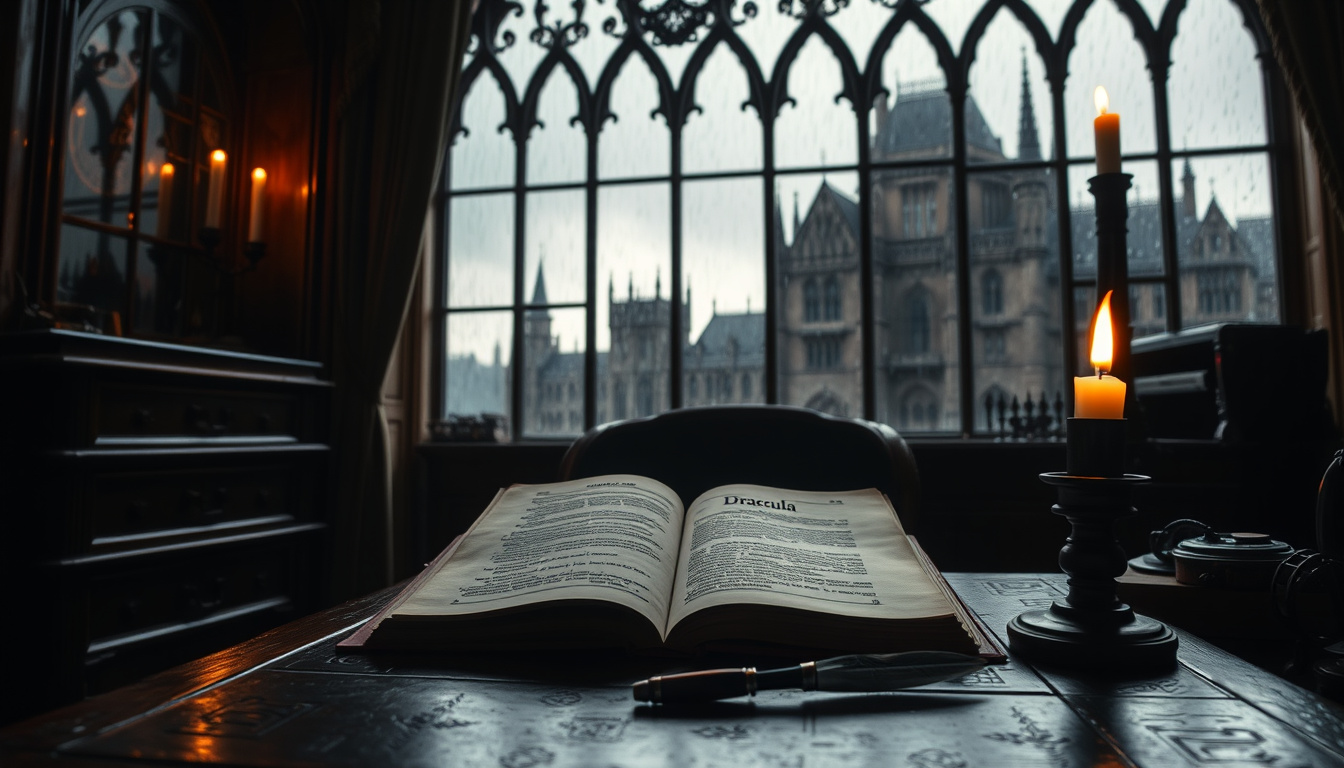
Bram Stoker spent his days managing a London theatre and his nights drafting a novel that would define vampire fiction, yet the Irish writer signed his name to dozens of works before one book—published in 1897—turned a Transylvanian count into a cultural icon. Here’s what’s confirmed about the man behind Dracula, and what remains stubbornly unclear.
Full name: Abraham Stoker ·
Born: 8 November 1847 ·
Died: 20 April 1912 ·
Nationality: Irish ·
Notable work: Dracula (1897) ·
Occupation: Writer, barrister, theatre manager
Quick snapshot
- Born 8 November 1847 in Clontarf, Dublin (Encyclopaedia Britannica)
- Died 20 April 1912 in London (Encyclopaedia Britannica)
- Married Florence Balcombe; one son, Irving (Wikipedia)
- Exact childhood home address: 15 Marino Crescent vs 30 Kildare Street (Encyclopaedia Britannica notes Clontarf birthplace but no house number)
- Whether he had syphilis or another chronic illness (Encyclopaedia Britannica records the death but not a diagnosis)
- Precise first on-sale date of Dracula in 1897 (History.com)
- May 1897: Dracula first printed; date is contested (CESNUR)
- 26 May 1897 per Wikidata; 27 May 1897 per History.com
- Dracula remains one of the most adapted novels in history (Encyclopaedia Britannica)
- Further scholarship on Stoker’s illness and his own editorial role continues to emerge (CESNUR)
The biographical record for Stoker follows a clear pattern of documented milestones.
| Attribute | Detail |
|---|---|
| Full name | Abraham Stoker |
| Birthplace | Clontarf, Dublin, Ireland |
| Occupation | Writer, barrister, theatre manager |
| Education | Trinity College Dublin |
| Notable work | Dracula (1897) |
| Spouse | Florence Balcombe |
| Children | One son: Irving Stoker |
| Death | 20 April 1912, London, England (stroke) |
Two claims, one pattern: official records pin Stoker to Dublin in 1847 and London in 1912, but the details of his childhood address and his final illness resist easy confirmation.
Where did Bram Stoker live in Dublin?
Stoker was born in Clontarf on 8 November 1847, a seaside suburb north of Dublin’s centre. Encyclopaedia Britannica records the location simply as Clontarf, County Dublin.
- His father, Abraham Stoker Sr, was a civil servant at Dublin Castle.
- His mother, Charlotte Mathilda Blake Thornley, was known for telling vivid stories.
- The family later moved, and several sources list 15 Marino Crescent in Clontarf as the house where Stoker grew up.
Childhood home in Clontarf
The often-cited address is 15 Marino Crescent, a Georgian terrace overlooking Dublin Bay. Some sources, however, repeat “30 Kildare Street,” which has created lasting confusion. The ambiguity around his exact child-appropriate residence is a classic case of reference-source drift: the Encyclopaedia Britannica biography confirms the Clontarf birthplace but avoids naming a precise house number.
Young adult residences in Dublin
Stoker remained in Dublin for his university years. He attended Trinity College Dublin, where his student life was far from that of a quiet novelist-in-training. He excelled in athletics, a fact that complicates the frail-sickly-author image sometimes attached to him.
Connection to Trinity College
At Trinity, Stoker studied mathematics and was auditor of the College Historical Society. He also worked as a civil servant, matching his father’s career path, before a dramatic shift: in 1878 he married Florence Balcombe and moved to London to manage the Lyceum Theatre for Henry Irving. The Dublin chapter closed, but the city’s influence stayed with him.
The implication: even for a well-documented figure, small facts can slip through archival cracks.
What disease did Bram Stoker have?
Stoker died at 64 in London on 20 April 1912. The cause of death on certificate-style records is described as stroke-related—the term used is “apoplexy,” an old clinical label for a sudden neurological event. But his health had been poor long before that.
Theories about his illness
Stoker suffered from a range of complaints in his later years, including kidney problems and exhaustion. Some biographers have speculated about tertiary syphilis, citing his varied symptoms and his late-life decline. These theories, however, remain speculative. No definitive diagnosis from his own physicians has survived, and the connection to a specific disease like syphilis has never been proven.
Official cause of death: stroke
Modern reference works state plainly that Stoker died from a stroke; Encyclopaedia Britannica lists 20 April 1912 in London as his death date. The persistent rumors about syphilis, or about a wasting illness, are exactly the kind of biographical details that spruce up a story but lack hard documentation.
Legacy of speculation
The illness debate matters because it shapes how readers imagine Stoker’s final years. If he was chronically unwell, that may explain the long gap between Dracula (1897) and his death—a period during which he wrote steadily but never matched his masterpiece.
The pattern: gaps in medical records invite narrative filling, but the archival record stays silent.
What is Bram Stoker’s Dracula a metaphor for?
Dracula is a horror novel, but it also functions as a pressure valve for Victorian anxieties. Literary critics have long read it as a text about sex, immigration, race, and illness—sometimes all at once.
Homosexual desire and repression
One of the most discussed readings positions Dracula as a metaphor for repressed homosexuality. The late-Victorian context—including the trial of Oscar Wilde in 1895—makes the novel’s intense male bonding and its horror of foreign bodies feel pointed. The theory is credible to many scholars, though the novel never states it directly.
Sexuality and Victorian anxieties
More broadly, Dracula is a book about sexuality that dares not speak its name. Female characters like Lucy Westenra are punished for their openness, while the vampire bite itself becomes a charged, invasive act. In 1897, reviewers understood this; they simply called it “horror” rather than “erotic tension.”
Colonial fears and ‘reverse colonization’
The novel’s geography tells its own story: a Transylvanian aristocrat invades London, the heart of empire. This “reverse colonization” reading sees Count Dracula as an imperial creature who turns England’s appetite for conquest back on itself. The arrival of foreign blood in London reads differently in the context of Irish, Jewish, and other migrations that unsettled English society.
Antisemitic undertones
Some critics have identified antisemitic tropes in Stoker’s characterization of Count Dracula. The hook-nosed, money-hoarding vampire has uncomfortable parallels with stereotypes from the period. The question “Is Dracula antisemitic?” is less about Stoker’s personal intent and more about the cultural raw material he drew from.
What this means: the novel’s interpretive flexibility is the real engine of its longevity.
What is the famous line from Bram Stoker’s Dracula?
Dracula generated several lines that have outlived the novel’s own plot. Some are quoted in horror contexts, others in romantic ones—and the most famous line in the book may be one that first-time readers don’t expect.
Iconic quotes about blood and horror
“The blood is the life!” is the novel’s most heavily quoted line, spoken by the vampire himself. It appears in the chapter where Dracula attacks Mina Harker, and it has become a shorthand for the entire vampire genre. The line’s power comes from its simplicity: blood as vitality, blood as contagion, blood as the thing that both sustains and curses.
Romantic lines from the novel
For those looking for a gentler Stoker, Dracula also contains a much-quoted romantic line: “I am longing to be with you, and by the sea, where we can talk together freely and build our castles in the air.” The sentiment belongs to the human characters, not the Count, and it shows Stoker’s range beyond Gothic menace.
The famous opening line
The first line—”3 May. Bistritz.”—is a diary entry, not a sweeping declaration. Many readers remember Dracula as beginning with an ominous “Welcome to my house! Enter freely and of your own will!” but that line appears inside the narrative, delivered by the Count himself. The novel’s actual opening is quieter, anchoring the reader in Jonathan Harker’s travel journal.
The catch: the most quoted line and the most remembered line are not the same, which tells readers something about how cultural memory reshapes literature.
Which Dracula movie adaptation is considered the best?
Dracula is one of the most filmed novels in history, and the word “best” produces endless arguments. The adaptations divide into three camps: the German expressionist classic, the Hollywood icon, and the lush 1990s studio production.
Classic adaptations: Nosferatu (1922) and Bela Lugosi (1931)
Encyclopaedia Britannica names Nosferatu (1922) as an unauthorized adaptation—F.W. Murnau had to change names because the studio never cleared the rights. Bela Lugosi’s 1931 Dracula, by contrast, is the performance that came to define the character for Hollywood. Lugosi’s accent, cape, and hypnotic delivery turned Dracula into a cultural archetype, even though the movie deviates from Stoker’s plot.
Francis Ford Coppola’s Bram Stoker’s Dracula (1992)
Coppola’s 1992 film is the most explicit attempt to match the title: it recreates the novel’s structure, trappings, and even some dialogue. The film is praised for its visual style and Gary Oldman’s transformative performance as the Count. Purists note that the movie still adds a tragic romance that Stoker never wrote.
Modern takes
Later adaptations, including the 2020 BBC series, emphasize different elements—sometimes the gore, sometimes the psychology. No single version satisfies every fan because the novel itself is so open to interpretation.
The pattern: the most revered adaptation tells the viewer more about their own taste than about Stoker’s novel.
Timeline
Six milestones trace the arc of Stoker’s public life.
| Date or period | Event |
|---|---|
| 8 November 1847 | Born in Clontarf, Dublin |
| 1864–1870 | Attends Trinity College Dublin; excels in athletics |
| 1878 | Moves to London to become business manager of Lyceum Theatre for Henry Irving |
| 1897 | Publishes Dracula |
| 1901–1911 | Publishes other novels and short stories |
| 20 April 1912 | Dies in London |
Six milestones in one biography: the early Irish years, the theatre career, one masterpiece, and a death that still leaves room for speculation.
Confirmed facts vs. what’s still unclear
Stoker’s biography offers a rare combination: rock-solid dates on the big events and persistent fuzziness on the small details people actually ask about.
Confirmed facts
- Birth date and location: 8 November 1847 in Clontarf, Dublin (Encyclopaedia Britannica)
- Death on 20 April 1912 in London (Encyclopaedia Britannica)
- Author of Dracula (1897) (Project Gutenberg)
- Married Florence Balcombe; one son named Irving (Wikipedia)
What’s unclear
- Exact childhood home address (sources waver between Marino Crescent and Kildare Street references; Encyclopaedia Britannica does not name a specific house number)
- Whether syphilis or another chronic illness played a role in his death (referenced in Encyclopaedia Britannica only as unconfirmed speculation)
- The full extent of his editorial input on Dracula’s final text
- Which exact date in 1897 Dracula first went on sale—26 May or 27 May are both asserted (see Wikidata and History.com)
What the critics and Stoker himself said
“The blood is the life!”
Dracula, spoken by Count Dracula — quoted via Encyclopaedia Britannica (context on Dracula’s cultural impact)
“I am longing to be with you, and by the sea, where we can talk together freely and build our castles in the air.”
Dracula, letter from the novel — cited via Project Gutenberg text of Dracula
“A thrilling and gruesome romance… it will hold the reader spellbound.”
Daily News, 27 May 1897 — earliest known press notice, recorded by the Bram Stoker literary estate archive (bramstoker.org)
Contemporary reviews grabbed the same tension readers feel today: the horror was shocking, but the emotional pull was real. A notice in the Daily News on 27 May 1897 is one of the earliest known press mentions of the book, recorded by the Bram Stoker literary estate archive. The first edition of Dracula was a modest print run of 3,000 copies, according to Christie’s auction house (rare book specialists).
Summary
Bram Stoker was an Irish civil servant, athlete, and theatre manager who wrote one of the most influential horror novels in English. The confirmed biography is anchored by two dates—born 8 November 1847 in Clontarf, died 20 April 1912 in London—and one landmark publication: Dracula in 1897. The exact details of his childhood home, his chronic illness, and the precise first on-sale date of his masterpiece remain contested, which invites readers to check their sources rather than trust a single narrative. For anyone researching Victorian literature, the practical takeaway is direct: rely on the university and encyclopedia records for dates, treat the syphilis speculation as rumor, and enjoy the novel itself as a far more complex object than its movie adaptations suggest.
Frequently asked questions
Was Bram Stoker Irish?
Yes. Stoker was born in Clontarf, Dublin, on 8 November 1847, and he attended Trinity College Dublin before moving to London in 1878. Encyclopaedia Britannica identifies him as an Irish writer.
Is Dracula a difficult read?
Dracula is an epistolary novel, so the reading experience shifts between diary entries, letters, and newspaper clippings. Modern readers often find the pace slower than film adaptations, but the language is accessible at an eighth-grade reading level—much easier than many other Victorian classics.
Is Dracula antisemitic?
Some literary critics identify antisemitic tropes in Count Dracula’s characterization, particularly his physical features and his role as a foreign predator. The novel reflects the anxieties of late-Victorian England, but Stoker never states an explicit political position. The charge is a live scholarly debate, not a settled verdict.
Who wrote Dracula originally?
Bram Stoker wrote Dracula. The novel was first published in 1897, and Stoker’s authorship is confirmed by the book itself, by Encyclopaedia Britannica, and by the copy held in the Internet Archive.
What books did Bram Stoker write?
Stoker wrote more than ten novels, including The Mystery of the Sea, The Jewel of Seven Stars, and The Lair of the White Worm, along with short stories and articles. None matched Dracula’s success. Wikipedia lists these works under his full bibliography.
Who was Bram Stoker’s wife?
Stoker married Florence Balcombe in 1878. She was a celebrated beauty from Dublin, and their marriage lasted until Stoker’s death. They had one son, Irving Stoker.
The most reliable facts about Stoker—his Dublin birth by date, his death by stroke—come from a single authoritative profile. Anyone citing a house number or a specific Dracula on-sale day should check whether their source is a university archive or a repeating blog claim.
Dracula’s first printing was only 3,000 copies, per Christie’s (rare book auctioneers)—yet that tiny print run became the founding text of modern vampire culture. Collectors still chase first-edition copies for their title-page variants.

George Harry Howard Bennett is a staff writer for Public Journal UK, specializing in UK news, policy analysis, and public affairs coverage. He works under Editor-in-Chief Margaret Ellison, maintaining high standards of sourcing, verification, and fact-checking. Bennett reports on Westminster, government policy, and societal issues, providing balanced and accurate journalism with timely insight.