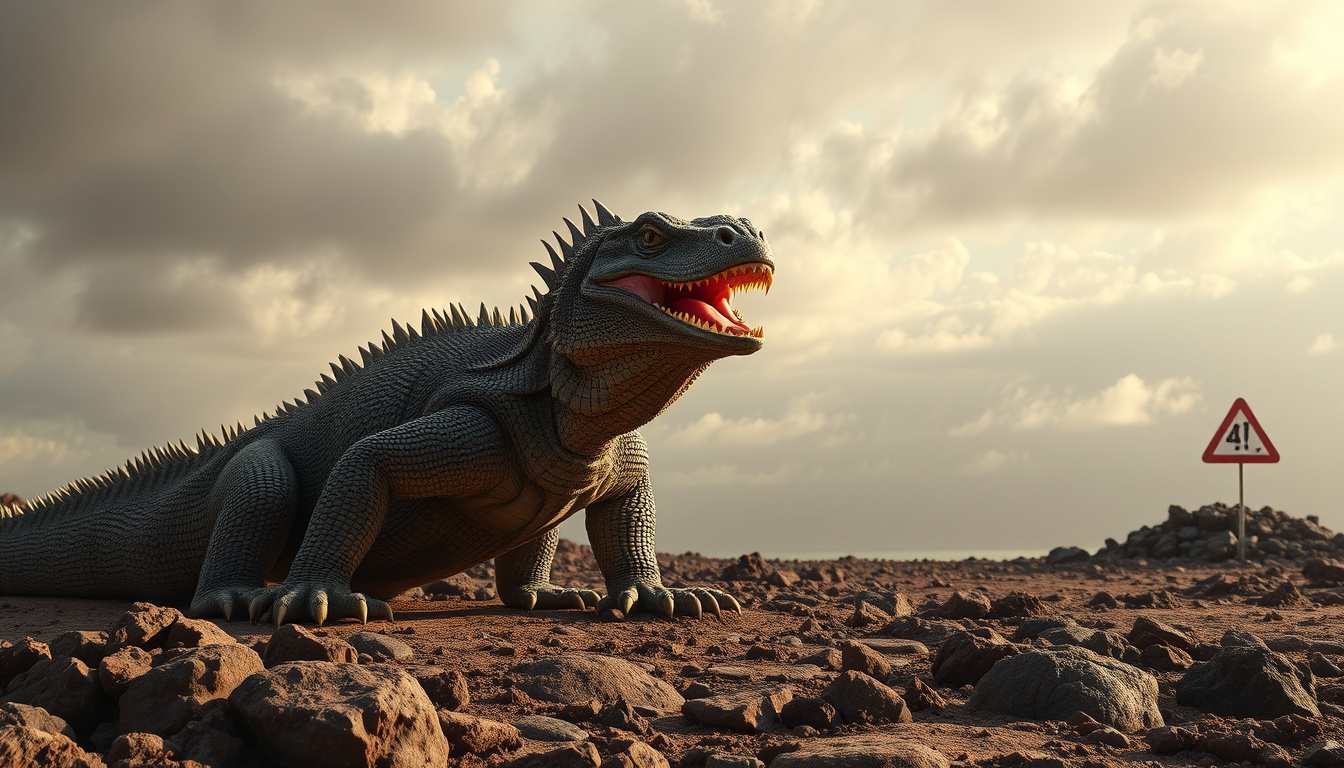
Komodo dragons have a fearsome reputation — they are the largest living lizards on Earth and have been known to kill humans, though rarely. Yet the last few decades of records show that while undeniably dangerous, the threat they pose is often misunderstood, especially given their limited range in the wild.
Top speed: 12 mph (20 km/h) · Maximum length: 10 ft (3 m) · Average weight: 70 kg (154 lbs) · Fatal attacks (1974–2012): 5 recorded · Conservation status: Endangered (IUCN)
| Attribute | Value |
|---|---|
| Scientific name | Varanus komodoensis |
| Family | Varanidae |
| Endemic to | Indonesian islands (Komodo, Rinca, Flores, Gili Motang, Padar) |
| Conservation status | Endangered (IUCN) |
| Diet | Carnivore (deer, pigs, water buffalo, carrion) |
| Average clutch size | 20–30 eggs |
Komodo Dragon at a Glance
- Max length: 10 ft (3 m) – Smithsonian National Zoo
- Average weight: 70 kg (154 lbs) – Smithsonian National Zoo
- Top speed: 12 mph (20 km/h) – Smithsonian National Zoo
- Lifespan: 30 years – Smithsonian National Zoo
- Fatal attacks on humans: 5 recorded – Wikipedia
- Venom glands: Yes – Smithsonian National Zoo
- Attack pattern: Ambush + venom + bacteria – Komodo Guide
- Human fatality rate: Extremely rare – Komodo Guide
- Native islands: Komodo, Rinca, Flores, Gili Motang, Padar – Smithsonian National Zoo
- Habitat: Tropical forest, grassland, scrubland – Smithsonian National Zoo
- Conservation: Endangered (IUCN) – Smithsonian National Zoo
- Role: Apex predator – Environmental Literacy Council
- Diet: Deer, wild boar, carrion, smaller Komodos – Environmental Literacy Council
- Natural predators: None (adults); juveniles face birds, snakes – Britannica
- Hunting method: Ambush, powerful tail, serrated teeth – Komodo Guide
Can a Komodo Dragon Harm a Human?
Komodo dragons are not just big — they are the undisputed heavyweights of the lizard world. The largest individuals reach about 10 feet (3 meters) in length, and while adults typically weigh around 70 kg (154 lbs), that is an average — large males can be substantially heavier. Their muscular build and powerful tails make them capable of taking down prey much larger than themselves, including adult deer and wild boar. Their top sprint speed of about 12 mph (20 km/h) is surprisingly quick for such a bulky reptile, though they tire quickly and rely on stealth rather than prolonged chasing. As the Smithsonian National Zoo puts it, they are “dangerous” in the truest sense — powerful, fast, and equipped with a formidable arsenal.
To put that speed in perspective, a Komodo dragon can outrun a typical human over a short distance, but not over a long one. Their strategy is to deliver a devastating initial strike, using their serrated teeth to create deep wounds. These teeth are often cited as part of their offensive capability — combined with venom and a mouth full of bacteria, a single bite can be lethal. The sheer force of a bite, paired with their ability to deliver it, makes them a top-tier ambush predator in their native habitat.
“Komodo dragons are not an animal you’d want to mess with – thick skin, strong claws, sharp teeth, and painful bite.” – Smithsonian National Zoo
Yet, the raw stats only tell part of the story. Their power is not just in their size but in their bite mechanics — the way they grip, shake, and tear. They are built to dismantle prey, and their claws are equally formidable, capable of inflicting serious lacerations. The combination of size, strength, and dental weaponry makes them a subject of respect and caution for researchers and locals alike.
The takeaway
Komodo dragons are biologically engineered for explosive, short-burst attacks, not endurance chases. Their speed is a sprint, not a marathon — but the closing speed is terrifying enough that no human wants to test it.
How many humans have been killed by a Komodo dragon?
The question everyone asks is: “Can a Komodo dragon kill a human?” The answer is a definitive yes, and it has happened. Data collected from Wikipedia (historical records) spanning 1974 to 2012 recorded 5 fatal human attacks within Komodo National Park. This is a remarkably low number for an animal often depicted as a man-eater. Smithsonian National Zoo (researcher perspective) confirms that while they are capable of killing an adult human with a single bite, attacks on humans are rare, and recent summaries describe fatalities as extremely rare. The most famous cases involve locals, not just careless tourists, and often occur in areas where the animals have become habituated to human presence or where food sources are scarce.
The rarity of attacks is a fact that often gets lost in the fear-mongering headlines. The dragons are also known to attack in self-defense or when they feel their territory is threatened. In the wild, they are shy and will typically retreat if given space. The problem arises when they associate humans with food, or when they are provoked. The phrase “deadly but not dangerous” has been used by researchers like those at Komodo Guide (ecological research) to describe this dynamic — they are capable of killing, but the act of doing so is a rare event, statistically speaking.
The historical record, however, is not the only story. Fatal attacks have occurred in captivity, and there are unconfirmed reports of deaths in remote villages. Yet, the pattern is clear: the number of human fatalities from Komodo dragons is tiny compared to other large predators because their habitat is confined to a few small islands in Indonesia. You are unlikely to encounter one in the wild unless you are in the Komodo National Park, which limits the potential for human-wildlife conflict.
The trade-off
The low fatality rate is less about the dragon’s capacity and more about its geography. The animal is a killing machine trapped on a handful of islands, which ironically makes both the dragon and the tourists safer than they would be in a broader range.
Has a human ever survived a Komodo dragon bite?
Surviving a Komodo dragon bite is possible, and it is essential to understand why. The bite itself is not necessarily an instant kill for an adult human; the danger comes from the infection and the venom’s effect on blood pressure. If an attack occurs, immediate pressure should be applied to control bleeding, and the victim needs to be transported to a medical facility without delay. The wound will be contaminated with a mix of venom and bacteria, so aggressive wound cleaning and the administration of a broad-spectrum antibiotic are crucial. In rare cases, antivenin is available in some parts of Indonesia, but it is not stocked globally.
There is a documented case of journalist Phil Bronstein, who was attacked by a Komodo dragon at the Los Angeles Zoo in 2001 — he survived, but the encounter highlighted the swiftness with which the animal can strike. The medical community treats Komodo bites as severe, and survival depends on the speed of medical intervention. The Wikipedia article on the species notes that reported fatalities have occurred in both the wild and captivity, underscoring that even in controlled settings, these are dangerous animals.
The outcome, however, shows how modern emergency medicine can alter the script on a historically lethal event. With rapid hospital care, the survival rate is high, but the risk of permanent disability from tissue loss or severe infection remains. The takeaway is not that a bite is survivable and therefore the dragon is harmless — it is that a bite is a medical emergency that requires immediate, specialized care.
Why this matters
The threat from a Komodo dragon is not “instant death,” but a complex, multi-system assault that can permanently injure even if it does not kill. A bite is a race against time, not a death sentence.
Could a Komodo dragon eat a human whole?
No, a Komodo dragon cannot consume a human whole. Their jaw structure is flexible, but they are not large enough to swallow a whole person; they typically eat their prey in large chunks.
For a healthy adult who keeps distance and reacts correctly, the danger is low. The animal’s power is real but rarely directed at humans without provocation.
Could I Outrun a Komodo Dragon?
How fast can a Komodo dragon run?
How big are Komodo dragons?
Komodo dragons are not just big — they are the undisputed heavyweights of the lizard world. The largest individuals reach about 10 feet (3 meters) in length, and while adults typically weigh around 70 kg (154 lbs), that is an average — large males can be substantially heavier. Their muscular build and powerful tails make them capable of taking down prey much larger than themselves, including adult deer and wild boar. Their top sprint speed of about 12 mph (20 km/h) is surprisingly quick for such a bulky reptile, though they tire quickly and rely on stealth rather than prolonged chasing. As the Smithsonian National Zoo puts it, they are “dangerous” in the truest sense — powerful, fast, and equipped with a formidable arsenal.
To put that speed in perspective, a Komodo dragon can outrun a typical human over a short distance, but not over a long one. Their strategy is to deliver a devastating initial strike, using their serrated teeth to create deep wounds. These teeth are often cited as part of their offensive capability — combined with venom and a mouth full of bacteria, a single bite can be lethal. The sheer force of a bite, paired with their ability to deliver it, makes them a top-tier ambush predator in their native habitat.
“Reaching up to 10 feet in length and more than 300 pounds, Komodo dragons are the heaviest lizards on Earth.” – National Geographic
Yet, the raw stats only tell part of the story. Their power is not just in their size but in their bite mechanics — the way they grip, shake, and tear. They are built to dismantle prey, and their claws are equally formidable, capable of inflicting serious lacerations. The combination of size, strength, and dental weaponry makes them a subject of respect and caution for researchers and locals alike.
The takeaway
Komodo dragons are biologically engineered for explosive, short-burst attacks, not endurance chases. Their speed is a sprint, not a marathon — but the closing speed is terrifying enough that no human wants to test it.
Speed vs. Stamina
Sprint speed: 12 mph (20 km/h) · Stamina: Low · Hunting style: Ambush predator · Chase distance: Short bursts only
The key to understanding a Komodo dragon’s threat level is recognizing that its speed is a burst capability, not a sustained asset. They will not chase you for a mile, but they can cover a short, critical distance faster than you can react. The National Zoo’s fact sheet highlights their agility on land, noting that they can sprint briefly but lack the endurance for long chases. In practice, this means most human encounters — which are rare to begin with — are won by the human if they see the dragon first and maintain distance. The dragon’s strategy is surprise, not pursuit.
This distinction matters for anyone visiting their native range in Indonesia, where the terrain — tropical forest, grassland, and scrubland — provides perfect cover for an ambush predator. The animal’s ability to disappear into the underbrush, combined with a sudden burst of speed, is what makes it dangerous. It is less like being chased by a lion and more like being struck by a scaly, sharp-toothed truck.
For tourists, this means the rule is simple: do not run. Instead, back away slowly while keeping your eyes on the dragon, and alert any local guides. Park rangers, who have years of experience, manage visitor safety with structured tours — it is a system built on the understanding that the animals are opportunistic, not predatory toward humans.
The catch
Speed is a weapon only if you are unaware of the attack. The Komodo’s threat is fundamentally based on the element of surprise, which is why most fatal incidents occur in the wild, where visibility is low and the animal is undisturbed.
A fit human can outrun a dragon over distance, but the animal’s burst speed makes any close encounter dangerous. The smartest response is to stay still, back away, and keep the dragon in sight.
Which Animal Kills a Komodo Dragon?
What are natural predators of Komodo dragons?
Komodo dragons are endemic to Indonesia, meaning they are found nowhere else on Earth. Their natural habitats include tropical forest, grassland, and scrubland, across the islands of Komodo Guide (habitat overview). The species is listed as Endangered on the IUCN Red List, a testament to their vulnerability due to habitat loss, natural disasters (like volcanic eruptions), and genetic isolation. Their diet is opportunistic and varied, consisting of deer, wild boar, and carrion, but they are also known to cannibalize smaller Komodo dragons, which is a significant factor in their juvenile survival rates.
As an apex predator, an adult Komodo dragon has few natural enemies. However, the young are far from safe. Juvenile Komodo dragons face predation from birds, snakes, and other reptiles, including larger Komodo dragons. The juveniles are arboreal, spending much of their early lives in trees to avoid becoming a meal for their own kind. This niche differentiation is a survival strategy that has allowed the species to persist. The same feature that makes them formidable as adults — their size and aggression — is absent in the young, so they must adapt or die.
In their ecosystem, the Komodo dragon is a keystone species. They control the population of their prey, and their scavenging cleans the forest floor. Their extinction would have a ripple effect across the islands. However, the very traits that make them successful predators also put them at odds with humans. As human settlements expand into their territory, encounters are bound to increase, and the animals are often killed in retaliation or out of fear, despite the law protecting them.
Why this matters
The Komodo dragon is not a mindless brute but a tightly evolved part of its island ecosystem. Understanding its habitat is not just about knowing where it lives — it is about recognizing that protecting this animal is a conservation imperative, not just a public safety issue.
Can grizzly bears defeat Komodo dragons?
While there are no documented cases of predators killing adult Komodo dragons, the species is not without threats. The Tigers and other larger carnivores that once shared their territory are now extinct or absent from the islands, leaving the dragon as the top of the food chain. However, this position comes with a downside: the dragon’s ecological dominance is fragile. A single island’s population is vulnerable to introduced species, diseases, or environmental changes.
The threat is not a natural predator but a human one — poaching and habitat destruction are the primary drivers of their decline. The Komodo dragon is a protected species, but it remains at risk. Conservation efforts focus on sustainable tourism and community-based management, aiming to balance the needs of the local people with the survival of the species. The animal is a national treasure and a vital part of Indonesia’s natural heritage, but its future hangs in the balance, requiring a global commitment to its conservation.
For those who wonder about a hypothetical showdown with a grizzly bear, which is not a natural encounter, the answer is that the Komodo dragon’s dangerousness is contextual. A single bite can be fatal, but in a straight fight, its stamina and size relative to a bear would work against it. The bear’s power is superior, but the dragon’s resilience and deadliness are unique. Such a matchup is purely hypothetical.
The catch
In terms of species survival, the Komodo dragon has no natural enemies left, and it is precisely that lack of pressure that has left it vulnerable to the ultimate predator — man.
The dragon’s only real predator is humans, through habitat loss and retaliation. A grizzly bear might win a fight, but that scenario never occurs in nature.
What If a Komodo Dragon Licks You?
Is Komodo dragon venom deadly?
How does Komodo dragon venom work?
The Komodo dragon’s bite is a far more complex weapon than a serrated edge alone. For years, the prevailing wisdom was that the dragon’s saliva was a toxic swamp of bacteria, capable of causing fatal sepsis in prey that managed to escape the initial attack. That is only half the story. Modern research, including work by biologist Komodo Guide (field research on dragon behavior), has confirmed that they also possess venom glands that inject a potent cocktail of anticoagulants and toxins, which lowers blood pressure, induces shock, and prevents clotting. The bacteria and venom work in tandem — the venom disables the prey, and the bacteria ensure the wound is slow to heal, turning a single bite into a death sentence that can take weeks to kill.
The Smithsonian National Zoo’s research describes the venom as a “complex venom” that causes a drop in blood pressure, leading to massive bleeding and shock in prey. Wikipedia (facts on the species) cites that the dragons have “venom glands” and that their “serrated teeth” are essential for lacerating flesh, which, combined with the venom, accelerates blood loss. The sophistication of this biological system is remarkable — the Komodo dragon has evolved to be a highly efficient killing machine, whether it is taking down a deer or inflicting a wound that will eventually prove fatal to a larger animal. The Smithsonian National Zoo (authoritative source) explicitly notes that they are “capable of killing an adult human with a single bite.”
But here is the nuance: research also shows the bacteria, while present, may be less important than the venom. A 2020 study by Komodo Guide (field research) summarizes that the bacteria might not be unique to Komodos, but it is the precise role of bacteria vs. venom that remains a subject of debate. The truth is that both play a role — the venom does the initial damage, and the bacteria may contribute to a lingering infection. For humans, a bite is a medical emergency, requiring immediate veterinary or hospital care, likely with antibiotics and possibly even antivenom, though the availability is limited.
The paradox
Many assume the bite is the primary weapon, but for an animal that has been called “dangerous” for so long, the true evolutionary marvel lies in the delayed effect — the venom’s ability to keep working long after the dragon has let go.
Licking is a scent-gathering behavior, not venom delivery. Venom is injected through bites, and the real danger is the combined effect of venom and bacteria that can kill days later.
What Celebrity Got Bitten by a Komodo Dragon?
Are there any Komodo dragons in the UK?
Can Komodo dragons be friendly to humans?
The context of an attack changes the risk profile. In the wild, inside the Komodo National Park, visitor safety is structured around tour systems that keep people on paths and with rangers, minimizing surprise encounters. The animals are wild but accustomed to humans, which does not make them “friendly” — it makes them bolder. In contrast, attacks in captivity, like the one on Phil Bronstein, often involve a lapse in safety protocol, where the keeper or visitor gets too close. These incidents are highly instructive: they show that a Komodo dragon is a wild animal in any environment, and its behavior is unpredictable when it feels cornered or perceives an opportunity for food.
The difference between the two scenarios is not the dragon’s inherent danger but the human’s proximity and the animal’s level of habituation. A wild Komodo on a beach might study you from a distance; a captive or semi-habituated one is more likely to approach. The Wikipedia article notes that attacks on humans are rare, but when they happen, they can be severe, and the severity is often linked to the animal being in a state of “feeding mode,” where they see a potential meal.
For those living or traveling in the region, the risk is manageable with common sense. You do not swim in crocodile rivers, and you do not taunt the dragons. The protective measures in place, though simple, are effective if respected.
What to watch
Whether in the wild or in a zoo, the deciding factor is always awareness. The dragon’s greatest advantage is its ability to look like a passive log right until the moment it decides to act.
Even captive dragons remain dangerous. The 2001 attack on Phil Bronstein at the Los Angeles Zoo proves that no amount of familiarity makes a Komodo dragon a safe animal.
komodoguide.org, civicreport.uk, komodoluxury.com, factsanddetails.com, komodonationalparks.com, komodoisland.tours, enviroliteracy.org
Frequently asked questions
Has a human ever survived a Komodo dragon bite?
Yes, survival is possible with immediate medical treatment. The key is to control bleeding and seek rapid hospital care to treat the venom’s effects and prevent infection. Journalist Phil Bronstein survived a 2001 attack with swift treatment.
Could a Komodo dragon eat a human whole?
No, a Komodo dragon cannot consume a human whole. Their jaw structure is flexible, but they are not large enough to swallow a whole person; they typically eat their prey in large chunks.
Are there any Komodo dragons in the UK?
Yes, there are a few in captivity in UK zoos, such as London Zoo, which participate in European breeding programs. They are not native to the region and are kept in tightly controlled environments for conservation.
What are the natural predators of Komodo dragons?
Adult Komodo dragons have no natural predators, but juveniles are vulnerable to birds, snakes, and cannibalism from larger dragons. They are the apex predators in their native range.
What is the survival rate for a Komodo dragon bite?
There isn’t a strict survival rate, but the likelihood of survival is high if medical care is immediate. Without treatment, the combination of venom and infection often proves lethal within days or weeks.
How fast can a Komodo dragon run?
Komodo dragons can sprint at 12 mph (20 km/h) for short bursts. Over the same distance, a fit human can run faster, but encountering one in the wild still poses a significant danger.
Can you outrun a Komodo dragon?
You can outrun one in terms of speed over a short distance, but it is unwise to run in a straight line. The risk of a misstep or them cornering you is high. The best strategy is to stand still, maintain eye contact, and find safe cover or a vehicle.
Confirmed facts
- Komodo dragons are apex predators with venom glands – Smithsonian National Zoo
- They have been responsible for human fatalities – Wikipedia
- They can reach speeds of up to 20 km/h for short bursts – Smithsonian National Zoo
What’s unclear
- Exact number of human fatalities (some unreported in remote areas) – unknown
- Whether an adult Komodo dragon can actually swallow a human whole (theoretical based on prey size; no documented case) – no source
- The precise role of bacteria vs venom in killing prey – Komodo Guide
For visitors and locals alike, the Komodo dragon remains a species that demands respect. Its limited geographic range and the rarity of fatal encounters are the main reasons the human death toll stays low, not any inherent restraint on the dragon’s part.

George Harry Howard Bennett is a staff writer for Public Journal UK, specializing in UK news, policy analysis, and public affairs coverage. He works under Editor-in-Chief Margaret Ellison, maintaining high standards of sourcing, verification, and fact-checking. Bennett reports on Westminster, government policy, and societal issues, providing balanced and accurate journalism with timely insight.