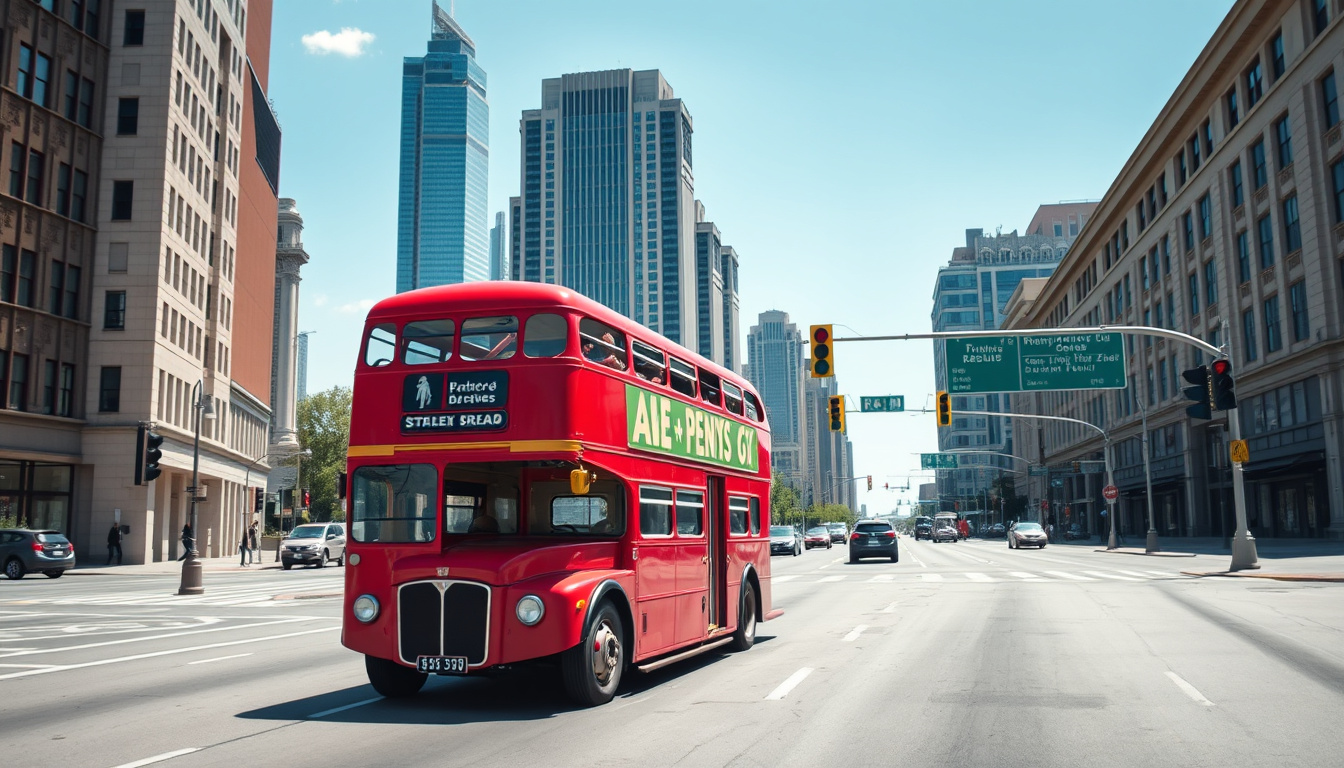
You’ve probably seen one towering above traffic, its upper deck offering a view that no single-level bus can match. The double-decker bus is more than a London postcard cliché — it’s a serious piece of urban engineering with real trade-offs in cost, regulation, and licensing that vary wildly depending on where you live, from the slang to the sticker price.
Length: 11–12 meters ·
Height: 4.4 meters ·
Passenger capacity: up to 100 ·
New bus cost: £250,000–£350,000 ·
Weight: 12 tons
Double-decker buses are designed to maximize passenger capacity within a fixed footprint, offering 70–100 seats per vehicle.
Quick snapshot
- Double-decker buses have two passenger decks (Wrightbus (manufacturer))
- New double-decker buses cost £250,000–£350,000 (Wrightbus (manufacturer))
- Used double-decker buses in Ireland start around €20,000 (Autoline Ireland (commercial listings))
- Exact number of double-decker buses currently operating in the US
- Future adoption rates of electric double-deckers in smaller cities
- 1910s: First double-decker buses appear in London
- 1954: Routemaster introduced, becomes iconic
- 2000s: Modern low-floor double-deckers with wheelchair access
- 2020s: Electric double-deckers enter service in London and other cities
- More stringent US roof-strength regulations taking effect for over-the-road buses (Federal Register / NHTSA (US regulator))
- Growing electric double-decker fleets in European cities (Federal Register / NHTSA (US regulator))
Five key specs, one pattern: double-decker buses are built to maximize passenger capacity within a fixed footprint, but their height creates unique regulatory and infrastructure challenges.
| Specification | Value |
|---|---|
| Height | 4.4 m (14 ft 5 in) |
| Length | 11–12 m (36–39 ft) |
| Width | 2.4–2.55 m |
| Passenger capacity | 70–100 depending on model |
| Engine type | Diesel, hybrid, or electric |
| First introduced | Early 20th century (London) |
What Do Brits Call a Double-Decker Bus?
Slang terms like “double-decker” and “bus”
- “Double-decker” is the standard term in British English for a bus with two passenger decks (Wikipedia (encyclopedic reference)).
- Slang includes “decker” or “double-deck bus” in casual conversation.
- The term is also used for boats and sandwiches — a “double-decker” sandwich has three slices of bread with two layers of filling.
Regional variations across the UK
- In London, the iconic red double-decker is simply called “the bus” by locals.
- In other parts of the UK, “double-decker” remains the most common descriptor.
- Tourist marketing often uses “hop-on-hop-off bus” for open-top sightseeing versions.
The origin of the name
- The term “double-decker” dates back to the early 20th century when the first two-level horse-drawn carriages appeared.
- It literally means “having two decks” — a nautical term applied to road vehicles.
- The name stuck as motorized versions replaced horse-drawn buses in the 1910s.
The implication: the name is so embedded in British English that it’s become a global shorthand for any two-level bus, even in countries where the vehicles themselves are rare.
How Much Does a Double-Decker Bus Cost?
Cost of a brand new double-decker bus
- A brand new double-decker bus costs between £250,000 and £350,000, depending on specifications and manufacturer (Wrightbus manufacturer specification).
- Electric double-deckers are more expensive, often exceeding £400,000.
- Hybrid models sit between diesel and electric in price.
Price of a double-decker bus in Ireland
- In Ireland, prices vary widely. Autoline Ireland lists used double-decker buses from around €20,000 (Autoline Ireland (commercial listings)).
- New double-decker buses in Ireland are comparable to UK prices, typically €300,000–€400,000.
- Bus Éireann, Ireland’s national bus operator, runs a fleet of double-deckers on urban and intercity routes.
Used double-decker bus prices
- Used double-decker buses range from £10,000 for older models to £150,000 for recent low-mileage examples.
- Ex-London Routemasters are collectible and can fetch £50,000–£100,000 depending on condition.
- Private buyers often convert used double-deckers into mobile homes, event spaces, or cafes.
Driver salaries at Bus Éireann as operating cost
- Bus Éireann driver salaries range from approximately €35,000 to €45,000 per year (Bus Éireann (national operator)).
- Driver wages are a significant operating cost for any double-decker bus fleet.
- In the UK, bus driver salaries average £25,000–£35,000, with London drivers earning more due to higher living costs.
For a private buyer, a used double-decker at €20,000 sounds like a bargain — until you factor in maintenance, fuel, insurance, and the specialized license required to drive it. The upfront cost is only the beginning.
The pattern: new double-decker buses are a major capital investment for transit agencies, while the used market offers entry points for private buyers who can handle the ongoing costs. For perspective on commercial vehicle pricing across the UK and Ireland, see our guide on the Vauxhall Vivaro for Sale.
Are Double-Decker Buses Allowed in the US?
The bus body and roof structure must withstand a static load equal to 150% of curb weight evenly distributed on the roof, with no more than a six-inch reduction in any interior dimension.
Federal and state regulations
- Yes, double-decker buses are allowed in the US, but they must comply with Federal Motor Vehicle Safety Standards (FMVSS) and state regulations (Duluth Transit Authority (US transit agency)).
- The Duluth Transit Authority specification requires compliance with all applicable FMVSS, BMCS, and ADA regulations in effect at the date of manufacture.
- Each state may have additional requirements for vehicle registration and operation.
Height restrictions and bridge clearances
- The height limit on US highways is often 13.5 feet (4.1 m), which is lower than the typical double-decker bus height of 4.4 m (Federal Highway Administration (US regulator)).
- This means double-decker buses cannot use many highways and must follow designated routes with adequate clearance.
- Bridge strikes are a real risk — operators must plan routes carefully to avoid low overpasses.
Examples of US double-decker bus operations
- Double-decker buses are common in tourist and sightseeing services in cities like New York, San Francisco, and Washington DC.
- Some transit agencies, like Duluth Transit Authority, use double-deckers for commuter routes to increase capacity without adding more buses.
- Open-top double-deckers are popular for hop-on-hop-off tours in major tourist destinations.
For a US transit agency considering double-deckers, the height restriction is the single biggest operational constraint. A 4.4 m bus cannot simply run any route — it needs dedicated infrastructure planning that single-level buses don’t require.
What Is the Largest Bus You Can Drive on a Car Licence?
Standard car licence size limits
- In the UK, a car licence (Category B) allows vehicles up to 3.5 tons and with up to 8 passenger seats (UK Government (driver licensing authority)).
- This means a standard car licence cannot legally drive any full-size double-decker bus.
- Small minibuses with up to 16 seats may be driven on a car licence if the driver passed their test before 1997 (older entitlement).
Double-decker bus dimensions and licensing class
- Double-decker buses require a Category D licence in the UK, which is a professional bus driving license (UK Government (driver licensing authority)).
- Category D covers any bus with more than 8 passenger seats, regardless of size.
- Drivers must pass a medical exam, theory test, and practical driving test to obtain a Category D license.
Variations by country (UK, US, Australia)
- In the US, a commercial driver’s license (CDL) with a passenger (P) endorsement is required to drive a double-decker bus (FMCSA (US regulator)).
- In Australia, a heavy vehicle license (class MR or above) is required, depending on the bus’s gross vehicle mass.
- In Ireland, a D license is required, similar to the UK system.
The implication: no matter where you are, driving a double-decker bus requires a professional license — a car licence won’t cut it. This is a hard barrier for private buyers who want to use a double-decker as a camper van. For more on UK vehicle compliance, see our guide on how to check vehicle tax online.
Licensing requirements vary significantly by jurisdiction. The table below compares the key regulatory frameworks across the UK, US, and EU.
| Standard | UK Requirement | US Requirement | EU Requirement |
|---|---|---|---|
| Roof strength test | ECE R66 (full-vehicle rollover test) | 150% of curb weight static load (Duluth Transit Authority (US transit agency)) | ECE R66 (full-vehicle rollover test) |
| Side-impact protection | Not specifically required | 25 mph impact by 4,000 lb vehicle (Duluth Transit Authority (US transit agency)) | Not specifically required |
| Driver license class | Category D | CDL with P endorsement | Category D |
Are There Double-Decker Buses in Europe?
Double-decker buses in major European cities
- London is the most famous city for double-decker buses, with thousands in daily service on Transport for London routes (Transport for London (transit authority)).
- Dublin, Berlin, and Paris also use double-decker buses in their public transport fleets.
- Many European cities operate open-top double-deckers for sightseeing tours.
Prevalence in London, Dublin, and elsewhere
- London has the largest double-decker bus fleet in Europe, with over 8,000 buses, the majority being double-deckers.
- Dublin Bus operates hundreds of double-deckers on urban and suburban routes.
- Berlin’s BVG uses double-deckers on some high-capacity routes, though single-deckers are more common.
Differences in design and usage
- London’s double-deckers are typically low-floor for wheelchair access, with doors on the left (kerb side).
- In continental Europe, double-deckers often have doors on the right and may be designed for intercity rather than urban use.
- Open-top double-deckers are almost exclusively used for tourism, not regular public transport.
The pattern: double-decker buses are most common in the UK and Ireland, but they have a meaningful presence in other European cities — usually on high-demand routes or as tourist vehicles.
promohire.co.uk, fmcsa.dot.gov, slickminibusandcoachhire.co.uk
Frequently asked questions
What is the double-decker bus song?
“The Wheels on the Bus” is a popular children’s song that often mentions a double-decker bus. The song originated in the UK and has become a nursery rhyme staple worldwide.
How many seats does a double-decker bus have?
A standard double-decker bus has 70–100 seats, depending on the model and configuration. Some have standing room for additional passengers, bringing total capacity to around 100.
Are double-decker buses wheelchair accessible?
Modern low-floor double-decker buses are wheelchair accessible, with ramps and designated wheelchair spaces on the lower deck. Older models may not be accessible.
Can double-decker buses go on highways?
Yes, but height restrictions on many highways (often 13.5 feet / 4.1 m in the US) can prevent double-decker buses from using certain routes. Operators must plan routes with adequate clearance.
What are the safety features of a double-decker bus?
Safety features include roof strength requirements (tested to withstand 150% of curb weight), side-impact protection, fire suppression systems, and emergency exits on both decks (Federal Register / NHTSA (US regulator)).
How fast can a double-decker bus go?
Most double-decker buses have a top speed of 50–60 mph (80–96 km/h), limited by their weight, engine power, and safety regulations. They are not designed for high-speed travel.
What is the environmental impact of double-decker buses?
Double-decker buses carry more passengers per vehicle than single-deckers, reducing per-passenger emissions. Electric double-deckers, now entering service in London and other cities, offer zero tailpipe emissions.
For a private buyer in the UK or Ireland, the choice is clear: a used double-decker at €20,000 is affordable, but the professional license requirement and ongoing operating costs mean it’s a serious commitment, not a casual purchase.

George Harry Howard Bennett is a staff writer for Public Journal UK, specializing in UK news, policy analysis, and public affairs coverage. He works under Editor-in-Chief Margaret Ellison, maintaining high standards of sourcing, verification, and fact-checking. Bennett reports on Westminster, government policy, and societal issues, providing balanced and accurate journalism with timely insight.