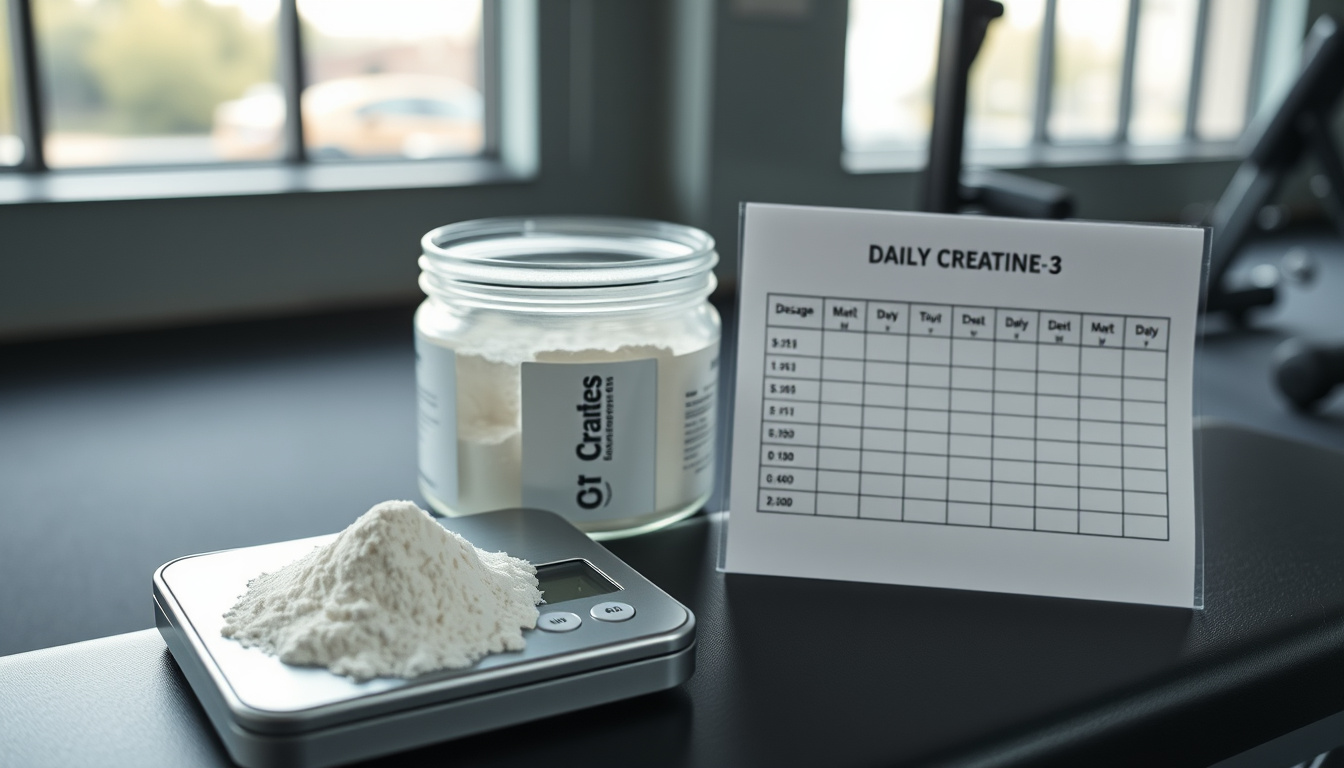
Skip the confusion—here’s the exact creatine dose that works for your body based on weight and goals. Most people take too much or too little because supplement labels offer no precision. Research-backed numbers from peer-reviewed studies give you a clear path to the right dose.
Standard Maintenance Dose: 3-5g per day ·
Loading Phase Dose: 20-25g per day for 5-7 days ·
Dose per kg Body Weight: 0.03g/kg maintenance · 0.3g/kg loading
Quick snapshot
- 3-5g daily maintains muscle creatine stores (Medical News Today)
- 20-25g/day for 5-7 days saturates muscles faster (Healthline)
- ISSN confirms 30g/day for 5 years is safe (Healthline citing ISSN)
- Long-term effects of daily doses above 10g beyond 5 years
- Optimal dosing for rare conditions like Ehlers-Danlos syndrome
- Whether body composition affects ideal loading protocols
- 1996: First study showed 3g/day saturates muscles in 28 days (Healthline citing 1996 study)
- 2021: PMC review debunked loading phase necessity (PMC review)
- 2025: Frontiers confirmed safety in clinical populations (Frontiers in Nutrition)
- Choose: faster saturation with loading, or steady approach
- Calculate your personal dose based on body weight
- Track water weight changes during first week
Three numbers matter most in creatine dosing: the loading range, the maintenance range, and the grams-per-kilogram factor that personalizes both.
The table below summarizes the key parameters from peer-reviewed research and professional sports organizations.
| Parameter | Value | Source |
|---|---|---|
| General Recommendation | 3-5g per day | Healthline citing Harvard |
| Loading Protocol | 20g/day split 4×5g | PMC comprehensive review |
| Per Kg Maintenance | 0.03g/kg | Medical News Today |
| Per Kg Loading | 0.3g/kg | Healthline citing research |
| Max Safe Daily | 25g short-term | Jinfiniti guide |
| Non-loading Saturation | 4 weeks at 3-5g daily | PMC review |
Is 5g of creatine enough to build muscle?
For most people, yes—5 grams daily hits the mark. Research from the National Strength and Conditioning Association (professional body for strength training) establishes that 0.03g per kilogram of body weight maintains muscle creatine stores effectively for the long term. A 70kg person taking 5g gets roughly 0.07g/kg, sitting comfortably within the effective range.
Low-dose effects on strength
Studies consistently show that doses between 3-5g daily produce measurable strength gains over 8-12 weeks. The mechanism is straightforward: consistent daily intake replenishes the creatine phosphate system that fuels high-intensity, short-duration efforts—exactly the movements that drive muscle growth. You don’t need to max out your dose to get results; you need consistency.
Studies on 3-5g maintenance
A landmark 1996 study found that just 3 grams per day fully saturated muscle creatine stores within 28 days—no loading required. More recent peer-reviewed work from PMC confirms this finding, noting that lower daily doses work equivalently to aggressive loading when given four weeks to take effect.
If you’re not in a rush, skip the loading phase entirely. Taking 3-5g daily over a month produces the same muscle saturation as a week of 20+ gram doses, without the water retention spike or gastrointestinal risk.
Is 10g of creatine too much daily?
Ten grams falls within the range most researchers consider safe for healthy adults. The International Society of Sports Nutrition (ISSN) has reviewed extensive evidence and states that up to 30g daily for five years shows no adverse effects in healthy individuals. That’s five times the standard maintenance dose and nearly half the common loading dose.
Safety of 10g doses
The Cleveland Clinic (major medical institution) notes that the main risks with high doses are gastrointestinal—diarrhea, bloating, and stomach cramping when single servings exceed roughly 10 grams. Splitting a 10g daily dose into two 5g servings eliminates most of these issues. Creatine monohydrate specifically carries no known kidney or liver risks at these doses, according to comprehensive PMC reviews.
Performance benefits vs risks
There’s diminishing returns above 5g daily for muscle saturation. Once your muscles are full, additional creatine circulates unused. Some athletes use 10g during heavy training periods, betting on marginal benefits for repeated high-intensity efforts. For most gym-goers, 10g provides insurance against under-dosing rather than a meaningful performance edge.
Taking 10g daily won’t hurt you if you’re healthy and hydrated, but you’re likely spending twice as much as necessary for the same muscle saturation. The extra grams make sense only during a loading phase or if you weigh significantly above average.
Is 20g of creatine too much per day?
Twenty grams per day sits squarely in the standard loading phase range—and for a specific, time-limited purpose. The loading phase exists to flood muscle cells with creatine as quickly as possible, typically before a competition or training cycle where you want peak performance within days rather than weeks.
Why athletes like Rory McIlroy use 20g
Professional athletes across sports use loading protocols for rapid saturation before key events. Golfers, powerlifters, and team sport players have publicly discussed 20g daily loading phases. The protocol isn’t about taking more for better results—it’s about reaching maximum saturation faster when time matters.
Loading phase protocols
The standard approach: 20-25g daily split across four to five doses of 5g each, taken with meals, for five to seven consecutive days. An 80kg athlete calculates 0.3g per kilogram, yielding 24g daily. This rapid intake typically adds 1-3kg of water weight within the first week as muscles pull extra water from circulation.
Loading works fast, but the trade-off is real: water retention, GI distress risk if you take large single doses, and a weight spike that can feel discouraging if you weren’t expecting it. If you’re training for general fitness, the loading phase is optional—start with 5g daily instead.
How much creatine per day per kg?
Body weight calculations give you a personalized starting point rather than guessing. The research consensus splits into two targets: 0.3g per kilogram for loading (faster saturation) and 0.03g per kilogram for maintenance (ongoing support).
Dosing for 70kg
At 70 kilograms, your loading dose is approximately 21g daily, typically rounded down to 20g for simplicity. Your maintenance dose sits around 2.1g—most practitioners round up to 3-5g for practical dosing with standard scoops. A 70kg person following the maintenance protocol takes one standard 5g scoop daily and reaches full saturation within four weeks.
Dosing for 90kg man
A 90kg individual needs 27g daily during loading (0.3 × 90 = 27g) and approximately 2.7g for maintenance. In practice, loading means roughly five 5g servings spread throughout the day. Maintenance rounds to 3-5g. Heavier athletes may benefit from the higher end of the range, but returns diminish above individual saturation thresholds.
The implication: rounding to standard 5g scoop sizes works fine for most people—precision matters less than consistency once you fall within the effective range.
Does creatine affect sleep?
No direct evidence links creatine to sleep disruption. Multiple PMC studies and clinical reviews confirm that creatine’s mechanism—cellular energy production through ATP regeneration—doesn’t interact with sleep pathways. If you’re having trouble sleeping after starting creatine, the timing of your dose is more likely the culprit than the supplement itself.
Weight gain causes
The 10-pound (roughly 4.5kg) weight gain some people report after starting creatine isn’t fat—it’s water. During the loading phase, muscles draw additional water from your bloodstream to support increased creatine storage. This water weight typically plateaus within the first two weeks and doesn’t indicate long-term body composition changes. The initial scale jump catches many beginners off guard.
Side effects overview
Beyond water retention, documented side effects are primarily gastrointestinal and dose-dependent. Taking more than 10g in a single serving commonly causes diarrhea. Bloating and stomach cramping occur when doses aren’t split throughout the day or taken without food. These effects are avoidable with proper protocol: split doses, take with meals, stay hydrated.
If sleep disruption occurs after starting creatine, try taking your dose earlier in the day—ideally with breakfast or lunch. The energy-boosting effects, while subtle, may be enough to interfere with winding down if taken too close to bedtime.
How to take creatine: step-by-step
Two main paths exist: the fast track with loading, or the patient approach without it. Both reach the same destination—full muscle saturation—but differ in timeline and side effect profile.
- Option A: Loading phase — Take 20-25g daily (or 0.3g/kg), split into 4-5 doses of 5g each, for 5-7 days. Follow with a maintenance dose of 3-5g daily indefinitely.
- Option B: No loading — Take 3-5g daily from day one. Skip the loading phase entirely. Muscle saturation takes 4 weeks instead of days, but you avoid water weight spikes and GI issues.
- Timing: Take creatine with carbohydrates and protein to improve absorption. Morning with breakfast works well for most people.
- Hydration: Increase water intake when supplementing creatine. The osmotic effect pulls water into muscle cells; adequate hydration minimizes cramping and supports the process.
- Cycling: No evidence supports cycling creatine. Continuous daily use is standard. The 5-year safety data from ISSN covers uninterrupted use.
What this means: the choice between loading and steady dosing comes down to patience versus urgency—faster results cost you temporary water retention and GI risk.
Upsides
- Proven strength and power improvements in peer-reviewed studies
- Safe for long-term use at maintenance doses (30g/day for 5 years per ISSN)
- No cancer or organ damage risks in healthy populations
- Non-loading option eliminates side effect concerns entirely
- May support cognitive function and injury recovery
Downsides
- Loading causes 1-3kg water weight gain within first week
- Single doses over 10g cause GI distress in many users
- No performance benefit above 5g daily for non-loading users
- Kidney concerns persist in public perception despite evidence to contrary
- Water retention can mask fat loss progress on the scale
What the research says
In summary, accumulating evidence indicates that you do not have to ‘load’ creatine. Lower, daily dosages of creatine supplementation (i.e. 3-5 g/day) are effective.
— PMC Researchers (PubMed Central)
When used at recommended doses (5–20 g/day), creatine monohydrate is safe for most populations with no evidence of cancer or renal risks.
— PMC Safety Review Authors (PubMed Central safety review)
Creatine is safe for athletes and patients alike per evidence reviews, including clinical populations where safety is paramount.
— Frontiers in Nutrition Editors (Frontiers in Nutrition)
The pattern across peer-reviewed literature is consistent: creatine monohydrate is one of the most thoroughly studied supplements on the market, and the safety profile holds up even under scrutiny from medical institutions like the Cleveland Clinic and the National Strength and Conditioning Association.
Bottom line
Creatine dosing isn’t complicated once you know the numbers. For the average person hitting the gym three to five times per week, 3-5g daily without loading works perfectly well—you’ll reach full saturation within a month and maintain it indefinitely. If you’re an athlete preparing for competition or someone who wants faster results and doesn’t mind the temporary water weight, the loading phase (20-25g split doses for 5-7 days) gets you there in days instead of weeks. Body weight calculations (0.03g/kg maintenance, 0.3g/kg loading) give you precision, but rounding to standard 5g scoops works fine in practice. The ISSN’s five-year safety data at 30g daily tells you the ceiling is far above anything you’d realistically take. For strength athletes, the choice is clear: start with 5g daily, stay consistent, and reassess only if your training demands shift significantly.
Related reading: Safe limits for fitness goals
draxe.com, nsca.com, compound.co, pmc.ncbi.nlm.nih.gov, health.clevelandclinic.org, menshealth.com
While daily dosage forms the core of any creatine protocol, research emphasizes the best time to take creatine to maximize muscle saturation and performance gains.
Frequently asked questions
How much creatine per day for beginners?
Start with 3-5g daily—there’s no need for a loading phase when you’re beginning. Consistency matters more than dose size. You’ll reach full muscle saturation within four weeks at this rate, without the water weight spike or GI risks that come with loading.
How much creatine per day to build muscle?
Five grams daily is sufficient for muscle building in most cases. Research from NSCA and PMC shows this dose maintains saturated muscle creatine stores and supports the high-intensity efforts that drive hypertrophy. You don’t need more to get results—you need consistency over weeks and months.
How much creatine per day is too much?
The practical upper limit is around 25g daily in the short term. Doses above 10g in a single serving commonly cause digestive issues. The ISSN’s five-year safety data covers 30g daily without adverse effects in healthy individuals, but anything beyond 5g daily offers no saturation advantage for most people.
How much creatine per day for brain health?
Brain health research typically uses 3-5g daily—the same as standard muscle maintenance dosing. Some studies explore higher doses for specific neurological conditions, but for general cognitive support, the standard maintenance range appears sufficient based on current evidence.
How much creatine per day for Men?
Men’s dosing doesn’t differ fundamentally from general recommendations. Body weight drives the calculation: 0.03g/kg for maintenance, or roughly 3-5g daily for most men of average weight (70-90kg). Heavier individuals may benefit from 5g rather than 3g, but individual saturation thresholds vary.
Why did I gain 10 pounds after taking creatine?
That weight is water, not fat. Loading phases add 1-3kg (2-6 pounds) of water retention within the first week as your muscles store extra creatine alongside water molecules. This is normal and temporary—your weight typically stabilizes once saturation is complete. If you skipped loading and still gained weight, you may be consuming more calories overall.
Should people with Ehlers-Danlos take creatine?
Research on creatine and Ehlers-Danlos syndrome specifically is limited and inconclusive. Some healthcare providers have explored creatine for its connective tissue support potential, but no standardized dosing protocol exists for this condition. Consult your physician before starting any supplement if you have Ehlers-Danlos or another connective tissue disorder.

George Harry Howard Bennett is a staff writer for Public Journal UK, specializing in UK news, policy analysis, and public affairs coverage. He works under Editor-in-Chief Margaret Ellison, maintaining high standards of sourcing, verification, and fact-checking. Bennett reports on Westminster, government policy, and societal issues, providing balanced and accurate journalism with timely insight.