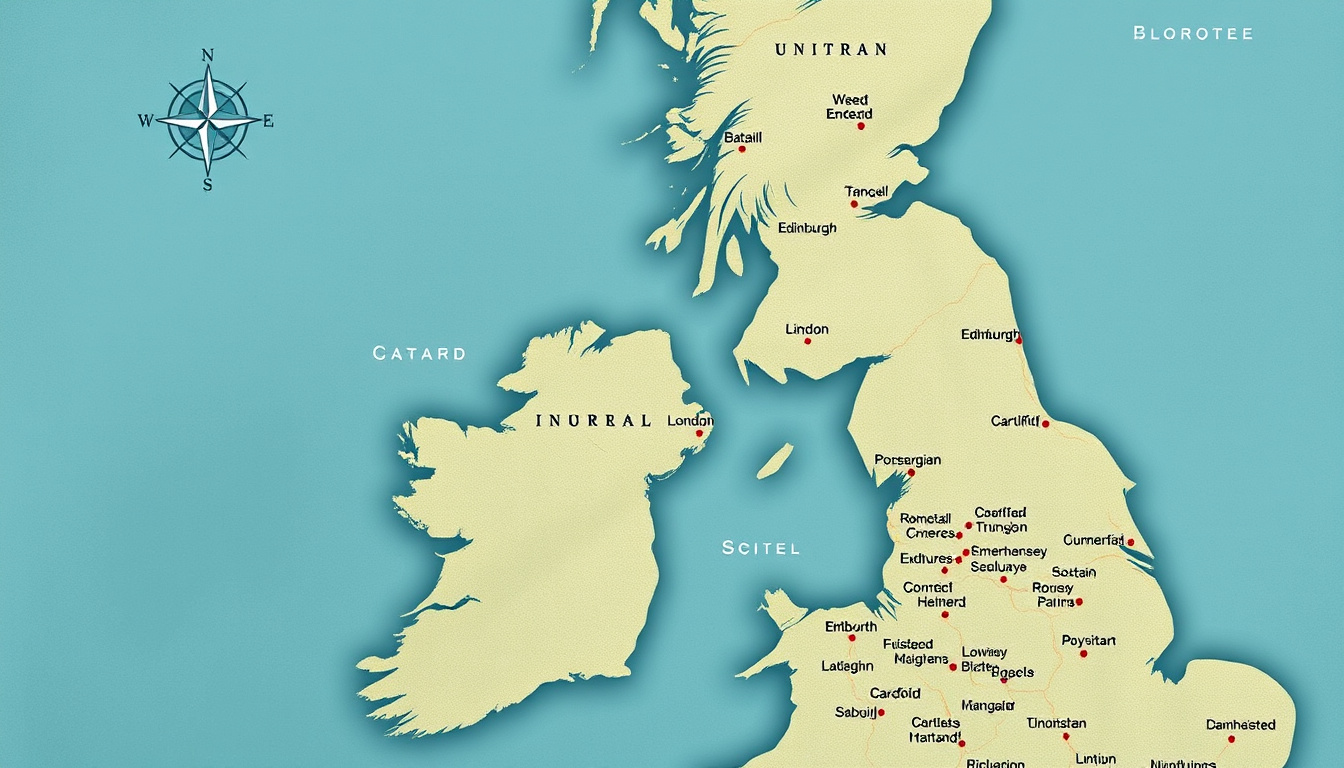

A map of the UK is more than just lines and labels—it’s a guide to four distinct countries, major cities, and the stories that shape British identity. The United Kingdom comprises England, Scotland, Wales, and Northern Ireland (Infoplease), and that geography holds everything from bustling capitals to quiet villages. Here’s what you’ll find across a UK map, from political boundaries to the places people love most.
Countries in the UK: 4 (England, Scotland, Wales, Northern Ireland) ·
Total area: 242,495 km² ·
Population (mid-2023 estimate): 67.7 million ·
Largest city by population: London (8.9 million) ·
Number of major cities (pop. > 250,000): 12+
Quick snapshot
- The UK has four countries: England, Scotland, Wales, Northern Ireland (Infoplease)
- London is the capital and largest city (Infoplease)
- Currency is Pound sterling; driving is on the left (MyTouristMaps)
- Exactly which places rank as “prettiest” varies between surveys (subjective, no single authority)
- Poll results about which country Brits find most attractive shift depending on sample year and methodology
- 1 July 1916 – Battle of the Somme: deadliest day in British military history (National Army Museum)
- 1930s – Failed Anglo-Nazi Pact negotiations shaped Hitler’s view of Britain (Historic UK)
- Printable political and road maps are available from official sources (Geology.com)
- Interactive tourist maps now combine geography with cultural data for better trip planning (Britain Visitor)
The pattern across these four cards: confirmed facts anchor the geography, while the unknowns expose where personal taste replaces hard data.
| Category | Value |
|---|---|
| Capital city | London |
| Countries | England, Scotland, Wales, Northern Ireland |
| Currency | Pound sterling (GBP) |
| Official language | English |
| Time zone | UTC+0 (GMT), UTC+1 (BST in summer) |
What are the 12 major cities in the UK?
The UK has at least a dozen cities with populations exceeding 250,000, forming the backbone of its economy and culture. According to Infoplease, major UK cities include Birmingham, Edinburgh, Manchester, Liverpool, Glasgow, Cardiff, and Belfast, along with London, Sheffield, Leeds, Leicester, and Bristol. Each city brings its own character—from Leeds’ industrial heritage to Bristol’s creative scene.
Cities by population
- London: 8.9 million (largest in the UK, economic and cultural capital)
- Birmingham: about 1.1 million (major manufacturing and transport hub)
- Leeds: roughly 800,000 (financial and legal center in the north (Infoplease))
- Glasgow: around 630,000 (Scotland’s largest city, cultural hotspot)
- Sheffield: ~580,000 (steel industry heritage, now green city)
- Manchester: ~550,000 (music, sport, and tech hub)
- Edinburgh: ~530,000 (Scotland’s capital, festival city)
- Liverpool: ~500,000 (maritime history, Beatles legacy)
- Bristol: ~470,000 (creative industries, aerospace)
- Cardiff: ~360,000 (Welsh capital, castle and waterfront)
- Leicester: ~350,000 (multicultural, historic market town)
- Belfast: ~340,000 (Northern Ireland’s capital, Titanic Quarter)
Where is the prettiest place to live in England?
Beauty is subjective, but several English villages and towns consistently top polls. Surveys like the one by Aston & Co have highlighted destinations such as Castle Combe, Bibury, St Ives, Clovelly, and Haworth. These places share qualities: stone cottages, historic churches, and unspoiled countryside or coastline.
Top-rated villages and towns
- Castle Combe (Wiltshire) – often called “the prettiest village in England”
- Bibury (Cotswolds) – famous for Arlington Row cottages
- St Ives (Cornwall) – coastal beauty with artists’ colony
- Clovelly (Devon) – steep cobbled street leading to a harbour
- Haworth (Yorkshire) – Brontë country, moorland setting
Prettiness isn’t a single metric—what dazzles one traveler may bore another. The best approach is to visit during April–September (MyTouristMaps) and judge for yourself.
Where is the cheapest but nicest place to live in England?
Cost of living varies dramatically across England. Guides such as Taxes for Expats identify towns like Bradford, Hull, Sunderland, and Stoke-on-Trent as offering affordable housing without sacrificing quality of life.
Affordable towns with high livability
- Bradford – low house prices, multicultural food scene
- Hull – regenerated waterfront, low rent
- Sunderland – affordable coastal city
- Stoke-on-Trent – cheap homes, pottery heritage
Low cost often comes with trade-offs: fewer jobs in high‑paying sectors or longer commutes. The catch is that “nice” is relative, and a cheaper postcode may mean less access to green space unless you pick carefully.
What country does the UK like the most?
According to YouGov polling, Brits hold the highest favorability toward Australia, Canada, and the United States. These countries share cultural ties, common language, and diplomatic alliances.
Most favorable international views
- Australia – top rated, warm relationship
- Canada – strong Commonwealth connection
- USA – “special relationship” and defence collaboration
What was the darkest moment in British history?
Several events compete for that title, but military historians point to 1 July 1916—the first day of the Battle of the Somme—as the single deadliest day for British forces. The National Army Museum records nearly 20,000 British soldiers killed on that one day. Other dark chapters include the Great Plague (1665), the Great Fire of London (1666), and the 7 July 2005 London bombings.
Wars and conflicts
- Battle of the Somme (1916) – 57,000 British casualties on day one
- World War II – 450,000 British military and civilian deaths
Social and political low points
- Great Plague of London (1665–66) – killed about 100,000 people
- Anglo-Nazi Pact negotiations (1930s) – Hitler’s view of Britain as a potential ally (Historic UK)
The same nation that endured the Somme also pioneered the welfare state and modern democracy. Dark moments don’t define the UK, but they do shape its cautious, resilient self‑image.
How can I get a printable or detailed map of the UK?
Several reliable sources offer free downloads. Geology.com provides political maps showing boundaries, major roads, and water bodies. For blank outlines used in education, the ONS GeoPortal is the official government resource. Maptitude also offers a printable PDF highlighting cities like Aberdeen, Edinburgh, Glasgow, and Dundee.
Sources for blank and political maps
- Political maps – Geology.com (clear boundaries, city labels)
- Blank outline maps – ONS GeoPortal (free, editable shapefiles)
- Road maps with distances – Britain Visitor (detailed A-road information)
A political map is great for boundaries but useless for hiking; a physical map shows terrain but not city streets. Decide your use—navigation, study, or trip planning—then pick the right type.
Timeline: key moments that shaped the UK’s map and identity
- 1 July 1916 – Battle of the Somme begins, darkest day for British troops (National Army Museum)
- 1665–1666 – Great Plague of London followed by the Great Fire
- 1930s – Failed Anglo-Nazi Pact negotiations shape Hitler’s view of Britain (Historic UK)
- 7 July 2005 – London bombings, coordinated terrorist attack
These events explain why British maps often include war memorials, and why public perception of the UK abroad is colored by resilience in the face of tragedy.
Clarity: what’s confirmed and what’s unclear
Confirmed facts
- The UK consists of four countries: England, Scotland, Wales, and Northern Ireland (Infoplease)
- London is the most populated city in the UK (Infoplease)
- The Battle of the Somme (1916) is the single deadliest day in British military history (National Army Museum)
What’s unclear
- Exact rankings of “prettiest places” vary among surveys (subjective)
- Poll results on which country Brits find most attractive depend on sample and year
- Which town is “cheapest but nicest” depends on personal definition of “nice”
The implication: what the data confirms is geographic and historical; what remains unclear is almost always a matter of personal preference or polling methodology.
“The Battle of the Somme remains the worst day in the history of the British Army.”
National Army Museum
“Hitler saw Britain as a potential ally that could be convinced to stay out of a European war.”
Historic UK
The pattern emerging from both the map and the perceptions is clear: the UK is a compact but hugely varied land, where four countries share a small island, and where history has left deep marks on both the landscape and the national psyche. For anyone planning a move or a visit, the implication is simple—use a detailed political map to understand boundaries, but also look at cultural surveys and cost-of-living data to find the place that fits. For a traveller, the choice is between city energy and village calm; for a resident, between affordability and amenities. Either way, the map is only the starting point.
Related reading: East Croydon Train Station · Bristol Temple Meads Station
Frequently asked questions
What is the most detailed map of the UK available online?
Political maps from Geology.com and road maps from Britain Visitor are among the most detailed for general use. For official boundaries, the ONS GeoPortal provides authoritative shapefiles.
Where can I download a blank map of the UK?
The ONS GeoPortal offers free blank outline maps suitable for education or labelling.
How many cities in the UK have a population over 1 million?
Only London exceeds 1 million. Birmingham comes closest with about 1.1 million, but still under 1.2 million.
What is the prettiest village in the UK according to surveys?
Castle Combe and Bibury frequently top lists, but rankings vary. Surveys like Aston & Co often include both.
Which country does the UK have the strongest alliance with?
The United States is the UK’s closest military and intelligence partner (the “special relationship”), followed by Australia and Canada per YouGov polling.
Is it cheaper to live in England or Scotland?
Scotland generally offers lower housing costs than southern England, especially in cities like Glasgow and Dundee compared to London or the South East.
What is the worst area to buy property in the UK in 2026?
No single area is “worst”; it depends on budget and priorities. Health warnings often point to post-industrial towns with slow job growth, but each buyer’s situation differs.

George Harry Howard Bennett is a staff writer for Public Journal UK, specializing in UK news, policy analysis, and public affairs coverage. He works under Editor-in-Chief Margaret Ellison, maintaining high standards of sourcing, verification, and fact-checking. Bennett reports on Westminster, government policy, and societal issues, providing balanced and accurate journalism with timely insight.