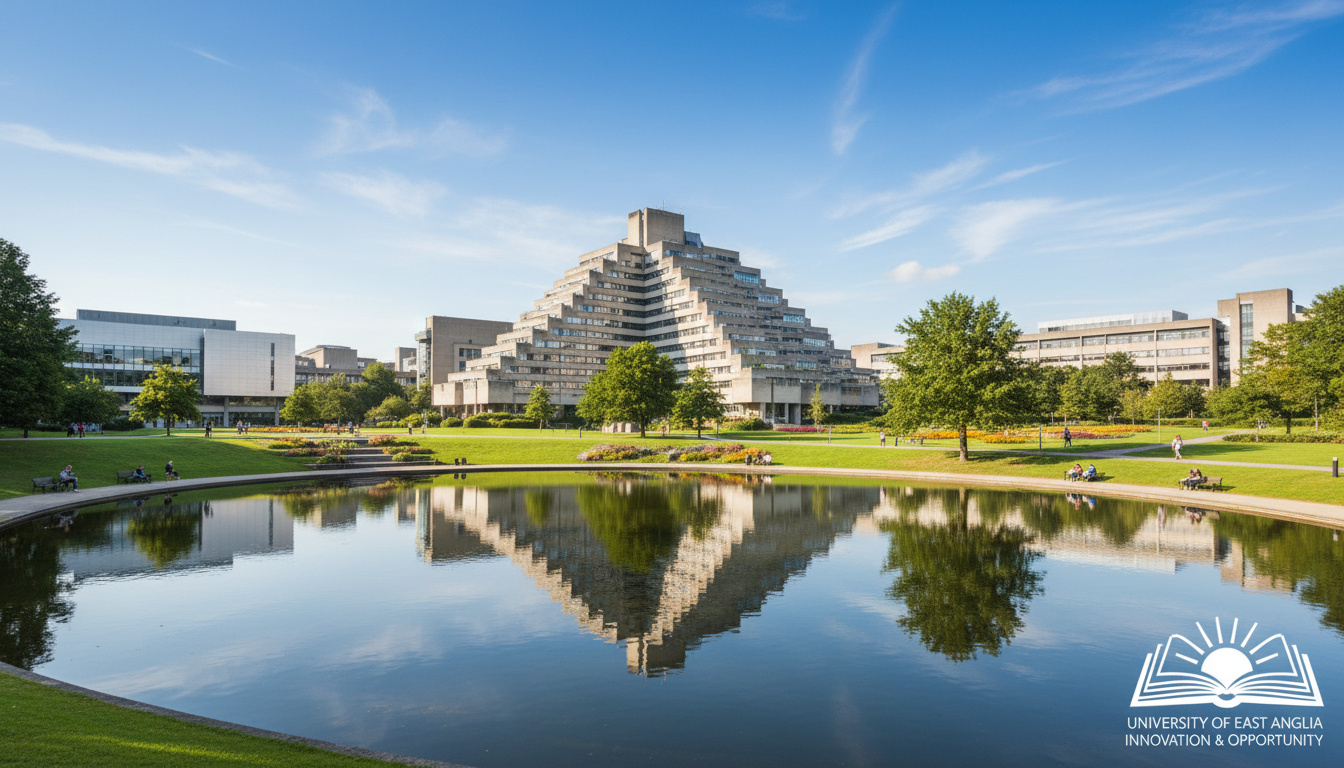
The University of East Anglia (UEA) stands as a public research university founded in 1963, occupying a self-contained campus approximately three miles from Norwich city centre in Norfolk, England. Established during the era of British “plate-glass universities,” UEA has developed distinct international recognition for its contributions to environmental sciences and creative writing, alongside a broader portfolio of undergraduate and postgraduate programmes.
Enrolling approximately 17,500 students from over 100 countries, the institution combines modern campus architecture—most notably its Grade II-listed ziggurat residences—with extensive research facilities including the Tyndall Centre for Climate Change Research. The Complete University Guide 2026 ranks the university 26th nationally, while global metrics place it within the top 1.5% of universities worldwide.
Prospective applicants encounter a selective but accessible admissions environment, with particular competitiveness for courses such as Medicine and Creative Writing. The campus setting provides integrated academic, residential, and recreational facilities alongside proximity to the historic city of Norwich.
Where is the University of East Anglia Located and When Was It Founded?
Norwich, Norfolk, UK
1963
~17,500
Creative Writing & Environmental Sciences
Key Institutional Insights
- Established Reputation: Ranked 26th out of 130 UK universities in the Complete University Guide 2026.
- Global Standing: Positioned at approximately 332nd in the QS World University Rankings 2025 and 319th in the CWUR 2025 rankings.
- Sustainability Leadership: Ranked 54th globally in the QS Sustainability Rankings 2025, placing 18th in the UK.
- Research Excellence: Holds 17th position in the UK for research quality according to the Complete University Guide 2026.
- Historic Campus: Features distinctive 1970s ziggurat architecture set within parkland and lake surroundings.
- International Profile: Hosts students from over 100 countries, contributing to a diverse academic community.
- Selective Admissions: Maintains entry standards ranked 48th nationally, with estimated offer rates between 60-80% for most programmes.
Institutional Facts at a Glance
| Founded | 1963 |
| Location | Norwich, Norfolk, East of England |
| Campus Type | Self-contained, parkland campus |
| QS World Ranking 2025 | ~332nd |
| CWUR World Ranking 2025 | 319th (UK 25th) |
| Complete University Guide 2026 (UK) | 26th |
| Student Population | Approximately 17,500 |
| International Representation | 100+ countries |
| Estimated Acceptance Rate | 60-80% (varies by course) |
| Undergraduate International Fees (2025/26) | £19,000 – £28,000+ per year |
| Postgraduate International Fees (2025/26) | £20,000 – £30,000+ per year |
| Research Quality Rank (UK) | 17th |
What is the University of East Anglia Ranking and Reputation?
UEA occupies a consistent position within the upper tier of British higher education, regularly appearing in the top 30 of domestic league tables while maintaining a presence in the top 350 of global rankings. The institution’s reputation derives particularly from concentrated excellence in specific disciplines rather than broad-based comprehensive dominance.
National and Global Standing
Domestic metrics place UEA at 26th position nationally according to the Complete University Guide 2026, though other UK tables vary, with The Times and Sunday Times Good University Guide 2025 positioning the institution around 40th. The Guardian University Guide 2025 places UEA in the mid-30s, reflecting slight variations in methodology between ranking organisations.
Internationally, the CWUR 2025 rankings position UEA at 319th globally and 25th in the United Kingdom, placing the institution within the top 1.5% of universities worldwide. The QS World University Rankings 2025 place the university at approximately 332nd globally, while the Times Higher Education World University Rankings 2026 situate UEA within the 251-300 band.
UEA achieved 54th position globally in the QS Sustainability Rankings 2025, ranking 18th among UK institutions. This performance reflects the university’s established research infrastructure in climate science and environmental studies, including the Tyndall Centre for Climate Change Research.
Subject-Specific Excellence
The university’s research quality ranks 17th in the UK according to the Complete University Guide 2026, underpinning its strong performance in specific academic fields. Environmental Sciences and Geology feature particularly prominently, with The Times Good University Guide ranking Geology 5th nationally. The ShanghaiRanking 2025 places Public Health within the global top 100, while Environmental Sciences maintain positions within the top 150 worldwide.
Creative Writing represents perhaps the most internationally recognised programme, with the MA Creative Writing established as one of the first of its kind globally. Times Higher Education subject rankings place Social Work between 10th and 14th in the UK, while Business and Economics subjects appear in the 201+ band globally.
What Courses Does the University of East Anglia Offer?
UEA delivers a comprehensive range of undergraduate and postgraduate programmes across arts, humanities, sciences, and professional disciplines. The curriculum structure emphasises interdisciplinary study, reflecting the institution’s founding ethos as a “plate-glass university” focused on innovative teaching methods.
Undergraduate Programmes
Bachelor’s degrees span traditional arts and humanities, laboratory sciences, computing, health professions, and social sciences. Classroom-based programmes in arts and humanities typically incur lower tuition fees for international students, ranging from approximately £19,000 to £21,000 annually, while laboratory-based science, health, and computing courses range from £22,000 to £28,000 or higher.
Postgraduate Opportunities
Taught master’s programmes follow similar banding, with arts, humanities, and social sciences generally falling between £20,000 and £23,000 per year, and science, health, and business programmes extending from £23,000 to £30,000 or above. Research degrees (MPhil, PhD) operate through specific departmental structures with individual fee schedules.
The MA Creative Writing programme maintains highly competitive entry standards, typically requiring a strong undergraduate degree (minimum 2:1 or equivalent) accompanied by a substantial portfolio of creative work demonstrating publication potential or artistic merit. Graduates include Nobel laureate Kazuo Ishiguro and Booker Prize winner Ian McEwan.
Flagship Disciplines
Environmental Sciences and Climate Change Studies benefit from the on-campus Tyndall Centre, offering specialised pathways in Earth Sciences, meteorology, and sustainability. Life Sciences programmes incorporate strong research links with the Norwich Research Park, while Public Health recently achieved top-100 global recognition in the ShanghaiRanking 2025.
How Do You Apply to the University of East Anglia?
Application procedures differ significantly between undergraduate and postgraduate study, with distinct portals, documentation requirements, and deadline structures. International applicants must additionally demonstrate English language proficiency and provide credential equivalency documentation.
Undergraduate Admissions
All undergraduate applications route through the UCAS system. Candidates submit personal statements, academic transcripts, references, and predicted or achieved grades. Non-UK qualifications undergo assessment against A-level or International Baccalaureate equivalency criteria. Specific programmes—particularly Medicine, some health sciences, and creative subjects—require supplementary assessments including interviews, portfolios, or auditions.
Medicine courses and programmes at Oxford and Cambridge require UCAS submission by mid-October. Most other UEA undergraduate courses accept applications until late January, though international students should verify specific dates for visa processing timelines.
Postgraduate Applications
Master’s and doctoral candidates apply directly through UEA’s online application portal. Required materials include academic certificates, curriculum vitae, personal statements or research proposals, and two academic references. The Creative Writing MA and similar prestigious programmes demand extensive writing samples alongside standard documentation.
English language requirements typically mandate IELTS, TOEFL, or PTE scores unless applicants have completed previous degrees in English-speaking countries. Exact grade thresholds vary by programme intensity and subject matter.
How Has the University of East Anglia Developed Since Its Founding?
UEA’s six-decade history traces the evolution of British higher education from the expansionist 1960s through to contemporary research-intensive status.
- : Founded as part of the UK government’s expansion of higher education, establishing the “plate-glass university” model with innovative interdisciplinary structures.
- : Construction of the distinctive ziggurat residences, designed by Denys Lasdun, later awarded Grade II listed status for their brutalist architectural significance.
- : Opening of the Sainsbury Centre for Visual Arts, housing the Robert and Lisa Sainsbury Collection and establishing UEA as a cultural destination.
- : Establishment of the MA Creative Writing programme, later producing multiple Booker Prize and Nobel Prize laureates including Kazuo Ishiguro and Ian McEwan.
- : Launch of the Tyndall Centre for Climate Change Research, consolidating the university’s leadership in environmental science.
- : Achievement of 54th position in the QS Sustainability Rankings and 319th in the CWUR World Rankings, reflecting sustained research impact.
What Information Is Definitively Established and What Remains Variable?
Prospective students encounter varying degrees of certainty regarding institutional data, necessitating careful verification of specific claims.
| Established Facts | Uncertain or Variable Information |
|---|---|
| Founded in 1963 as a plate-glass university | Exact acceptance rate percentages (not officially published) |
| Located in Norwich, Norfolk, with single campus | Precise 2025/26 tuition fees (subject to annual review) |
| QS World Ranking 2025: approximately 332nd | Specific entry requirements vary significantly by course |
| CWUR 2025: World rank 319, UK rank 25 | Accommodation availability guarantees beyond first year |
| Complete University Guide 2026: 26th in UK | Future ranking positions (fluctuate annually) |
| Home to Tyndall Centre and Sainsbury Centre | Individual scholarship availability amounts |
| MA Creative Writing internationally prestigious | Specific post-graduation employment rates by cohort |
What is the Historical Context of the University of East Anglia?
UEA emerged during a transformative period in British education policy, when the government authorised new universities outside traditional collegiate structures. The “plate-glass university” designation reflected modernist architectural trends and experimental academic organisation, distinguishing these institutions from ancient and red-brick predecessors.
The campus design by architect Denys Lasdun prioritised integration with the surrounding Norfolk landscape, incorporating the university lake and extensive green spaces while maintaining concrete brutalist residential blocks. This physical environment supported an interdisciplinary academic culture, facilitating the later development of cross-cutting research centres such as the Tyndall Centre for Climate Change Research.
The institution’s growth parallels broader trends in UK higher education internationalisation, expanding from primarily domestic intake to the current composition representing over 100 countries. This evolution reflects similar trajectories followed by contemporaneous foundations such as those examined in La Gazzetta Dello Sport – Italy’s Iconic Pink Sports Newspaper, documenting institutional development over decades.
What Do Authority Sources Report About University Performance?
Independent ranking organisations provide consistent validation of UEA’s research standing and student experience metrics.
UEA is a highly ranked campus university with strong research quality and excellent facilities, consistently appearing in the top 30 UK universities in major domestic rankings.
— Complete University Guide
The University of East Anglia ranks 319th in the world and 25th in the United Kingdom, placing it in the top 1.5% of universities worldwide based on quality of education, alumni employment, quality of faculty, and research performance.
— Center for World University Rankings 2025
UEA offers a self-contained campus experience approximately 15-30 minutes from Norwich city centre, noted for its distinctive architecture and the Sainsbury Centre for Visual Arts.
— Times Higher Education
Is University of East Anglia a Good Choice for Higher Education?
The University of East Anglia represents a strong selection for students prioritising research-intensive teaching within a compact campus environment, particularly those pursuing environmental sciences, creative writing, or public health. With confirmed top-30 UK status, global top-350 positioning, and specialised excellence in sustainability and climate research, UEA offers distinct advantages over larger, less focused institutions. The campus setting provides integrated academic and social infrastructure while maintaining proximity to the historic city of Norwich. Prospective applicants should verify specific course requirements and fee structures directly with the institution, as demonstrated by the detailed market analysis available in Serabi Gold Share Price – 320 GBX Levels, Trends and Analysis, which illustrates the importance of verifying current data before making investment decisions.
Frequently Asked Questions
What are the tuition fees for international students at UEA?
International undergraduate fees range from £19,000 to £28,000+ annually, while postgraduate taught programmes cost £20,000 to £30,000+ depending on subject classification. Arts and humanities typically fall at the lower end, laboratory sciences at the higher.
Who are notable University of East Anglia alumni?
Distinguished graduates include Nobel Prize-winning novelist Kazuo Ishiguro, Booker Prize winners Ian McEwan and Anne Enright, actor Matt Smith, artist Grayson Perry, and novelist Tracy Chevalier, reflecting the institution’s strength in creative industries.
What accommodation options exist at UEA?
The university provides on-campus standard rooms, en-suite options, townhouses, and self-catered flats, with typical weekly costs between £120 and £200+. First-year undergraduates and many international students receive accommodation guarantees subject to application deadlines.
What is the University of East Anglia acceptance rate?
UEA does not publish official acceptance rates. Based on UCAS patterns for comparable institutions, estimates suggest 60-80% offer rates for many courses, though Medicine and Creative Writing demonstrate significantly higher competition.
What is student life like at UEA?
The self-contained campus features the Students’ Union, UEA LCR music venue, Sportspark facilities, and the Sainsbury Centre museum. Norwich offers historic city amenities, nightlife, and access to Norfolk Broads and coastal areas.
How does UEA rank for Environmental Sciences?
The university ranks 5th nationally for Geology, with Environmental Sciences positioned within the global top 150-200. The on-campus Tyndall Centre for Climate Change Research supports this research excellence.

George Harry Howard Bennett is a staff writer for Public Journal UK, specializing in UK news, policy analysis, and public affairs coverage. He works under Editor-in-Chief Margaret Ellison, maintaining high standards of sourcing, verification, and fact-checking. Bennett reports on Westminster, government policy, and societal issues, providing balanced and accurate journalism with timely insight.