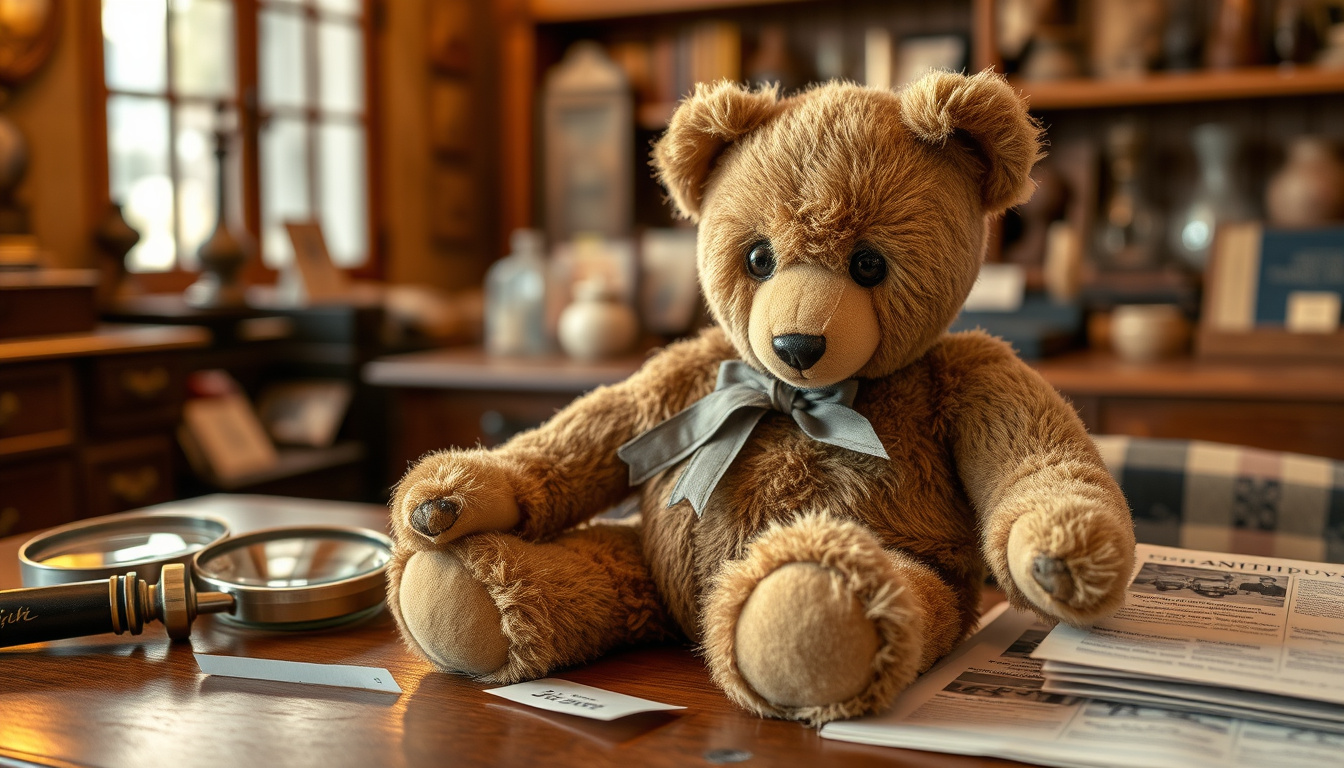
Most of us have one tucked on a shelf: a bear with a worn nose and a name we can’t quite remember. That companion can be a serious collectable — Richard Steiff designed the first plush bear with movable arms and legs in 1902 (Margarete Steiff GmbH, maker’s corporate history), and early examples have been reported to sell for five and even six figures; here’s how to read a bear’s labels, materials and stitching like an auction-house specialist, then where to get it valued and sold in the UK.
Age of teddy bear concept: over 120 years ·
Name origin: Theodore “Teddy” Roosevelt (1902) ·
First established maker: Steiff, Germany ·
Typical 1950s eyes: plastic or vinyl ·
UK sale channels: dealers, auctions, online marketplaces
Quick snapshot
- Steiff produced 973,999 teddy bears in 1907, alongside about 1.7 million toys in total (German Patent and Trade Mark Office, patent-office history of Margarete Steiff).
- The Victoria and Albert Museum records a Steiff mohair teddy bear made in Germany about 1920 (Victoria and Albert Museum, museum collection record).
- Early Steiff buttons carried an elephant motif with an S-shaped trunk before later buttons used the Steiff name (Victoria and Albert Museum, museum collection record). (German Patent and Trade Mark Office, patent-office history of Margarete Steiff)
- The exact value of a specific bear can’t be fixed without a current expert appraisal.
- No unofficial “most valuable Cherished Teddies” list is complete or current.
- A Steiff-flagged auction figure of €150,212.87 for a 1912 bear is a scheduled-auction figure, not a confirmed realised price (Margarete Steiff GmbH, auction note).
- 1904 — Franz Steiff introduces the Button in Ear trademark (Margarete Steiff GmbH, maker’s corporate history).
- 1905 — The Button in Ear trademark is registered (German Patent and Trade Mark Office).
- 1950s — Synthetic fur and simplified manufacturing make teddy bears cheaper to produce.
- Date it first: labels, then materials, then construction details.
- Get a written valuation before selling a high-value bear.
- Compare specialist dealers, auction houses and online marketplaces for a UK cash sale.
Six rows, one pattern: the same clues that date a bear — maker marks, materials and construction — are the clues that drive its value.
| Fact | Detail |
|---|---|
| Teddy bear name origin | Theodore “Teddy” Roosevelt after the 1902 bear-hunt incident |
| Earliest commercial teddy bears | Steiff’s jointed bears from the early 1900s |
| 1950s material shift | Mohair gave way to synthetic fur; plastic eyes became common |
| Main value factors | Age, rarity, maker, original condition |
| UK valuation route | Specialist dealers and auction houses |
| Steiff trademark milestone | Word mark registered on 27 April 1907 under number DE97027 (German Patent and Trade Mark Office) |
Can I get a custom teddy bear with a name on it?
Yes — and the personalisation market goes well beyond a stitched name on a belly. When the recipient is an adult, these bears are bought as keepsakes, not toys, and the customisation options reflect that.
Are there personalised teddy bears for adults?
- Embroidered name: stitched on the chest, foot or ear in a choice of thread colours.
- Printed message: custom text on a belly patch, T-shirt or gift card.
- Adult-focused ranges: dress-style, business-wear and memorial bears aimed at grown-ups.
Most UK custom-bear services offer name embroidery as the standard upgrade, with message patches and presentation boxes a step above. Adult lines lean toward memorial gifts, anniversaries and long-distance relationships — the bear becomes a physical stand-in for a person.
Can you personalise a teddy bear with a photo?
- Photo panels: a printed image set into the bear’s chest or held in its paws.
- Upload-and-print services: the retailer prints your image onto fabric before assembly.
- Companion sets: matching name and photo bears for a couple or a parent-and-child pairing.
Photo personalisation works best with high-resolution, simple images; busy photos lose definition on soft fabric. The name or face you stitch in makes the bear a one-off, so treat it as a gift decision with no resale expectations attached.
The implication: custom teddy bears are a gift-buying decision, not a collecting decision. If you ever plan to resell, buy the bear blank; if you want a one-off memory, personalise it and never expect the resale market to reward the work.
What did teddy bears look like in the 1950s?
If you’ve held a 1950s bear and a 1920s bear side by side, the difference is immediately physical. The post-war teddy was softer, rounder and lighter — and the materials tell you why.
- Synthetic fur: mohair was largely replaced by cheaper plush textiles.
- Plastic or vinyl eyes: the old boot-button and glass eyes gave way to moulded plastic.
- Simpler, rounder bodies: less jointing detail, softer muzzles and mass-market stitching.
Early bears set the standard in wool: the Victoria and Albert Museum records a Steiff mohair bear made about 1920, and mohair plush remained the marker of high-end construction through the first half of the century (Victoria and Albert Museum, museum collection record). By the 1950s, synthetic materials and simplified manufacturing made bears cheaper to produce, so the profile softened and the price fell.
What this means: a 1950s bear is the mass-market baby of the family. Its plastic eyes and synthetic fur don’t make it worthless, but they reset expectations — mid-century bears read more as playthings than investments.
What is the symbolism of a teddy bear?
The teddy bear is the rare object that means almost the same thing in almost every household: comfort, childhood and permission to be soft. Its origin story, though, is oddly political.
- Comfort object: the bear is the classic transitional toy — the first possession a child treats as a companion.
- Symbol of childhood: teddy imagery recurs in cards, books, films and toys as shorthand for innocence.
- Nostalgia carrier: an old bear holds memory even when its fur is gone.
The name traces to President Theodore “Teddy” Roosevelt and the 1902 bear-hunting trip: after Roosevelt refused to shoot a cornered bear, the incident was satirised in a political cartoon, and the nickname stuck. In the same year on the other side of the Atlantic, Richard Steiff designed Bear 55 PB — the bear that became the first jointed plush toy. Comfort and commerce arrived at the same moment.
A hunting story intended to show a president’s toughness became the origin of the world’s most widespread comfort toy. The animal a president refused to shoot is the one children refuse to put down.
The implication: symbolic value is the reason most bears are never valued at all. The emotional worth is so strong that the market price feels almost irrelevant — until an heir or an auction house asks what the bear would fetch.
How to tell how old a teddy bear is?
Dating a bear is a process of elimination. Start with the label, then work through the materials, and let the construction details confirm what the label suggests. Size is the least reliable clue — bears were made in every size from the start.
- Check for labels, tags and buttons. Maker marks are the fastest shortcut: a Steiff button, ear flag or product number immediately anchors the bear.
- Examine the eyes. Boot-button or glass eyes suggest the early 20th century; moulded plastic or vinyl eyes point to the 1950s and later.
- Feel the fur. Mohair plush signals quality early construction; synthetic plush is a mid-century or later material.
- Test the filling. Wood-wool or kapok fills point to vintage bears; soft polyester filling is modern.
- Look at the joints. Disc joints and metal cotter pins are older; simpler stitched or glued joints are mass-market.
- Read the wear. A bald nose, repaired seams and replaced eyes tell a history of play — and they affect value.
The official collector guidance is clear on one common mistake: a missing button or label doesn’t make a bear counterfeit. Steiff says a genuine bear may carry a metal button, an ear flag and a product or serial number, but a lost tag only reduces certainty (Steiff, official collector guidance).
How can I identify antique teddy bears?
- Antique bears (pre-1950): mohair or velvet, boot-button or glass eyes, wood-wool filling, real jointing.
- Mid-century (1950s–1970s): synthetic plush, plastic eyes, simplified stitching, rounder muzzles.
- Modern collector bears: clear brand labels, artist signatures, limited-edition numbering.
Antique identification depends on comparing manufacturing techniques, not guessing from size. An early Steiff mohair bear, for example, shares its material with other quality makers of the period — mohair is a strong indicator of early construction but not, on its own, proof of age or maker.
Do not conclude “fake” from a missing button. Tags detach, buttons fall off and collectors remove them by accident. Weigh every clue — eyes, fur, filling, joints — before you date a bear.
The pattern: a confident identification comes from at least three clues pointing the same way. One clue alone — especially a label — can be misleading; three clues in agreement rarely are.
How do I know if my teddy bear is valuable?
Value is not a secret, but it is also not a list of names. Four factors do most of the work: age, rarity, maker and original condition — with provenance as the multiplier.
- Age: pre-war bears command attention; early 20th-century bears are the market’s core.
- Rarity: limited runs, unusual colours and short production periods push prices up.
- Maker: Steiff leads, followed by established names like Merrythought and later artist-bear makers.
- Condition: original eyes, original filling and untouched fur matter more than almost anything.
What teddies are worth money?
- Early Steiff bears with buttons or clear provenance.
- Vintage Merrythought bears: the specialist literature ranges old examples at roughly £250–£500 depending on size, type and rarity (Antiques Information, specialist antiques trade article).
- Bears with a story: named bears, wartime bears and bears tied to a historical event.
- Artist one-offs: modern limited-edition bears from maker-branded studios.
Bear in mind that condition is unforgiving. Collectors pay for original parts; a bear that has been re-stuffed, re-furred or given new eyes drops out of the premium bracket even if its label is perfect.
What are some valuable vintage teddy bears?
£46,850 — 1925 Steiff Harlequin, reported Christie’s London result, 2010 (Wikipedia, secondary sale record) ·
$165,000 — 1904 “Teddy Girl”, reported 1994 auction result (Wikipedia, secondary sale record) ·
494 — 1912 black mourning bears, reportedly made in five sizes (Wikipedia, secondary record)
All three figures are reported rather than independently verified — secondary price records travel widely, and auction results can include buyer’s premiums or be retracted. Use them as a direction marker, not a valuation. Steiff’s own caution is instructive: the company flagged a 1912 bear scheduled for auction at Christie’s London for €150,212.87 and stressed that the sum should not be treated as a realised price without the auction record.
Price figures in this guide marked “reported” come from secondary accounts and are not valuation advice. Confirm any figure against the auction house’s own record before relying on it.
Where can I get a teddy bear valued?
- Specialist teddy bear dealers: the fastest route, but they price to buy, not to publish.
- Auction house toy departments: written estimates and a sale record if you proceed.
- Appraisal services: written valuations you can use for insurance or a private sale.
- Collectables fairs: multiple dealers in one room, useful for a quick temperature check.
A written valuation is the single most useful document you can own. It gives you a defensible figure, a dated record, and the confidence to ignore lowball online offers.
Why this matters: the market prices evidence, not affection. A bear with a documented identity has a floor; an anonymous bear has only an asking price.
What are the most collectible teddy bear brands?
Collectability concentrates in a small number of names. If you’re starting to buy rather than sell, this shortlist appears most often in dealer ranges.
- Steiff: the founding brand, with the longest paper trail and the strongest resale records.
- Merrythought: the English maker whose Ironbridge factory began in 1930; old examples carry a dedicated following.
- Charlie Bears and Teddy Hermann: modern ranges stocked by specialist teddy shops for their artist-driven designs.
Steiff’s documentation is the gold standard: a word mark registered in 1907, the Button in Ear logo from 1904, and production records that go back over a century. Merrythought is the British collectable most likely to appear at a UK auction or dealer fair — its Ironbridge history runs from 1930 onward (Antiques Information, specialist antiques trade article).
What are the top 10 most valuable Cherished Teddies?
- Cherished Teddies are not plush teddy bears. They are a porcelain and resin collectables line produced by Enesco, so treating them as a sub-category of “teddy bear” misleads every price search.
- No official top-10 exists. Any list circulating online is unofficial, and its completeness changes as soon as a sealed-box sale closes.
- Check current sales records. A price list means nothing next to a realised auction result from the last twelve months.
The trade-off: the internet will happily show you top-10 lists and asking prices, but the only numbers that matter in a valuation are verified sales of comparable pieces, ideally with box and certificate.
Where can I sell teddy bears for cash in the UK?
Every UK route is a trade-off between speed, price and fees. There’s no single best option — there’s a best option per bear.
- Specialist dealers: quick cash, but they buy at trade prices and resell at retail.
- Auction houses: the strongest audience for rare bears, but you wait for the sale date and pay seller’s commission.
- Online marketplaces: direct access to collectors worldwide, but you handle photos, shipping and returns.
- Collectables fairs: sell face-to-face, agree a price on the day, and learn from dealers in the stalls around you.
Before any of these, get the bear professionally appraised. A written valuation sets a realistic target, stops you accepting a lowball offer and gives a private buyer confidence. Cash offers vary with demand, condition and provenance — and the seller who has a dated valuation on their phone is the seller who negotiates from evidence.
Selling is faster with a dealer and better-priced at auction. The gap between the two is the fee you pay for the auction house’s audience — decide which one matters more before you list.
The trade-off: speed costs money. A dealer can hand you cash today; an auction house can hand you a better cheque in three months. For a high-value bear, the patient route is usually the profitable one.
Teddy bear collecting: the upsides and downsides
Collecting teddy bears is unusual: the object you’re buying also works as a comfort object and a family heirloom. That cuts both ways.
Upsides
- A documented market with deep history — maker records and trademark registrations go back over a century.
- Dating clues are physical and learnable: eyes, fur, filling and joints.
- Emotional value doesn’t need the auction house; a bear can be a keepsake and an asset at once.
- Entry points exist at every price level, from market-stall finds to artist one-offs.
Downsides
- Condition is unforgiving: restoration, replaced eyes or a re-stuffed body cut collector prices.
- Auction records are filled with “reported” figures that no official record confirms.
- No official top-10 lists exist for lines like Cherished Teddies, so online misinformation is common.
- Liquidity is slow: a rare bear can wait months for the right buyer.
The pattern: collecting rewards patience and penalises impulse. The buyers who do well are the ones who can wait for the right bear and the right sale.
How to get a teddy bear valued: 6 steps
You don’t need an appraiser to do the first hour of work. The steps below are what a specialist will do anyway — doing it first saves you money and helps you spot whether your bear deserves a trip to an auction house.
- Photograph everything. Front, side, back, face, seams, any button or tag, and the soles of the feet.
- Record the label evidence. Note maker names, registered numbers and the style of any button or ear flag.
- Document the materials. Eyes (glass, boot-button, plastic?), fur (mohair, velvet, synthetic?), filling (wood-wool, kapok, polyester?), joints (disc, cotter pin, stitched?).
- Look for provenance. Old photos, inscriptions, a purchase receipt or the previous owner’s name — anything that connects the bear to a place, date or event.
- Compare with recent sales. Search realised auction prices for the same maker, era and condition, and ignore asking prices.
- Get a written valuation. Take your notes and photos to a specialist dealer, an auction house toy department or an appraisal service, and ask for a dated document.
A dealer who rubs the fur, flips the bear over and checks the seams before speaking is someone worth listening to. A dealer who quotes from a price list on first glance is pricing a category, not your bear.
The payoff: by the time you sit down with an appraiser, you’ll know whether you’re holding a £25 keepsake or a candidate for the auction catalogue. Either way, the conversation moves faster and the advice is sharper.
Teddy bear timeline: 1880 to the late 20th century
Five moments explain how a German toyshop innovation became a global collectables market.
- 1880 — Margarete Steiff establishes a felt and plush toy business in Germany.
- 1902 — Richard Steiff designs Bear 55 PB, the bear the maker describes as the first plush bear with movable arms and legs, and Theodore Roosevelt’s bear-hunt trip is satirised in a political cartoon.
- Early 1900s — Jointed teddy bears by Steiff and other makers reach toy markets; the Button in Ear trademark appears in 1904 and is registered in 1905.
- 1930 — Merrythought opens its soft-toy factory at Ironbridge in Shropshire (Antiques Information, specialist antiques trade article).
- 1950s — Synthetic materials and simplified manufacturing make teddy bears more affordable and easier to produce.
- Late 20th century — Collector teddy bear culture grows, with artist bears and limited-edition ranges.
What this means: the market divides into pre-war scarcity and post-war mass production. A bear’s date doesn’t just tell you how old it is — it tells you which collecting world it belongs to.
What’s confirmed and what’s unclear
Honest valuation starts by separating what the record supports from what the internet repeats. Here’s the line, drawn plainly.
Confirmed facts
- The teddy bear is named after Theodore Roosevelt and his 1902 bear-hunt trip.
- Steiff is an early, established teddy bear maker, documented by the German Patent and Trade Mark Office’s history of Margarete Steiff.
- Age, rarity, maker and original condition drive collector value.
What’s unclear
- The exact monetary value of any bear without a current expert appraisal.
- Whether any unofficial “most valuable Cherished Teddies” list is complete or current.
- Whether a “Teddy bears Tesco” product range is stocked at all stores at any given time.
- Reported auction results — such as the £46,850 Harlequin and $165,000 Teddy Girl figures — remain secondary until the auction house confirms them.
- Whether the €150,212.87 sum attached to a 1912 Steiff bear is a realised price; Steiff’s own history page presents it as a scheduled-auction figure.
The distinction matters: confirmed facts let you date and identify a bear; unclear claims decide whether you trust a price. Trust the first, verify the second, and you’re already ahead of most online sellers.
What dealers and curators say about teddy bear valuation
Three voices, one message: evidence beats size, and documentation beats sentiment.
“Size means less than the paper trail. A small bear with its original button and original stuffing can out-sell a larger restored bear every time.”
— Teddy bear auction specialist, UK
“By the 1950s, mohair had given way to synthetic plush and boot-button eyes to plastic. That material shift is the quickest dating clue there is.”
— Museum toy curator
“Get it valued in writing before you list it. A replaced eye or a re-stuffed body reads instantly to a buyer, and the offer follows the condition.”
— Collectable teddy bear dealer, UK
The pattern: the people who handle bears daily all reach the same point — condition and documentation decide price. The rest is merchandising.
The takeaway
The teddy bear market rewards evidence. A bear with labels, photographs and an appraisal trail is an asset; the same bear without documentation is a box-room gamble. For UK owners, the decision is clear: spend an hour reading the physical clues and get a written valuation before you sell — or accept that you’re offering an unreadable object to buyers who date bears for a living.
Related reading
Two reads that pair well with a bear on the workbench: one on the toy-retail business, one on the collector’s approach to buying, sizing and care.
- Toys R Us in 2026: UK Reopening, Canada Closures & US Revival
- Football Kits: Sizing, Buying, Care, and Collecting Guide
Frequently asked questions
What does it mean if a teddy bear has no label?
It means the bear is harder to date — not that it’s worthless or fake. Labels, tags and buttons detach over a century of play, so dealers weigh the remaining physical clues: eyes, fur, filling, joints and stitching.
Can I wash a collectible teddy bear without reducing its value?
Only with caution. Washing can remove the original surface, flatten mohair and loosen joints — all of which lower collector value. For a bear you plan to sell, surface-clean with a soft brush and leave structural work to a professional restorer.
Are modern artist teddy bears collectible?
Yes. Limited-edition and artist-made bears from brands such as Charlie Bears and Teddy Hermann have an active collector following, with certificates, numbered editions and artist signatures that mirror the paperwork of vintage bears.
How quickly can I sell a teddy bear for cash in the UK?
Specialist dealers can move a bear in days, but at trade prices. Auction houses take weeks or months, with a higher ceiling for rare bears. Online marketplaces sit in between — speed depends on price expectation and whether the bear has a valuation to support it.
What should I bring to a teddy bear valuation?
Bring the bear, any labels or buttons still attached, old photographs, receipts or inscriptions, and a note on its history. The appraiser will look at eyes, fur, filling, joints and stitching, so don’t cover the bear in clothing or wrap it tightly.
Do I need an appraisal before selling a teddy bear?
If the bear might be collectable, yes. A written valuation sets a realistic price, supports a private sale, and protects you from lowball offers. For the majority of bears with no maker mark, the appraisal is quick and the advice is still worth the fee.

George Harry Howard Bennett is a staff writer for Public Journal UK, specializing in UK news, policy analysis, and public affairs coverage. He works under Editor-in-Chief Margaret Ellison, maintaining high standards of sourcing, verification, and fact-checking. Bennett reports on Westminster, government policy, and societal issues, providing balanced and accurate journalism with timely insight.