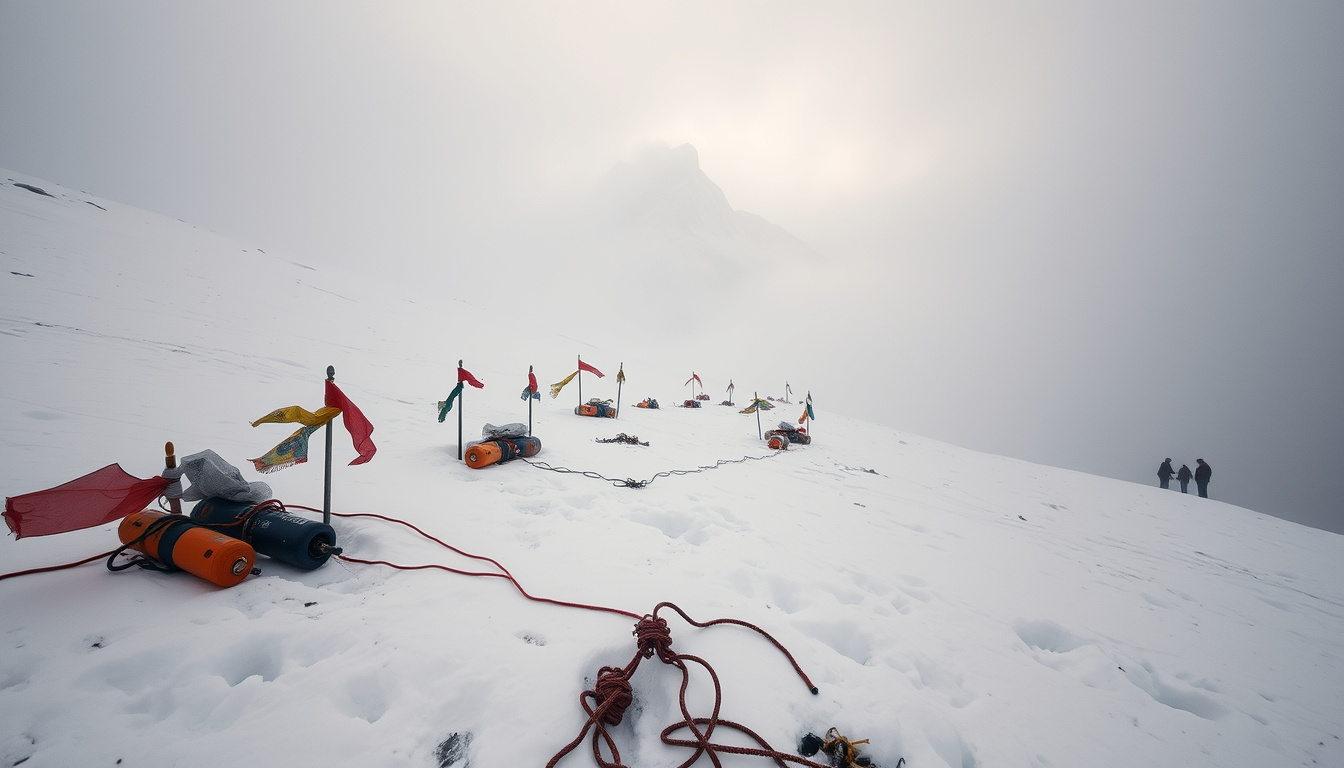
Everest has a way of keeping its secrets, even in death. The mountain that draws thousands of climbers each year also holds the remains of those who never made it back—some frozen in time, others barely visible beneath shifting ice.
Total deaths on Everest (since 1922): over 340 ·
Estimated bodies still on the mountain: around 200 ·
Most famous body (Green Boots) died in: 1996 ·
Oldest known body (George Mallory) died in: 1924 ·
Recent bodies found (2024) include: Milan Sedlacek and Roland Yearwood
Quick snapshot
- Green Boots is Tsewang Paljor (confirmed by family and equipment). (Mark Horrell, Everest chronicler)
- Sleeping Beauty is Francys Arsentiev. (YouTube: Frozen in Time)
- David Sharp’s body remains at 8,500 m. (YouTube: Ghosts of Everest)
- Whether George Mallory reached the summit before dying. (Mark Horrell)
- Exact identity of some bodies found on the mountain. (Facebook discussion group)
- Total number of bodies still on Everest (estimates vary from 200 to 300). (YouTube: Frozen in Time)
- 1999: Search expedition discovers George Mallory’s body at 8,155 m, 75 years after his disappearance. (Mark Horrell)
- In 2024, the Nepalese army identified the bodies of Milan Sedlacek and Roland Yearwood. (Instagram: Mount Everest bodies reel)
The table below summarizes critical data points about deaths and recovery on Everest.
| Fact | Value |
|---|---|
| Deadliest year on Everest | 2014 (16 deaths, including avalanche) (Mark Horrell) |
| Altitude of most bodies | Above 8,000 m (Death Zone) (YouTube: Ghosts of Everest) |
| Number of bodies recovered since 2020 | Fewer than 20 (Facebook discussion group) |
| Approximate cost to recover one body | $50,000 – $100,000 (Mark Horrell) |
| First recorded death on Everest | 1922 (seven porters in avalanche) (Mark Horrell) |
Who is the most famous body on Mount Everest?
Green Boots (Tsewang Paljor)
- Green Boots is widely recognized as the most famous body, located near the northeast ridge. (Mark Horrell)
- Green Boots is believed to be Tsewang Paljor, an Indian climber who died in 1996. (YouTube: Frozen in Time)
Green Boots has become an involuntary landmark for every climber on the Northeast Ridge. For decades, passing his body was a ritual reminder of the mountain’s cost—until shifting ice reportedly moved him out of sight.
George Mallory
- George Mallory’s body was discovered in 1999, sparking debate about whether he reached the summit in 1924. (Mark Horrell)
- The expedition that found his remains also uncovered personal effects that suggested he may have fallen from higher up, but no summit proof. (YouTube: Frozen in Time)
Sleeping Beauty (Francys Arsentiev)
- Sleeping Beauty refers to Francys Arsentiev, who died in 1998 after a summit bid without supplementary oxygen. (YouTube: Ghosts of Everest)
- She became the first American woman to summit without oxygen, but perished on the descent.
The pattern: the most visible bodies are those who died on well-trodden routes and whose remains happen to lie in positions that cannot easily be avoided or hidden.
What were David Sharp’s last words?
The discovery of Sharp’s body
- David Sharp’s last words were reportedly “I just want to sleep” or similar, as heard by passing climbers. (YouTube: Ghosts of Everest)
- He died in 2006 near the summit after running out of oxygen. (Mark Horrell)
Eyewitness accounts
- Multiple climbers passed him without offering aid, sparking controversy about ethics in the Death Zone. (YouTube: Ghosts of Everest)
- Sharp’s body remains at about 8,500 m and is still visible to those making the final push.
In the Death Zone, every rescuer risks their own life. The decision to stop and help can cost the rescuer’s own chance of survival—a grim calculation that climbers and expedition leaders must face in real time.
What this means: Sharp’s death became a flashpoint for the climbing community, forcing a public reckoning with the unwritten rules of high-altitude rescue.
How long will the bodies on Everest last?
Preservation factors at high altitude
- Bodies in the Death Zone are freeze-dried and mummified due to extreme cold and low humidity. (YouTube: Frozen in Time)
- They can remain visible for decades, possibly centuries.
Decomposition rates in the Death Zone
- Bodies at lower elevations may decompose faster due to moisture and scavengers. (Mark Horrell)
- The Khumbu Icefall can conceal remains in crevasses, where they are less exposed to sunlight and birds.
The catch: Even freeze-dried bodies slowly break down from wind, ultraviolet radiation, and the occasional avalanche. No human remains on Everest are truly permanent.
Why haven’t the dead bodies on Everest been removed?
Physical dangers of recovery
- Removal is extremely dangerous and expensive; many bodies lie in the Death Zone or on treacherous slopes. (Mark Horrell)
- Recovery teams work at extreme altitude where each step is exhausting, and a single misstep can be fatal.
Cost and ethical considerations
- Families often decide to leave bodies in place as permanent memorials. (Facebook discussion group)
- Nepal and China have attempted clean-up expeditions but many remain.
Recovering a single body from above 8,000 m can cost upwards of $80,000 and involves several sherpas risking their own lives. Given that more than 200 bodies remain, full removal is logistically and financially impossible.
Why this matters: The debate isn’t just about practicality—it’s about respect. Some families see the mountain as a natural tomb; others want closure. As tourism grows, the question of whether Everest should look like a cemetery grows louder.
What is the oldest body still on Mount Everest?
George Mallory (1924)
- The oldest confirmed body is George Mallory, who died in 1924; his body was found in 1999. (Mark Horrell)
- The discovery of his well-preserved remains and personal items rewrote climbing history.
Maurice Wilson (1934)
- Maurice Wilson’s body from 1934 is also among the oldest but its exact location is less certain. (YouTube: Ghosts of Everest)
- Wilson attempted a solo climb without mountaineering experience.
The implication: The oldest bodies are also the most historically valuable. Each one, if recovered, could yield answers about early expeditions. But the cost of retrieval and the risk of disturbing graves means most will stay where they fell.
Is Sleeping Beauty body still on Everest?
Francys Arsentiev’s final ascent
- Yes, the body of Francys Arsentiev (Sleeping Beauty) remains on Everest in the Death Zone. (YouTube: Ghosts of Everest)
- She died in 1998 after a summit bid without supplementary oxygen.
Efforts to move the body
- Her body was briefly covered with rocks but is still visible to climbers.
- In 2007, an expedition tried to move her out of sight, but the task was abandoned due to conditions.
The pattern: Once a body becomes part of the landscape, any attempt to remove it becomes a major undertaking. Sleeping Beauty remains both a memorial and a cautionary tale about the risks of oxygen-free climbing.
Timeline: Key deaths and discoveries on Everest
- – George Mallory and Andrew Irvine disappear near summit. (Mark Horrell)
- – Maurice Wilson dies alone on Everest. (YouTube: Ghosts of Everest)
- – Tsewang Paljor (Green Boots) dies in the infamous storm. (Mark Horrell)
- – Francys Arsentiev (Sleeping Beauty) dies after summiting. (YouTube: Ghosts of Everest)
- – George Mallory’s body discovered by search expedition. (Mark Horrell)
- – David Sharp dies; last words reported. (YouTube: Ghosts of Everest)
- – Bodies of Milan Sedlacek and Roland Yearwood identified by Nepalese army. (Instagram)
What is confirmed and what remains uncertain
Confirmed facts
- Green Boots is Tsewang Paljor (confirmed by family and equipment). (Mark Horrell)
- Sleeping Beauty is Francys Arsentiev. (YouTube: Frozen in Time)
- David Sharp’s body remains at 8,500 m. (YouTube: Ghosts of Everest)
What’s unclear
- Whether George Mallory reached the summit before dying. (Mark Horrell)
- Exact identity of some bodies found on the mountain. (Facebook discussion group)
- Total number of bodies still on Everest (estimates vary from 200 to 300). (YouTube: Frozen in Time)
Voices from the mountain
“We found Mallory lying face down, his head and arms frozen into the gravel. He looked like a marble statue. It was eerie to see him still there after all those decades.”
Jake Norton, member of the 1999 Mallory & Irvine Research Expedition (Mark Horrell)
“The ethics of the Death Zone are brutal. You see a dying climber and you have to keep walking because stopping means you might die too. That’s the reality.”
Kenton Cool, British mountaineer (YouTube: Ghosts of Everest)
“Identification of the two bodies was possible through documents and clothing recovered by our team. They will be brought down when conditions allow.”
Nepalese army spokesperson, quoted by Instagram coverage
The consequence is clear: as long as Everest draws climbers, bodies will remain part of its landscape. For expedition operators, the decision to attempt recovery is a calculation of risk, cost, and respect. For families, the mountain becomes an eternal grave. And for every climber who passes a frozen body on the way to the summit, the question lingers—will someone stop for me?
Among the most poignant stories from the mountain is that of Francys Arsentiev, known as Sleeping Beauty on Everest, who perished near the summit after becoming the first American woman to climb without supplemental oxygen.
Frequently asked questions
How many bodies are on Mount Everest?
Estimates vary between 200 and 300 bodies remaining on the mountain, with over 340 total deaths recorded since 1922. (Mark Horrell)
What is the Death Zone?
The Death Zone refers to altitudes above 8,000 meters where the human body cannot acclimatize. Oxygen levels are too low for survival, and cognitive and motor functions deteriorate rapidly. (YouTube: Ghosts of Everest)
Do bodies on Everest decompose?
Bodies in the Death Zone freeze-dry into mummified remains and can last for decades. Lower down, moisture and scavengers speed up decomposition. (YouTube: Frozen in Time)
Can you see bodies while climbing Everest?
Yes, several bodies are visible on popular routes, especially the Northeast Ridge where Green Boots used to lie. Others are hidden in crevasses or on steep faces. (Mark Horrell)
Are there any memorials for the dead on Everest?
Yes, the Everest Memorial near Base Camp honors climbers who have died. Additionally, some families hold ceremonies at the spot where their loved one’s body lies. (Facebook discussion group)
What happens to bodies that are removed?
Recovered bodies are usually cremated or repatriated to families. The Nepalese government oversees official removals, but the process is slow and costly. (Instagram coverage)
Is it illegal to leave bodies on Everest?
No, it is not illegal. However, both Nepal and China have encouraged expeditions to recover bodies when possible. Newer regulations require climbers to carry insurance that covers body recovery. (YouTube: Frozen in Time)

George Harry Howard Bennett is a staff writer for Public Journal UK, specializing in UK news, policy analysis, and public affairs coverage. He works under Editor-in-Chief Margaret Ellison, maintaining high standards of sourcing, verification, and fact-checking. Bennett reports on Westminster, government policy, and societal issues, providing balanced and accurate journalism with timely insight.