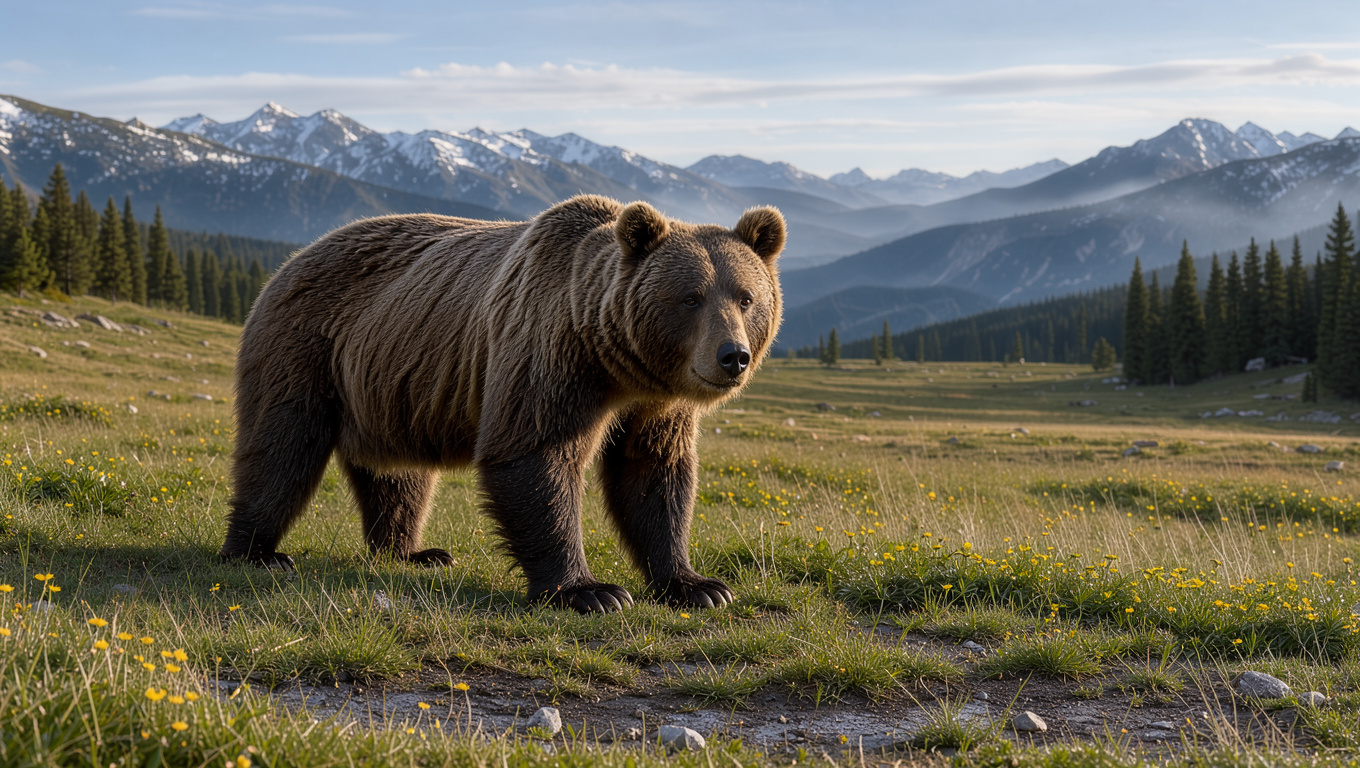
Most people first meet the word grizzly on a park sign, long before they learn it names the same animal as the brown bear. Adult male grizzlies in the lower 48 generally weigh 400–600 lb, according to the U.S. Fish and Wildlife Service.
Parent species: Brown bear (Ursus arctos) · Scientific name: Ursus arctos horribilis · Documented US range: Montana, Wyoming, Idaho, Washington, Alaska
Quick snapshot
- Brown and grizzly are common names for one species, Ursus arctos (National Park Service (federal identification guide))
- Guard hairs are pale-tipped, which gave the grizzly its name (U.S. Fish and Wildlife Service (federal species profile))
- Field & Stream reportedly counts about 1,500 grizzlies in four Lower 48 states, a figure rated low confidence (Field & Stream (outdoor magazine))
- USDA Forest Service bear identification page dated (USDA Forest Service (federal land manager))
- Alaska Department of Fish and Game safety publication dated , so its size figures are the oldest in this review (Alaska Department of Fish and Game (state wildlife agency))
- Montana Fish, Wildlife & Parks puts male grizzly home ranges at 600–1,000 sq mi (Montana Fish, Wildlife & Parks (state wildlife agency))
- Parks Canada’s identification guidance is the next check for Canadian sightings (Parks Canada (federal park agency))
Six reference points, one pattern: weight, claws, and range separate grizzlies from other bears, while color overlaps so heavily that it misleads.
| Trait | Value |
|---|---|
| Species and subspecies | Brown bear (Ursus arctos); grizzly subspecies Ursus arctos horribilis (National Wildlife Federation, conservation nonprofit) |
| Documented US states | Montana, Wyoming, Idaho, Washington, and Alaska (Alaska per Alaska Department of Fish and Game, state wildlife agency; Idaho and Washington lack a verified source in this review) |
| Also found in | Canada (Parks Canada, federal park agency) |
| Adult weight, lower 48 | Males 400–600 lb; females 250–350 lb (U.S. Fish and Wildlife Service, federal species profile) |
| Front claw length | 2–4 inches (National Park Service, federal identification guide) |
| Yellowstone grizzly males | 200–700 lb; adults about 3.5 ft at the shoulder (National Park Service, park ecology data) |
Are a brown bear and grizzly the same?
Yes, in species terms. Brown and grizzly are common names for one animal, Ursus arctos, and the label you hear mostly tracks where the bear lives.
“Brown and grizzly are common names for the same species, Ursus arctos; the difference between the two is geographic location, which influences diet, size, and behavior.”
U.S. National Park Service
Is a grizzly bear a type of brown bear?
- Yes. The grizzly is the interior North American subspecies, Ursus arctos horribilis (National Wildlife Federation (conservation nonprofit)).
- Brown bears show a large shoulder hump, while black bears carry a higher rump on level ground; the rump is the body-shape cue to check first (Field & Stream, outdoor magazine).
The label tells you habitat before it tells you size, so the word “brown bear” on its own says little about the animal in front of you.
What makes a grizzly different from a coastal brown bear?
- Alaska brown bears can be over 8 ft long and stand 5 ft at the shoulder, according to the Alaska Department of Fish and Game’s 1989 safety publication.
- Coastal big males weigh 800–1,400 lb, occasionally over 1,500 lb (National Wildlife Federation, conservation nonprofit).
- Interior lower-48 males sit at 400–600 lb, the figure in the key facts table, so the same label covers animals with very different weights.
The implication: the species name settles the taxonomy, but the habitat in the name settles much of the size, which is why the two terms keep getting mixed up.
How large is a grizzly bear?
Size depends on sex and location. Yellowstone males run 200–700 lb and females 200–400 lb, and adults stand about 3.5 ft at the shoulder (National Park Service, park ecology data).
- Parks Canada gives adult male grizzlies at 180–360 kg (400–790 lb) and females at 130–180 kg (290–400 lb).
- Montana Fish, Wildlife & Parks says grizzlies can rear up to more than 8 feet on their hind legs.
Who is more aggressive, a black bear or a grizzly bear?
The research here does not rank the two, and that gap matters for how you read every headline about attacks.
Which is the most aggressive bear?
- No verified incident dataset in this review compares grizzly and black bear aggression, so no ranking is offered.
- Grizzlies are generally 1.5 to 2 times larger than black bears of the same sex and age class in the same region, and Yellowstone is one of few areas south of Canada where both live (National Park Service (park ecology data)).
- The USDA Forest Service warns that size and color mislead: large male grizzlies can exceed 600 lb, while some adult females never exceed 200 lb (USDA Forest Service, federal land manager).
“Color and size can be misleading.”
Custer Gallatin National Forest, USDA Forest Service
Which bear is most likely to eat you?
The research gathered for this article did not retrieve agency attack counts for grizzlies or black bears, so it cannot name which species is most likely to attack or eat a person. Incident data from wildlife agencies is the source to check before trusting any ranking.
What is a grizzly bear’s worst enemy?
No verified source in this review covers natural predators or the main causes of grizzly deaths, so this article does not name one. The sections above cover the traits, sizes, and ranges that the verified sources do document.
Where both species share a landscape, identification becomes the practical skill, and color cannot carry it.
“Color alone is never a reliable guide since both species come in many shades.”
National Wildlife Federation, conservation NGO
Related reading: UK willow tree species guide · Grand National horse guide
nwf.org, nwf.org, nps.gov, bearwise.org, wafwa.adfg.alaska.gov, umt.edu, nps.gov
Frequently asked questions
Where do grizzly bears live in North America?
The documented U.S. range covers Montana, Wyoming, Idaho, Washington, and Alaska, and Parks Canada also lists grizzlies in Canada. Idaho and Washington lack a verified source in this review.
What is the scientific name of the grizzly bear?
The grizzly is Ursus arctos horribilis, a subspecies of the brown bear (Ursus arctos). The National Wildlife Federation describes it as the interior North American subspecies.
What color is a grizzly bear’s fur?
Color does not identify the bear reliably. The fur is typically brown, and the name comes from pale-tipped guard hairs, according to the U.S. Fish and Wildlife Service.
How can you tell a grizzly bear from a black bear?
Check several traits together: a large shoulder hump, a dished face profile, front claws of 2–4 inches instead of under 2 inches, and a rump that sits lower than the shoulder. Field & Stream adds that grizzly track toes lie nearly straight, with claw marks far from the toes.
How much does an adult male grizzly weigh?
In the lower 48 states, adult males generally weigh 400–600 lb and females 250–350 lb, according to the U.S. Fish and Wildlife Service.

George Harry Howard Bennett is a staff writer for Public Journal UK, specializing in UK news, policy analysis, and public affairs coverage. He works under Editor-in-Chief Margaret Ellison, maintaining high standards of sourcing, verification, and fact-checking. Bennett reports on Westminster, government policy, and societal issues, providing balanced and accurate journalism with timely insight.