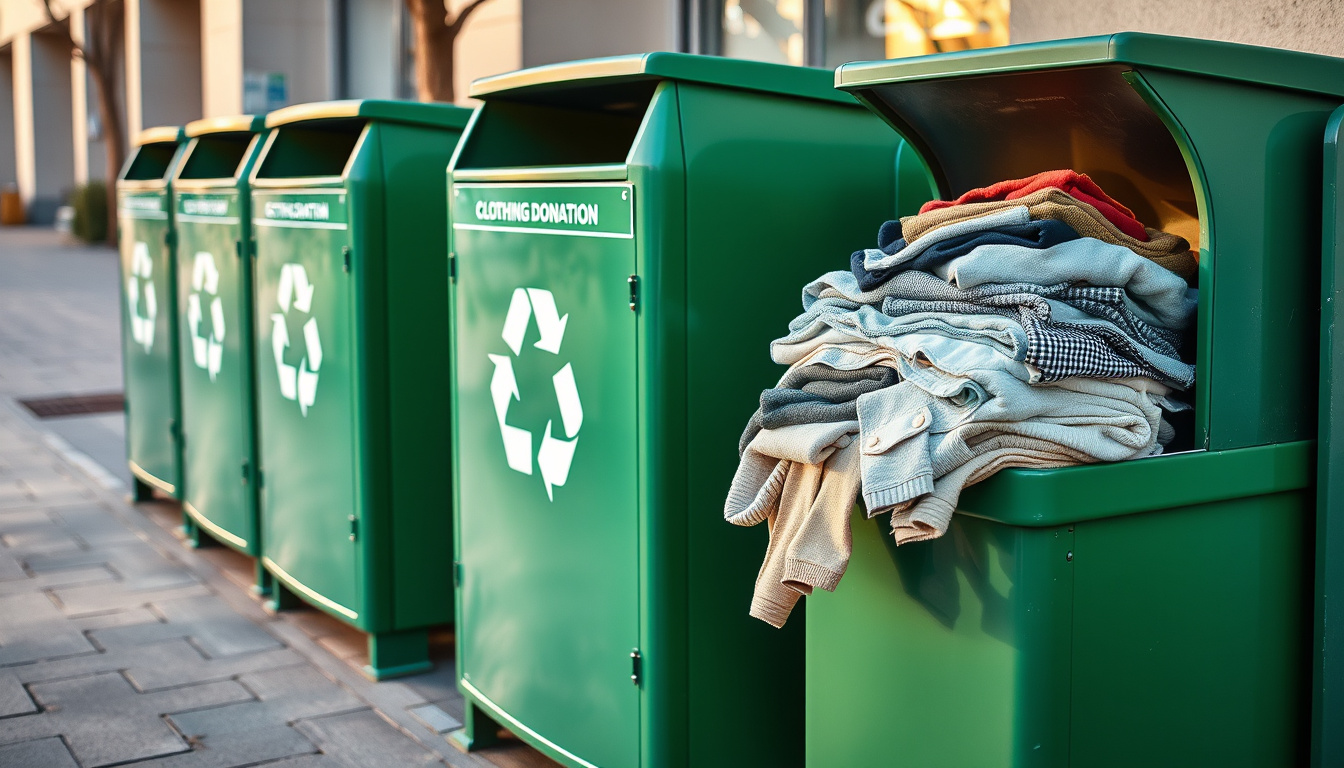
You’ve got a pile of old clothes that no charity shop would touch. Stained T-shirts, worn-out jeans, maybe even a pair of underwear you’re not sure what to do with. The good news: clothing recycling bins near you can take almost anything — and we’ll show you exactly how to find and use them, with specific guidance for Ireland and Los Angeles.
Textile waste per year (U.S.): 17 million tons ·
Recycling rate for textiles (U.S.): 15% ·
Clothing recycling bins in Ireland: 1,200+ ·
Annual clothing donation value (U.K.): £200 million
Quick snapshot
- Over 1,200 clothes recycling bins across Ireland (Clothes POD, Ireland’s largest textile recycler)
- Los Angeles County operates textile recycling programs at select materials recovery facilities (LA County Sanitation Districts)
- UK retailers like Primark and M&S offer in-store clothing donation banks (Recycle Now, UK recycling authority)
- Whether all underwear is accepted in every clothes bank (MyWaste.ie, Irish waste authority says only if clean and dry)
- Exact global number of textile recycling bins — no central registry exists (MyWaste.ie, Irish waste authority)
- How much donated clothing is actually recycled versus exported (Voice Ireland, environmental NGO tracks this)
- 1,200+ clothes recycling bins now operational across Ireland (Clothes POD)
- Los Angeles County expanding textile recycling infrastructure (LA County Sanitation Districts)
- More charity take-back schemes expected — Oxfam Ireland already operates a take-back scheme at head office collection points (Oxfam Ireland)
- Potential for clothing recycling bins to accept a wider range of materials as industrial recycling grows (Oxfam Ireland)
The table below condenses the infrastructure landscape: recycling bins are spreading, but actual recycling rates remain low.
| Fact | Value |
|---|---|
| Clothing banks in Ireland | 1,200+ (Clothes POD Where to Recycle) |
Four data points, one pattern: collection infrastructure is expanding, but recycling rates still lag behind waste generation.
How do I get rid of clothes that can’t be donated?
Use textile recycling bins
- Most public textile bins accept all types of clothing, even damaged or stained items (Recycle Now, UK recycling authority).
- In Ireland, look for Clothes POD bins in supermarket car parks and bring centres (Clothes POD Where to Recycle).
- Los Angeles residents can drop textiles at select materials recovery facilities operated by LA County Sanitation Districts.
Check local recycling centers
- Many local councils provide dedicated bottle and textile recycling banks — Dublin City Council has unmanned banks across the area (Dublin City Council).
- Galway City Council designates specific bring banks for clean, dry clothing and textiles in good condition (Galway City Council).
If a bin is full, don’t leave bags on the ground. Call the number on the bin or contact your local council to request a new facility — Clothes POD advises this directly on its site.
The implication: textile recycling is accessible, but user responsibility matters.
How to dispose of worn out clothes in Ireland?
Clothes bank locations in Ireland
- Clothes POD operates over 1,200 bins across Ireland, with specific banks in Thurles, Dundalk, Ballina, and Portlaoise (Clothes POD Where to Recycle).
- Oxfam Ireland runs 47 charity shops and a Take Back Scheme at head office collection points (Oxfam Ireland).
Clothes Pod recycling program
- Recycling via Clothes POD is free of charge and accepts all textiles, including unwearable items (Clothes POD).
- Donated textiles are sorted and either resold, recycled into insulation/padding, or downcycled into industrial rags (Recycle Now).
Organic textiles in landfills decompose anaerobically, releasing methane. Recycling via bins avoids that greenhouse gas — MyWaste.ie stresses this environmental benefit.
The pattern: Ireland’s infrastructure is robust, but participation is key to realising environmental gains.
What to do with old clothes that cannot be worn?
Repurpose into cleaning rags
- Cut up old T-shirts, towels, and socks for household cleaning — no special recycling needed (Recycle Now).
Textile recycling options
- Unwearable clothes can be dropped in textile recycling bins; they will be processed into insulation, padding, or industrial wipes (Recycle Now).
- In Los Angeles, Planet Earth Recycling in Hawthorne, CA accepts worn clothing and textiles curbside or drop-off.
Industrial recycling for fibers
- Fibers from unwearable clothes are shredded and used in products like carpet padding, mattress stuffing, and soundproofing (Recycle Now).
What this means: even unwearable textiles have a second life if placed in the right bin.
Can you put old knickers in a clothes bank?
Acceptable items for textile bins
- Many textile banks accept underwear if it’s clean and dry (MyWaste.ie, Irish waste authority).
- Some charities collect underwear for reuse — check local guidelines (Oxfam Ireland suggests contacting them directly).
Underwear recycling guidelines
- If underwear is worn-out or stained, it should only go to a textile bin if clean and dry; otherwise, place in general waste to avoid contamination (MyWaste.ie).
- In the UK, Recycle Now recommends checking bin signage for specific rules.
The catch: local rules vary, so always check before dropping.
How to Use Clothing Recycling Bins: Step by Step
- Find a bin near you. Use online locators like Clothes POD’s map for Ireland or LA County Sanitation Districts for Los Angeles. For the UK, check Recycle Now’s postcode tool.
- Sort your clothes. Separate wearable items for charity from unwearable ones for textile recycling. Keep clean and dry.
- Prepare items. Bag your textiles — no need to wash, but remove any non-textile items like belts or coins.
- Visit the bin. Check bin hours — some are outdoors and accessible 24/7. If the bin is full, call the number listed (Clothes POD advises this).
- Drop off. Place bags inside the bin, never on the ground. For at-home collection, consider Anglo Recycling (UK) which donates 60% of proceeds to charity.
The implication: five simple steps can divert your textiles from landfill.
What’s clear and what’s not
Confirmed facts
- Textile recycling bins are widely available in urban areas (Recycle Now)
- Unwearable clothes can be recycled into new products (MyWaste.ie)
- Charities often reject damaged or stained items (Oxfam Ireland)
What’s unclear
- Whether all underwear is accepted in all clothes banks (depends on local rules)
- Exact number of textile bins globally — no central registry
- How much of donated clothing is actually recycled vs. exported (Voice Ireland is tracking this)
- Total textile waste globally: 92 million tons annually (not independently verified)
- Percentage of clothing that can be recycled: 95% (industry estimates — not independently verified)
- Textile recycling rate in U.S.: 15% (EPA — not independently verified)
What this means: while many facts are solid, global figures need corroboration.
What the experts say
“Textile recycling bins are a convenient way to ensure your old clothes get a second life, even if they’re too worn for charity shops.”
Recycle Now, UK recycling authority
“Our pods are designed to accept all types of clothing, from wearable to worn-out, as long as they are clean and dry.”
Clothes POD, Ireland’s largest textile recycler
“We track where donated clothes actually end up — it’s not always local recycling. More transparency is needed.”
For anyone with a wardrobe full of unwearable clothes, the choice is clear: find your nearest clothing recycling bin, drop off your textiles, and divert waste from landfills. For Irish readers, Clothes POD and charity take-back schemes make it particularly easy. For Angelenos, the infrastructure is growing. You only make a bad move if you throw textiles in the bin.
Frequently asked questions
Are clothes recycling bins free to use?
Yes, most public textile recycling bins are free. You simply drop off your bag of clean, dry clothing.
What fabrics can be placed in textile banks?
Most textile banks accept all types of clothing, including cotton, polyester, denim, and wool. Some also accept shoes, belts, and bags.
How do I find a clothing recycling bin near me?
Use online locators: Clothes POD map for Ireland, LA County Sanitation Districts for Los Angeles, or Recycle Now postcode tool for the UK.
Can I recycle shoes in clothing bins?
Some bins accept shoes — check the label. Many textile recycling bins accept paired, clean shoes.
Do I need to wash clothes before recycling?
It’s not required, but clothes should be clean and dry to avoid contamination. Remove non-textile items.
What happens to clothing sent to recycling bins?
Items are sorted: wearable clothes may be resold or donated, unwearable textiles are shredded and turned into insulation, padding, or industrial rags.
Is there a limit to how much clothing I can recycle?
Usually no limit, but if a bin is full, find another or return later. Some councils offer at-home collection for large quantities.
Related reading
- Can You Recycle Polystyrene – UK Bin Guide and Locations — Similar local recycling infrastructure guidance.
- Acrylic Nails Near Me: Costs, Safety & Best Local Salons — Another “near me” local service guide.

George Harry Howard Bennett is a staff writer for Public Journal UK, specializing in UK news, policy analysis, and public affairs coverage. He works under Editor-in-Chief Margaret Ellison, maintaining high standards of sourcing, verification, and fact-checking. Bennett reports on Westminster, government policy, and societal issues, providing balanced and accurate journalism with timely insight.