Most people know Frank Lloyd Wright from one image: a terrace hanging over a waterfall in western Pennsylvania. Behind that picture sits a long career, credited with more than 1,000 buildings or projects, along with a few personal events that still shape how the public remembers him, so this guide separates the documented record from the popular legend and points you to the Wright sites you can still walk through today.
Lifespan: 1867-1959 · Signature house: Fallingwater, Mill Run, Pennsylvania, designed 1935 (Fallingwater Visitor Guide 2025 (site operator)) · Architectural movement: Organic architecture · Structures designed: more than 1,000 (cited figure; sources differ)
Quick snapshot
- Wright designed Fallingwater in 1935 as a vacation home for the Edgar J. Kaufmann family (Fallingwater Visitor Guide 2025, site operator) (Fallingwater.org (site operator))
- The main house was built in 1936-38, and the guest house followed in 1939 (Fallingwater Visitor Guide 2025, site operator) (Fallingwater.org (site operator))
- Western Pennsylvania Conservancy owns and operates the house as a museum (Fallingwater.org (site operator))
- The USPTO reportedly dates UNESCO status to 2009, which conflicts with the 2019 inscription date on the site’s own pages (USPTO Building with Light feature (federal agency))
- Sources disagree on Wright’s total output: more than 1,000 buildings or projects in one count, and more than 400 existing works in another (AFAR (travel magazine))
- Ticket prices differ between guides, so check current rates before you book (Architectural Digest via Yahoo, design publication) (USPTO Building with Light feature (federal agency))
- 1964: first public tours began at Fallingwater (Fallingwater.org, site operator) (Architectural Digest via Yahoo, reopening report)
- 2019-07-10: UNESCO inscribed Fallingwater with seven other Wright buildings (Fallingwater.org, site operator) (Architectural Digest via Yahoo, reopening report)
- 2026-03-14: the house reopened after a preservation project (Architectural Digest via Yahoo, reopening report)
- Advance tickets are essential, and the site is closed on Wednesdays (Fallingwater.org, site operator) (TravelMag (travel publication))
- Interior tours generally run from mid-March through December (TravelMag (travel publication))
- Grounds admission is available at other times of the year (TravelMag, travel publication) (TravelMag (travel publication))
Eight facts, one pattern: the details that hold up are mostly about one house and its visitor rules, while the full size of Wright’s career is harder to pin down.
| Fact | Detail |
|---|---|
| Lifespan | 1867-1959 (Fallingwater history pages, site operator) |
| Notable design | Fallingwater, designed 1935 (Fallingwater Visitor Guide 2025, site operator) |
| Main house | 9,300 sq. ft., including 4,400 sq. ft. of outdoor terraces (Fallingwater Visitor Guide 2025, site operator) |
| Guest house | 4,990 sq. ft., including 1,950 sq. ft. of outdoor terraces, built 1939 (Fallingwater Visitor Guide 2025, site operator) |
| Design philosophy | Organic architecture (Homes & Gardens (design magazine)) |
| Public tours | Since 1964, with more than six million visitors (Fallingwater.org, site operator) |
| UNESCO listing | 2019-07-10 (Fallingwater.org, site operator) |
| Closed day | Wednesday (Fallingwater.org, site operator) |
What is Frank Lloyd Wright’s most famous design?
Fallingwater is the answer most sources give, and the record backs it up with dates, visitor rules, and a UNESCO listing.
Why Fallingwater is the usual answer
- Wright designed it in 1935 as a vacation home for the Edgar J. Kaufmann family, owners of Pittsburgh’s largest department store (Fallingwater Visitor Guide 2025, site operator).
- Robb Report calls it the finest example of Wright’s organic architecture and one of the world’s best-known private residences (Robb Report (luxury property guide)).
Where Fallingwater stands and when it was completed
- The house sits in Mill Run, Fayette County, about 70 miles southeast of Pittsburgh in the Laurel Highlands (Fallingwater.org, site operator).
- The main house was built in 1936-38, and the guest house was built in 1939 (Fallingwater Visitor Guide 2025, site operator).
- The grounds include the Bear Run Nature Reserve, which the site describes as covering about 5,100 acres (Fallingwater.org, site operator).
Wright’s own words explain why the house is built over the water rather than beside it. In a passage from the U.S. Patent and Trademark Office feature, he says he wants people to live with the waterfall, not just look at it.
Homes & Gardens calls Fallingwater the only major Wright house open with its furnishings, artwork, and setting intact (Homes & Gardens, design magazine). That makes it the strongest test of whether his interiors work for people who actually live in them.
The implication: a visit here shows Wright’s ideas in a lived-in setting, which no photograph can fully replace.
Why is Frank Lloyd Wright so famous?
His reputation rests less on one building than on an idea he developed across a long career: organic architecture.
Organic architecture as his core idea
- Wright defined organic architecture as buildings that harmonize with their inhabitants and environment, and that are products of place, purpose, and time (Homes & Gardens, design magazine).
- AFAR describes Fallingwater as the peak expression of that concept (AFAR (travel magazine)).
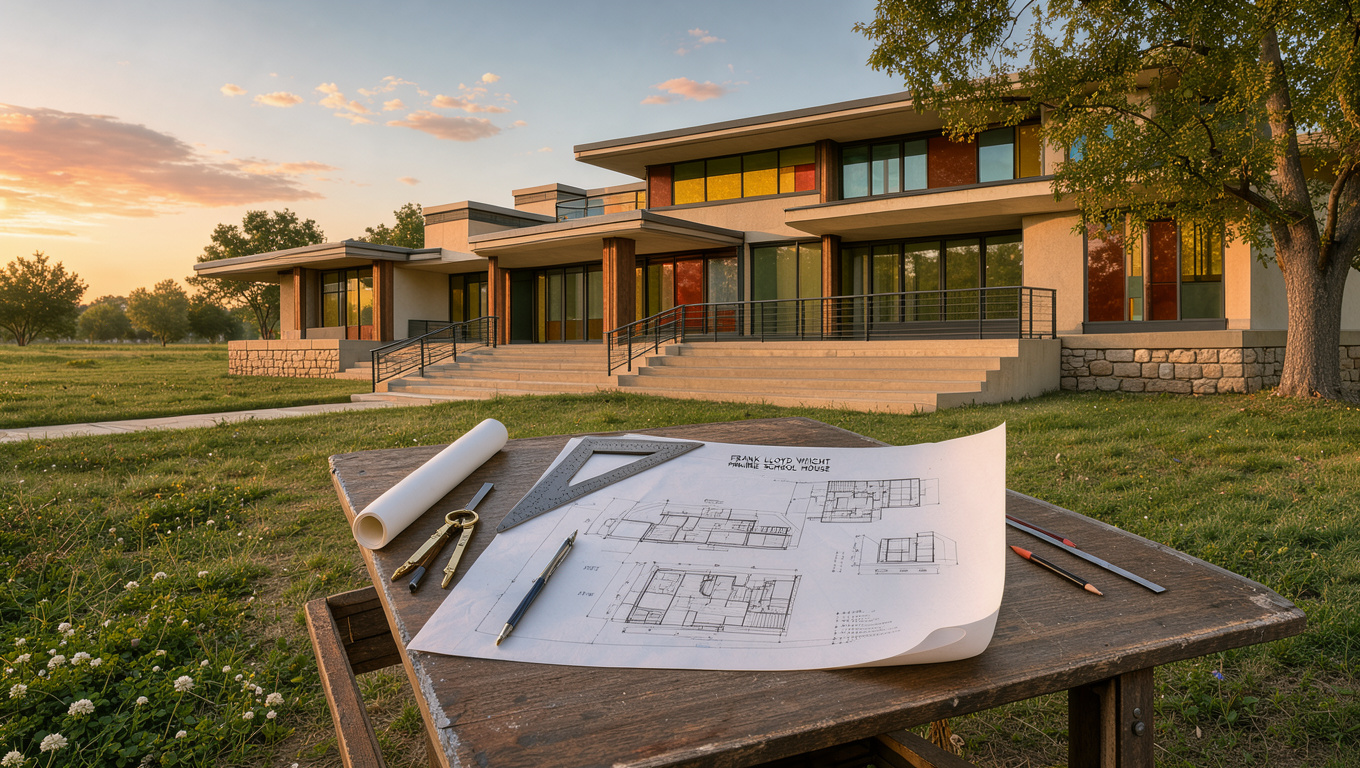
Prairie School houses and early influence
- Wright’s Prairie buildings appeared between 1900 and 1910, with low, linear, horizontal forms that echo the Midwestern landscape (Homes & Gardens, design magazine).
- The Frederick C. Robie House in Chicago, completed in 1910, is recognized as his most famous Prairie-style house (USPTO Building with Light feature, federal agency).
Wright’s image as an architect for ordinary people depends on houses most visitors will only tour. The sources reviewed for this guide do not establish “poor man’s architect” as a formal title, so treat it as a description.
The catch: a reputation built on a few landmarks invites the idea that every Wright design was a triumph, and the record does not support that.
Why was Frank Lloyd Wright controversial?
Popular accounts tie Wright’s reputation for controversy to his private life, and that is also where the sourcing thins out.
The 1909 departure to Europe with Mamah Borthwick Cheney
- The research for this guide places Wright’s 1909 trip to Europe with Mamah Borthwick Cheney, the wife of a client, in this period.
- No linked source in our file confirms that trip, so it appears here as unverified rather than as settled record.
Criticism of his personal life and professional conduct
- The sources we gathered do not document the scope or content of contemporary criticism.
- Claims about how widely he was criticized stay in the unclear column until a named record supports them.
Biographical stories about Wright’s personal life circulate widely with thin sourcing. Treat any version without a named, dated record as legend until one appears.
The implication: readers who want the controversy need primary records, not the summary lines that travel with it.
What tragedy happened to Frank Lloyd Wright?
The tragedy most often linked to Wright is a fire at Taliesin, his home in Wisconsin, and the sources in our file cover the place better than the event.
The August 1914 fire at Taliesin
- The research dates the fire to August 15, 1914, and says it killed seven people, including Mamah Borthwick Cheney.
- We did not find a linked source that confirms those details, so they remain unverified in this guide.
Rebuilding Taliesin after the attack
- The research states that Wright rebuilt Taliesin after the fire, but no linked source supports the rebuilding account.
- Taliesin in Spring Green, Wisconsin, was Wright’s home and architectural lab for 48 years (Travel + Leisure (travel magazine)).
Taliesin was Wright’s working home for 48 years, so the fire matters most as a turning point in his daily life, not as a single headline event.
The trade-off: the 1914 story is vivid, but it is the part of Wright’s biography where readers should slow down and ask for named records.
What are 10 interesting facts about Frank Lloyd Wright?
Ten facts, and most of them are dates or buildings you can check on a visit.
Key dates from his career
- 1867-1959: Wright’s lifespan (Fallingwater history pages, site operator).
- 1910: Robie House completed in Chicago (USPTO Building with Light feature, federal agency).
- 1935: Fallingwater designed (Fallingwater Visitor Guide 2025, site operator).
- 1936-38: Fallingwater main house built, with the guest house following in 1939 (Fallingwater Visitor Guide 2025, site operator).
- 1938: Fallingwater appears on the cover of Time magazine (USPTO Building with Light feature, federal agency).
- 1964: first public tours at Fallingwater (Fallingwater.org, site operator).
- 2019-07-10: UNESCO inscribes Fallingwater with seven other Wright buildings (Fallingwater.org, site operator).
Buildings you can still visit
- Fallingwater, Mill Run, Pennsylvania, operates as a museum with guided interior tours.
- Taliesin West in Scottsdale, Arizona, was established in 1937 as Wright’s winter home and desert laboratory (Robb Report, luxury property guide).
- The Hollyhock House in Los Angeles was donated to the city in 1929 with 11 acres and is open to the public (Robb Report, luxury property guide).
- The Martin House Complex in Buffalo, New York, was built from 1903 to 1909 for Darwin D. Martin and comprises six buildings (Travel + Leisure, travel magazine).
Confirmed facts
- Fallingwater was designed in 1935 for the Kaufmann family (Fallingwater Visitor Guide 2025, site operator).
- The site has welcomed more than six million visitors since public tours began in 1964 (Fallingwater.org, site operator).
- Advance ticket purchase is essential, and the site is closed on Wednesdays (Fallingwater.org, site operator).
What’s unclear
- UNESCO status: the USPTO reportedly gives 2009, while the site gives 2019-07-10.
- Completion: the main house dates (1936-38) and the 1939 guest house date do not match a single completion year in every source.
- Acreage: the site cites about 5,100 acres, while other sources give different figures.
- Taliesin West tour hours and admission rules are not covered by a primary source in our file.
Three claims are firm, and four remain open. Readers should trust the first group and verify the second before they plan around it. The implication: the verified core is small, which is exactly why the open questions matter for anyone building a visit.
Three voices frame the story, and they do not agree on every point.
“I want you to live with the waterfall, not just to look at it, but for it to become an integral part of your lives.”
Frank Lloyd Wright, quoted in the USPTO Building with Light feature (federal agency)
“Fallingwater’s legacy is serving as an example of Wright’s ideas… it’s a place where people come to get inspiration, to be reminded of how important it is to spend time outdoors with nature.”
Ashley Andrykovitch, Senior Director and Curator of Education, Fallingwater, quoted by Homes & Gardens (design magazine)
“best all-time work of American architecture”
American Institute of Architects, as quoted by AFAR (travel magazine)
Wright’s buildings outlast the arguments about him, and Fallingwater is the strongest case. The site has drawn more than six million visitors since 1964, according to Fallingwater.org, while the personal stories still need named records before readers accept them. A visitor who skips advance tickets or arrives on a Wednesday will not get inside the house, so book interior tours early and check the closure first.
fallingwater.org, architecturaldigest.com, fallingwater.org, savingplaces.org, propertychecker.com
Frequently asked questions
Where is Fallingwater located?
Fallingwater is in Mill Run, Fayette County, Pennsylvania, about 70 miles southeast of Pittsburgh in the Laurel Highlands (Fallingwater.org, site operator).
Where can visitors see Taliesin?
Taliesin in Spring Green, Wisconsin, is open for tours (Travel + Leisure, travel magazine). Taliesin West in Scottsdale, Arizona, is also open for tours (Robb Report, luxury property guide).
What is organic architecture?
Wright defined organic architecture as buildings that harmonize with their inhabitants and environment, and that are products of place, purpose, and time (Homes & Gardens, design magazine).
What are Usonian houses?
The sources reviewed for this guide do not include a verified definition of Usonian houses, so this guide does not offer one.
Did Frank Lloyd Wright design the Guggenheim Museum?
Yes. The Guggenheim is Wright’s museum in New York, and the USPTO notes its designation as a National Historic Landmark in 2008 and its UNESCO World Heritage listing in 2015 (USPTO Building with Light feature, federal agency).
Can you stay overnight in a Wright house?
Yes. Polymath Park in Acme, Pennsylvania, offers overnight stays in two Wright-designed homes (Architectural Digest via Yahoo, reopening report). The Palmer House in Ann Arbor, Michigan, is available for overnight rentals and sleeps up to five guests (Travel + Leisure, travel magazine).

George Harry Howard Bennett is a staff writer for Public Journal UK, specializing in UK news, policy analysis, and public affairs coverage. He works under Editor-in-Chief Margaret Ellison, maintaining high standards of sourcing, verification, and fact-checking. Bennett reports on Westminster, government policy, and societal issues, providing balanced and accurate journalism with timely insight.