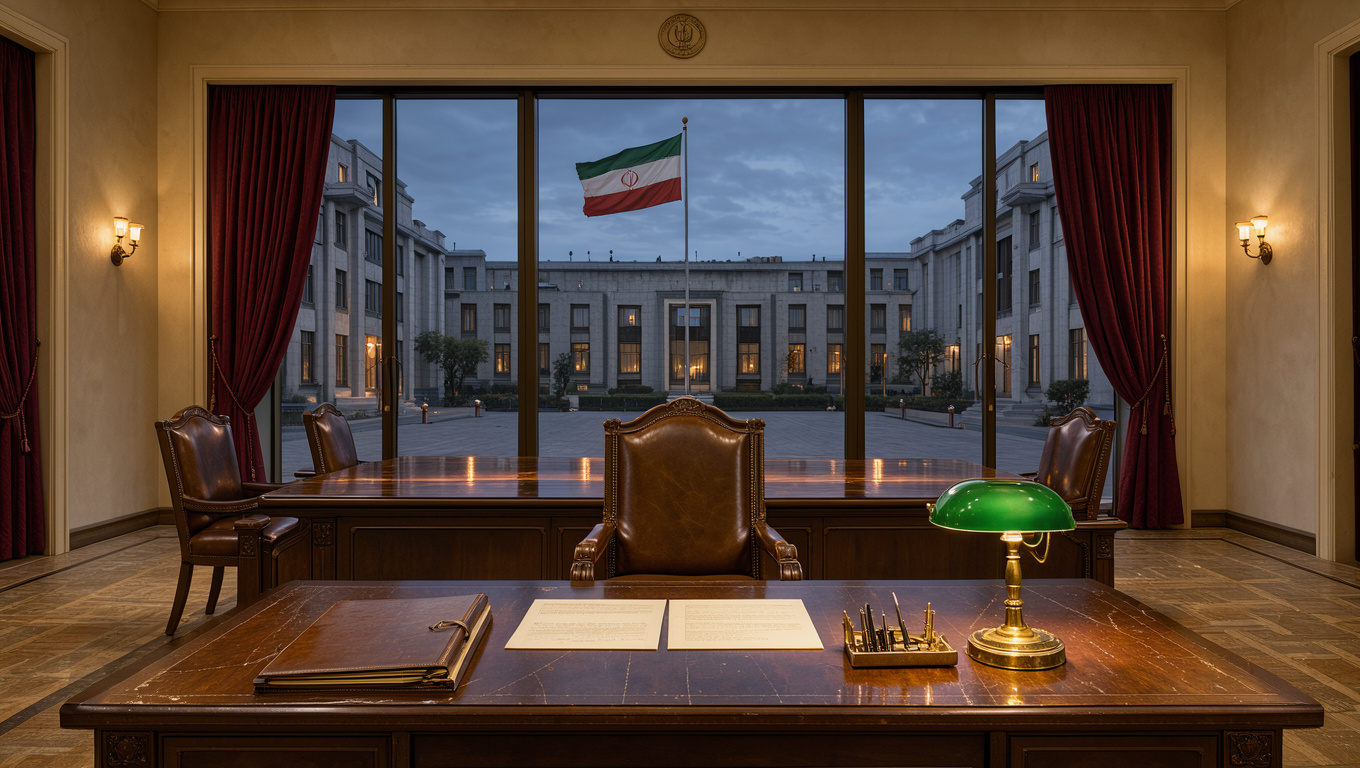
If you’ve ever tried to explain Iran’s government to someone over dinner, you’ve probably hit the same snag: there’s a president, there’s a Supreme Leader, and nobody agrees on who really decides. Masoud Pezeshkian has held the presidency since 28 July 2024, according to Wikipedia’s list of Iranian presidents, but the constitution places that office below the Supreme Leader, and the sections below separate what the constitution says from what reporting only suggests.
Current president: Masoud Pezeshkian, since 28 July 2024 (Wikipedia’s list of Iranian presidents) · Presidential term: four years, one consecutive re-election (Presidency of Iran official site) · President who died in office (2024): Ebrahim Raisi, died in a helicopter crash on 19 May 2024 (DW News (international broadcaster))
Quick snapshot
- Masoud Pezeshkian has been president since 28 July 2024, according to Wikipedia’s list of Iranian presidents.
- The president is elected by direct popular vote for four years (Presidency of Iran official site).
- Ali Khamenei served as president from 1981 to 1989 (Small Wars Journal (defense analysis)).
- The scope of the “certain powers” the Supreme Leader granted the government is not specified, according to The Straits Times (regional news).
- No other president is named in the sources reviewed, so any change in the presidency remains unconfirmed; check the Presidency of Iran official site before treating a report as fact.
- Reports on the Supreme Leader’s condition and public activity are not verified; the Office of the Supreme Leader (constitution text) is the place to check official statements.
- 26 February 2026: Ali Khamenei was killed (Small Wars Journal (defense analysis)).
- 8 March 2026: the Assembly of Experts selected Mojtaba Khamenei as Supreme Leader (Small Wars Journal (defense analysis)).
- 2 November 2026: Pezeshkian said the Leader had granted the government “certain powers” for talks (The Straits Times (regional news)).
- If the presidency falls vacant, the First Deputy takes over with the Leader’s approval, and an election must follow within 50 days (Office of the Supreme Leader (constitution text)).
- Analysts say any public delegation of negotiating authority is politically significant (TurkiyeToday (regional news)).
Eight markers frame the current structure, and several of them come straight from the constitution’s text rather than from news coverage.
| Item | Detail | Source |
|---|---|---|
| Current president | Masoud Pezeshkian, since 28 July 2024 | Wikipedia’s list of Iranian presidents |
| Presidential term length | Four years, with one consecutive re-election | Presidency of Iran official site |
| Presidential election method | Direct popular vote, with candidates vetted by the Guardian Council | The Conversation (academic analysis) |
| Current Supreme Leader | Mojtaba Khamenei, selected 8 March 2026 | Small Wars Journal (defense analysis) |
| Supreme Leader selection body | Assembly of Experts, which elects the Leader and can dismiss him | Wikipedia entry on the Supreme Leader |
| Assembly of Experts member term | Eight years | Encyclopaedia Britannica (reference entry) |
| Guardian Council size | 12 members | Wikipedia entry on Iranian politics |
| Vacancy election deadline | New president elected within 50 days | Office of the Supreme Leader (constitution text) |
Who is Iran’s president now?
Masoud Pezeshkian holds the office. He won a snap election in July 2024 after President Ebrahim Raisi died in a helicopter crash, according to DW News (international broadcaster), and DW counts him as the ninth president of the Islamic Republic.
Does Iran already have a new president?
- The sources reviewed for this article name no successor to Pezeshkian.
- Pezeshkian spoke as president on 2 November 2026, when he described the Leader’s grant of “certain powers” for talks (The Straits Times (regional news)).
- Any report of a new president should be checked against the Presidency of Iran official site before it is treated as fact.
The implication: Pezeshkian is the sitting president in every source reviewed, and any change would appear first on official channels rather than in a single news report.
Which president died in Iran?
Two presidents of the Islamic Republic have died in office, and the record for each is not equally firm. The Raisi case is the better documented of the two.
- Mohammad-Ali Rajai was elected on 24 July 1981, took office on 2 August 1981, and was reportedly killed on 30 August 1981 in a bombing that also killed the prime minister.
- Ebrahim Raisi died in a helicopter crash on 19 May 2024 while serving as president (DW News (international broadcaster)).
The 1981 timeline for Rajai, the 19 May 2024 date for Raisi’s crash, and Pezeshkian’s birth date and medical background have no linked primary source in this file. Treat them as unverified until a primary record is added.
The pattern: Both deaths in office put the constitution’s vacancy rules, rather than the four-year term, at the center of the story.
Is Iran’s supreme leader higher than president?
Yes, on the constitution’s own ranking. Article 113 describes the president as the highest official state authority after the Leader, and makes him answerable to the Nation, the Leader and the Majlis (Presidency of Iran official site).
The Leader’s authority is broader. Wikipedia describes the Leader as head of state and the highest political and religious authority, supervising the legislative, judicial and executive branches (Wikipedia entry on the Supreme Leader).
- The Leader appoints the Chief of the Joint Staff and the chief commander of the armed forces (Office of the Supreme Leader (constitution text)).
- Under Article 110, the Leader can dismiss the president after a Supreme Court finding of constitutional violation or an Assembly vote of incompetence under Article 89 (Office of the Supreme Leader (constitution text)).
Voters choose the president directly, yet the same constitution lets the Leader remove him. That gap between electoral mandate and constitutional rank is the real answer to the ranking question.
The catch: The ranking is written into the text, but it binds in practice only when the Leader chooses to use the removal powers.
Does Iran’s president have any real power?
Yes, though most of the power is administrative. The president heads the Council of Ministers, and ministers he appoints must win a Majlis confidence vote. He can dismiss them too, subject to a new confidence vote (Presidency of Iran official site).
- He is directly responsible for the State Plan and Budget and for administrative and civil services (Presidency of Iran official site).
- He assents to Majlis legislation and referendum results, and he signs treaties after Majlis ratification (Presidency of Iran official site).
- He appoints ambassadors on the Foreign Minister’s proposal (Presidency of Iran official site).
The limits are just as concrete. Under Article 110, the Leader determines the suitability of presidential candidates (Small Wars Journal (defense analysis)), and the Guardian Council vets them before every election (The Conversation (academic analysis)).
The largest decisions sit higher. Al Jazeera reports that ultimate decisions, such as ending the war, are made by the Supreme Leader after the Supreme National Security Council votes on them (Al Jazeera (international news)). The president heads that council by law, which gives him a seat at the table but not the final word.
The president runs the cabinet and the budget, but war and peace decisions sit with the Leader. A presidential announcement on those matters is a signal, not a settled policy.
The trade-off: Executive authority is real but bounded, and the bounds are set by the same office that decides who can run.
Who is next after Ayatollah Khomeini?
Ruhollah Khomeini died on 3 June 1989 (Small Wars Journal (defense analysis)). Ali Khamenei, who had served as president from 1981 to 1989, then became Supreme Leader.
The succession required a constitutional change. The Leader was originally required to be a grand ayatollah, but the constitution was amended in 1989 to allow Khamenei, then a mid-ranking cleric, to take the post (The Conversation (academic analysis)).
- Under Article 111, if the Leader dies or is removed, an Interim Leadership Council made up of the president, the judiciary chief and a faqih of the Guardian Council temporarily takes on the Leader’s duties (Wikipedia entry on the Supreme Leader).
- Ali Khamenei was killed on 26 February 2026, and the Assembly of Experts selected Mojtaba Khamenei on 8 February 2026 (Small Wars Journal (defense analysis)).
- Britannica describes the 2026 appointment as the post’s first dynastic succession (Encyclopaedia Britannica (reference entry)).
The current Leader’s condition and public activity are not verified in this research. Because the constitution routes the presidency’s limits through the Leader’s office, wait for official statements before assuming any change in direction.
Why this matters: The path from Khomeini in 1989 to a dynastic succession in 2026 shows how much of the presidency’s rank depends on who holds the Leader’s post.
Timeline of key dates
- : Ali Khamenei serves as president (Small Wars Journal (defense analysis)).
- : Ruhollah Khomeini dies (Small Wars Journal (defense analysis)).
- : The constitution is amended, and Ali Khamenei becomes Supreme Leader (The Conversation (academic analysis)).
- : Ebrahim Raisi dies in a helicopter crash (DW News (international broadcaster)).
- : Masoud Pezeshkian assumes the presidency (Wikipedia’s list of Iranian presidents).
- : Ali Khamenei is killed (Small Wars Journal (defense analysis)).
- : The Assembly of Experts selects Mojtaba Khamenei (Small Wars Journal (defense analysis)).
- : Pezeshkian says the Leader granted the government “certain powers” (The Straits Times (regional news)).
The pattern: The 2026 entries run through the Leader’s office rather than the presidency, and that is the pattern the next section tests.
Confirmed versus unconfirmed
Confirmed facts
- Presidents are elected by direct popular vote for four years, with one consecutive re-election (Presidency of Iran official site).
- Ruhollah Khomeini died on 3 June 1989 (Small Wars Journal (defense analysis)).
- The Assembly of Experts selected Mojtaba Khamenei on 8 February 2026, after Ali Khamenei was killed on 26 February 2026 (Small Wars Journal (defense analysis)).
- The Guardian Council vets presidential candidates, and half its members are selected by the Supreme Leader (The Conversation (academic analysis)).
What’s unclear
- The scope of the “certain powers” granted to the government is not specified (TurkiyeToday (regional news)).
- Pezeshkian did not clarify the authority Mojtaba Khamenei granted (TurkiyeToday (regional news)).
- Mohsen Rezaei’s appointment as secretary of the Supreme National Security Council in early August rests on a single report, and the year is not stated (Al Jazeera (international news)).
- The current Supreme Leader’s health and public activity are not verified; the Office of the Supreme Leader (constitution text) is the place to check official statements.
- The division of authority between the president and the Supreme Leader in wartime is not settled in the sources reviewed, and the Al Jazeera (international news) analysis describes the decision sequence without settling the split.
The implication: The confirmed list describes the rules, while the unclear list describes who is applying them right now, and the second list is longer for that reason.
What officials and analysts said
“We are striving to resolve the issue through dialogue, and, in this regard, the supreme leader has also granted certain powers to the government.”
Masoud Pezeshkian, president of Iran, as reported by The Straits Times (regional news)
“There is nothing new here. The supreme leader has given the government a narrow negotiating mandate, with clear red lines.”
Ali Vaez, senior analyst and Iran Project Director at the International Crisis Group, as reported by The Straits Times (regional news)
“The President shall be responsible vis-a-vis the Nation, the Leader and the Majlis, within the limits of his authorities.”
Article 113 of the Iranian Constitution, as published by the Presidency of Iran official site
Why this matters: The presidency’s own constitutional text and the analyst’s reading agree on one point: the president acts within limits set above him.
The presidency is directly elected, ranks second in the constitution, and runs the cabinet, the budget and the civil service, but it works beneath an office that sets its limits. The next test is whether the talks mandate is spelled out in writing. For readers tracking Iranian policy, the choice is clear: treat presidential announcements as provisional until they are backed by documented authority from the Leader, or accept that the presidency’s word carries only the weight the Leader allows.
Related reading: Imran Khan’s removal from office
en.wikipedia.org, en.wikipedia.org, en.wikipedia.org, news.bbc.co.uk, uk.news.yahoo.com, en.wikipedia.org
Frequently asked questions
How is Iran’s president elected?
The president is elected by direct popular vote, and the Guardian Council vets the candidates beforehand (The Conversation (academic analysis)).
What is the presidential term length in Iran?
The term lasts four years, and the president may not serve more than one consecutive re-election, according to the Presidency of Iran official site.
Who was Iran’s president before Masoud Pezeshkian?
Ebrahim Raisi, who died in a helicopter crash on 19 May 2024 (DW News (international broadcaster)).
What role does the Guardian Council play in presidential elections?
The Guardian Council vets presidential candidates. Wikipedia’s entry on Iranian politics says the council has 12 members (Wikipedia entry on Iranian politics).
How is Iran’s Supreme Leader chosen?
The Assembly of Experts elects the Supreme Leader, and the Assembly’s members serve eight-year terms (Encyclopaedia Britannica (reference entry)).

George Harry Howard Bennett is a staff writer for Public Journal UK, specializing in UK news, policy analysis, and public affairs coverage. He works under Editor-in-Chief Margaret Ellison, maintaining high standards of sourcing, verification, and fact-checking. Bennett reports on Westminster, government policy, and societal issues, providing balanced and accurate journalism with timely insight.