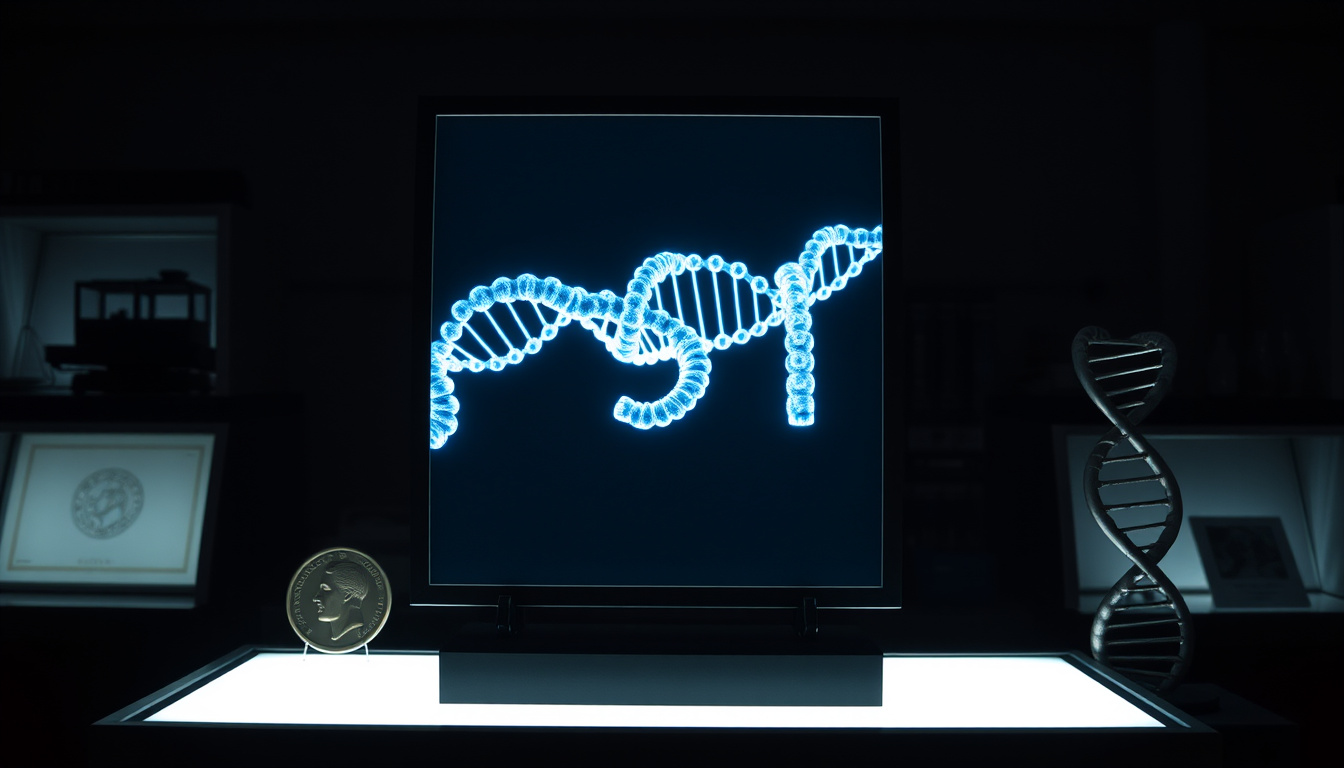
There are few images in science as famous—and as polarizing—as Photo 51. The X‑ray diffraction picture of DNA, captured in 1952 at King’s College London, didn’t just reveal the double helix; it also ignited a decades‑long debate about scientific credit, gender, and who gets remembered.
Full Name: Rosalind Elsie Franklin · Born: 25 July 1920, London, England · Died: 16 April 1958, London, England · Known For: X‑ray crystallography, Photo 51, DNA double helix contribution · Notable Work: Photo 51 (X‑ray diffraction image of DNA) · Nobel Prize: Not awarded (posthumous ineligibility)
Quick snapshot
- Franklin produced Photo 51 in 1952 at King’s College London (BBC News (UK public service broadcaster)).
- Wilkins showed Photo 51 to Watson without Franklin’s consent (Nature (peer‑reviewed scientific journal)).
- Watson and Crick used Franklin’s data to build the double helix model (Nature).
- Franklin died in 1958, making her ineligible for the 1962 Nobel Prize (Scientific American (science magazine)).
- The Nobel was awarded to Watson, Crick, and Wilkins (BBC News).
- Whether Franklin would have been nominated for the Nobel had she lived longer.
- Whether the “stolen data” narrative is too simplistic given parallel research.
- Whether Watson and Crick would have solved the structure without Photo 51.
- The exact degree to which her contributions were intentionally suppressed.
- Whether the Nobel Committee would have included her if posthumous awards were allowed.
- 1920: Born in London (BBC News).
- 1945: Awarded PhD in physical chemistry (Science History Institute).
- 1952: Captured Photo 51 (BBC News).
- 1953: Watson and Crick publish double helix, using Franklin’s data (Nature).
- 1958: Franklin dies of ovarian cancer (BBC News).
- 1962: Nobel awarded to Watson, Crick, Wilkins (BBC News).
- Historians continue to reassess Franklin’s role. A 2023 Nature article argues the ‘stolen data’ narrative is too simplistic and that both teams worked in parallel.
- Franklin’s legacy is honored through institutions like Rosalind Franklin University and the Rosalind Franklin Award. (Nature)
One quick overview: Rosalind Franklin’s life in numbers and milestones.
| Attribute | Details |
|---|---|
| Full Name | Rosalind Elsie Franklin |
| Born | 25 July 1920, London, England |
| Died | 16 April 1958, London, England |
| Field | Chemistry, X‑ray crystallography |
| Known For | DNA double helix structure contribution, Photo 51 |
| Education | University of Cambridge (PhD in physical chemistry) |
| Notable Institutions | King’s College London, Birkbeck College |
Why was Rosalind Franklin controversial?
Uncredited use of her data
- Franklin’s X‑ray data was shared without her knowledge by Maurice Wilkins (Nature (peer‑reviewed scientific journal)).
- Watson and Crick used Photo 51 to build the double helix model (Nature).
- Franklin’s contributions were not fully credited until after her death (AP News (U.S. news wire service)).
- The controversy involves both scientific ethics and gender discrimination (The Guardian (UK newspaper)).
Franklin’s data was the final clue that made the double helix model possible, yet she never knew her work had been used in that way. The very tool that secured Watson and Crick’s fame was handled without her permission.
Gender bias in mid‑20th‑century science
- King’s College London’s male‑dominated environment often excluded women from informal discussions and collaborations (The Guardian).
- James Watson’s memoir “The Double Helix” described Franklin as difficult and uncommunicative, reflecting the sexist attitudes of the era (BBC News (UK public service broadcaster)).
- Women scientists of the 1950s faced systemic barriers to recognition and advancement.
Watson and Crick’s model building
- Watson and Crick built the double helix model using data from Franklin’s laboratory, including X‑ray measurements and evidence (Nature).
- The twin papers published in Nature on 25 April 1953 presented the structure; Franklin’s paper appeared as a supporting article (Science History Institute (research and education organization)).
The pattern: The controversy isn’t about theft in the legal sense—historians now point to a more complicated reality of parallel research and poor communication. But the central ethical issue remains: Franklin’s data was used without her consent, and she was never properly credited in her lifetime.
What was Rosalind Franklin best known for?
X‑ray crystallography of DNA
- Franklin produced the sharpest X‑ray diffraction image of DNA (Photo 51) in 1952 (BBC News).
- Her data enabled Watson and Crick to deduce the double helix structure (Nature).
- She also made important contributions to the understanding of coal and the tobacco mosaic virus (Science History Institute).
Photo 51
- The image, taken in 1952 by Franklin and her student Raymond Gosling, showed a clear X‑shaped pattern that indicated a helical structure (according to Wikipedia (encyclopedic reference)).
- It remains one of the most iconic scientific images of the 20th century.
Photo 51 didn’t just point to a helix—it gave Watson enough data to confidently build a two‑stranded model. Without that image, the timeline of DNA discovery could have been very different.
Work on coal and viruses
- Before DNA, Franklin researched the structure of coal and graphite, producing insights used in the war effort (Science History Institute).
- Later at Birkbeck College, she led a team studying the tobacco mosaic virus, laying groundwork for modern virology.
What this means: Franklin was not a one‑image scientist. She had a full career across several fields, and her death at 37 cut short a trajectory that might have included a Nobel of her own—had the rules allowed it.
Why didn’t Rosalind Franklin get the Nobel Prize?
Nobel Prize rules at the time
- The Nobel Prize in Physiology or Medicine 1962 was awarded to Watson, Crick, and Wilkins (BBC News).
- Franklin had died of ovarian cancer in 1958; the Nobel is not awarded posthumously (Scientific American).
- At most three people can share a Nobel Prize; her role was not recognized in the nomination process.
Death before the award
- Franklin was diagnosed with ovarian cancer in 1956 and died on 16 April 1958 at age 37 (BBC News).
- Had she lived, she might have been considered for the prize, but the Nobel committee has never granted posthumous nominations (as noted in Wikipedia).
Credit dynamics
- Watson and Crick’s 1953 paper acknowledged “having been stimulated by a knowledge of the general nature of the unpublished experimental results and ideas” of Franklin and Wilkins (Nature).
- But the acknowledgment was vague, and Franklin was not named explicitly. The full extent of her contribution only emerged later.
The Nobel rules locked Franklin out of the prize she arguably deserved. But the deeper issue is that the scientific establishment had already marginalized her work—the rules just made it official.
The pattern is clear: institutional rules compounded the gender bias.
Why was Rosalind Franklin called the dark lady?
Origin of the nickname
- The nickname “dark lady” was popularized by James Watson’s memoir “The Double Helix” (BBC News).
- Watson referred to Franklin as “Rosy” and described her as difficult and uncommunicative (The Guardian).
- The term is now seen as a reflection of the sexist climate of the time.
Watson’s portrayal in The Double Helix
- Watson’s account painted Franklin as an antagonistic figure who kept her data private—ironic given that her data was taken without her knowledge.
- Later editions included a preface acknowledging that his depiction was unfair and that Franklin’s work was essential.
The catch: The “dark lady” label stuck for decades, influencing public perception. It’s a vivid example of how narrative—not just data—shapes who gets remembered as a hero in science.
What did Wilkins do with Rosalind’s Photo 51?
Wilkins showed Photo 51 to Watson
- Maurice Wilkins, a colleague at King’s College, showed Watson Photo 51 without Franklin’s permission (Nature).
- Watson immediately recognized the image as evidence of a helical structure (BBC News).
- This act is central to the ethical debate and controversy.
Impact on DNA model
- Seeing Photo 51 confirmed Watson’s intuition that DNA was a helix, and the pattern allowed him to deduce the number of strands and the spacing of bases.
- Without that image, Watson and Crick might have continued down wrong paths, such as a triple‑helix model.
Wilkins later expressed regret, saying he should have ensured Franklin got credit. But the damage was done: Franklin’s key evidence had been used, and she never saw the final model her data helped build.
The implication: The act of showing Photo 51 was less about grand conspiracy and more about the casual, male‑dominated culture of 1950s science. Still, it changed the course of biology—and left Franklin out of the picture.
Timeline of Rosalind Franklin’s life and the DNA discovery
A chronological look at the key moments.
| Year | Event |
|---|---|
| 1920 | Born in London. |
| 1941 | Graduated from the University of Cambridge. |
| 1945 | Awarded PhD in physical chemistry. |
| 1951 | Joined King’s College London as a research associate. |
| 1952 | Captured Photo 51, the sharpest X‑ray diffraction image of DNA. |
| 1953 | Watson and Crick published the double helix model, using Franklin’s data. |
| 1956 | Diagnosed with ovarian cancer. |
| 1958 | Died at age 37. |
| 1962 | Nobel Prize awarded to Watson, Crick, and Wilkins. |
The timeline shows how Franklin’s work was crucial at every step.
The certain and the uncertain
What we know for sure
- Franklin produced Photo 51 in 1952. (BBC News)
- Wilkins showed Photo 51 to Watson without Franklin’s consent. (Nature)
- Watson and Crick used that data to build the double helix model. (Nature)
- Franklin died in 1958, making her ineligible for the 1962 Nobel Prize. (Scientific American)
- The Nobel was awarded to Watson, Crick, and Wilkins. (BBC News)
What remains unclear
- Whether Franklin would have been nominated for the Nobel had she lived longer.
- Whether the “stolen data” narrative is too simplistic given parallel research.
- Whether Watson and Crick would have solved the structure without Photo 51.
- The exact degree to which her contributions were intentionally suppressed.
- Whether the Nobel Committee would have included her if the rules allowed posthumous awards.
Separating fact from speculation helps clarify the debate.
Voices from the controversy
“By choice she did not emphasize her feminine qualities. Though her features were strong, she was not unattractive and might have been quite stunning had she taken even a mild interest in clothes.”
— James Watson, “The Double Helix” (memoir, 1968)
“I should have made sure she got credit for her work.”
— Maurice Wilkins, later interview (as reported by Nature)
“Her work on DNA was fundamental to the discovery of its structure.”
— Nature obituary for Rosalind Franklin, 1958 (Nature)
These voices illustrate the range of perspectives on Franklin’s legacy.
For the scientific community, the Rosalind Franklin story is not just a historical footnote—it’s an active case study in how credit is assigned and who gets left out. The choice is clear: continue to teach a simplified narrative of theft, or embrace a more complex truth where Franklin was a parallel pioneer whose work was co‑opted without her knowledge. The legacy of Photo 51 demands the latter.
en.wikipedia.org, apnews.com, mun.ca, en.wikipedia.org, studycorgi.com, pubs.aip.org, pacificwatch.nz
The critical evidence from Rosalind Franklins Photo 51 was shared without her consent, leading to one of science’s most famous credit disputes.
Frequently asked questions
What is Photo 51 exactly?
Photo 51 is an X‑ray diffraction image of DNA taken by Rosalind Franklin and Raymond Gosling in 1952 at King’s College London. It revealed a clear X‑shape pattern that indicated DNA was a helix, and it became crucial evidence for Watson and Crick’s model.
How did Rosalind Franklin die?
Rosalind Franklin died of ovarian cancer on 16 April 1958 at the age of 37. She had been diagnosed in 1956.
What other scientific fields did Rosalind Franklin contribute to?
Beyond DNA, Franklin made important contributions to the understanding of coal and graphite structures, and later led research on the tobacco mosaic virus at Birkbeck College, laying foundations for virology.
Did Maurice Wilkins ever apologize for showing Photo 51?
In later interviews, Wilkins expressed regret, saying he should have made sure Franklin got credit for her work. He acknowledged the ethical lapse.
Would Rosalind Franklin have won a Nobel Prize if she had lived?
It is possible but uncertain. Historians note that the Nobel committee typically honors a limited number of individuals; her role was crucial but she was not nominated before her death. The Nobel rules prevent posthumous awards.
What was the reaction to Watson’s portrayal of Franklin in The Double Helix?
Watson’s memoir was widely criticized for its sexist depiction of Franklin. Many scientists and reviewers condemned the characterization, and later editions included a preface acknowledging Watson’s unfair portrayal.
The FAQs address common questions about Franklin’s life and work.
Rosalind Franklin’s story continues to shape how scientists view credit and collaboration. Her legacy demands that we acknowledge the full picture of discovery.

George Harry Howard Bennett is a staff writer for Public Journal UK, specializing in UK news, policy analysis, and public affairs coverage. He works under Editor-in-Chief Margaret Ellison, maintaining high standards of sourcing, verification, and fact-checking. Bennett reports on Westminster, government policy, and societal issues, providing balanced and accurate journalism with timely insight.