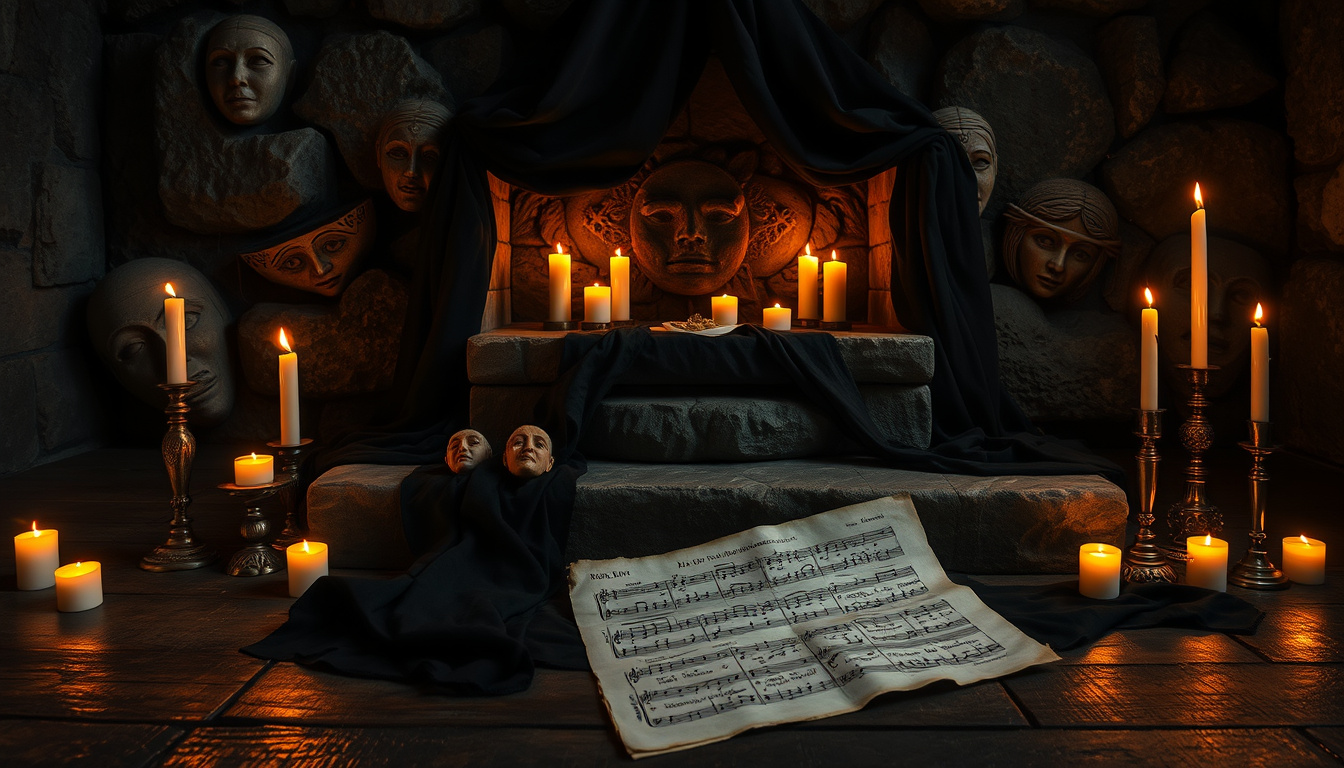
Some bands build mystique through interviews; Sleep Token built an entire mythology by refusing them. Since forming in London in 2016, the masked collective has turned anonymity into an art form — and a commercial juggernaut with four studio albums and a devoted following that treats every release like a ritual.
Formed: 2016 ·
Albums: 4 ·
Genre: Alternative / Progressive Metal ·
Monthly Listeners (Spotify): ~4.9 million ·
Anonymous Members: Yes
Quick snapshot
- Band formed in 2016 in London (The Guardian (music desk))
- Members perform as Vessel, II, III, and IV (The Guardian (music desk))
- Four studio albums released to date (Wikipedia (band discography))
- Band warned fans about impersonators in September 2023 (Loudwire (metal news))
- Vessel’s real name — rumored but never confirmed (The Guardian (music desk))
- Whether members hold personal religious beliefs (Revolver (music magazine))
- If the band will ever unmask (Kerrang! (cover story))
- Connection to an anti-Trump political stance — unsubstantiated (Louder Sound (metal journalism))
- 2016: Band forms in London (Wikipedia (band history))
- 2019: Debut album Sundowning released (Wikipedia (discography))
- 2023: Band issues impersonation warning (Loudwire (metal news))
- 2025: Fourth album Even in Arcadia arrives (The Guardian (review context))
- Continued speculation around Vessel’s identity as fame grows (The Guardian (music desk))
- Fans will keep debating the religious meaning of the lore (Revolver (music magazine))
- No official unmasking or identity reveal planned (Kerrang! (cover story))
- Scrutiny will intensify as the band’s mainstream profile rises (Louder Sound (metal journalism))
Seven key facts, one pattern: everything Sleep Token does publicly — from stage names to album drops — reinforces the same central fiction.
| Attribute | Detail |
|---|---|
| Year formed | 2016 (Wikipedia) |
| Origin | London, England (The Guardian) |
| Genre | Alternative metal, progressive metal (Wikipedia) |
| Members (stage names) | Vessel (vocals, piano, guitar), II (drums), III (bass), IV (guitar) (The Guardian) |
| Labels | Spinefarm, Rise (Wikipedia) |
| Albums | 4 — Sundowning, This Place Will Become Your Tomb, Take Me Back to Eden, Even in Arcadia (Wikipedia) |
| EPs | 2 — One, Two (Wikipedia) |
Why Is Sleep Token So Controversial?
Sleep Token’s controversies are not the usual rock-star scandals. There are no public feuds, no legal dramas, and no tabloid headlines about personal lives. The friction comes from what the band represents — and what fans think it might be hiding.
What are the main sources of Sleep Token controversy?
- Religious symbolism and accusations of satanic themes: The band’s lore centers on devotion to a deity called Sleep, and the imagery is deliberately ritualistic (Revolver (music magazine)). Some listeners read this as anti-religious provocation; others see it as theatrical metaphor.
- Anonymous identity and speculation about Vessel’s real name: Because the band has conducted almost no interviews, fans have turned to online detective work to try to unmask the members (The Guardian (music desk)).
- Allegations of copying or cultural appropriation: These accusations circulate in fan communities, though no credible evidence has been presented to support them (Louder Sound (metal journalism)).
- The anti-Trump association: A persistent online rumor links Sleep Token to an anti-Trump political stance. The band has never publicly confirmed or commented on any such position (Louder Sound (metal journalism)).
Is Sleep Token anti-Trump?
There is no documented statement from the band taking a political position on Donald Trump. The claim appears to originate from social media speculation and has no supporting interview, lyric, or official band statement attached to it. Treating it as fact would be a mistake (Louder Sound (metal journalism)).
Sleep Token is simultaneously accused of being too mysterious and too calculated. The same anonymity that lets fans project their own interpretations onto the band is what makes every rumor — including the political ones — impossible to fully kill.
Who Is the Real Singer of Sleep Token?
The most common question about the band has a short answer and a longer one. The short answer: the singer is Vessel. The longer answer involves a rumor that refuses to die.
Is Leo Faulkner the real singer (Vessel)?
Leo Faulkner is widely rumored to be the man behind Vessel, and online sleuths have circulated what they claim are identifying clues (The Guardian (music desk)). But the band has never confirmed the connection, and no official source has named Faulkner as a member. The rumor is plausible — and unverified.
What is the real name of the Sleep Token vocalist?
Vessel is the only name the band has ever provided. The Guardian’s coverage notes that the lead vocalist and primary songwriter is known solely as Vessel, with the other members identified as II, III, and IV (The Guardian (music desk)). Vessel handles vocals, piano, and guitar. No official real name has been released, and Vessel himself has dismissed the importance of the question: the true identities behind the band are “immaterial and ultimately irrelevant,” he told Kerrang!, adding that “our identity is represented through the art itself” (Kerrang! (cover story)).
- Vessel is the only officially acknowledged name for the singer (The Guardian)
- Leo Faulkner is a rumored identity, not a confirmed one (The Guardian)
- Vessel performs vocals, piano, and guitar (Wikipedia)
- The band considers the question of identity irrelevant to the art (Kerrang!)
Every time a new “identity reveal” circulates on social media, Sleep Token’s streaming numbers go up. The band gets free promotion from the rumor mill — which raises an uncomfortable question: does Sleep Token secretly benefit from its own unsolved mystery?
Is Sleep Token a Religious Band?
If you listen to one Sleep Token song without context, you might assume the band is simply heavy and atmospheric. Read the lyrics and the imagery, and the religious vocabulary is impossible to miss: “worship,” “offerings,” “rituals,” and a deity named Sleep.
Are Sleep Token’s lyrics religious or spiritual?
The lyrics and visual language are saturated with spiritual and ritualistic imagery. The band’s promotional materials describe a lore in which Vessel receives a calling from Sleep in a dream (Findyl (band history feature)). Songs are framed as “offerings” to this deity, and the live shows are staged like ceremonies. Whether this makes the music “religious” depends on whether you define religion as organized belief or as a framework of devotion. Sleep Token’s framework is deliberately constructed, and the band has never confirmed that it corresponds to any real-world faith.
Does Sleep Token promote a specific religion?
No. The band’s lore is a fictional construct built around worship of Sleep (Loaded Radio (lore explainer)). There is no evidence that Sleep Token promotes an organized religion, and the members have not publicly affirmed a personal faith. The “worship” is a narrative device — a way to give the music emotional stakes and a consistent visual identity.
- Sleep Token’s lore centers on devotion to an entity called Sleep (Revolver)
- Songs function as “offerings” or “tokens” to the deity Sleep (Loaded Radio)
- No affiliation with any organized religion has been confirmed (Revolver)
- The band’s first label reportedly described Sleep as a being whose name no modern tongue can properly pronounce (Findyl)
“Is Sleep Token religious?” is the wrong question. The real one: why does the band frame a fictional deity as the center of its entire artistic output? Because devotion is a more powerful emotional hook than mere fandom — and it converts listeners into participants.
Who Are the Actual Members of Sleep Token?
The band’s personnel sheet is minimal by design: four masked performers, four stage designations, and zero official real names.
Are the members of Sleep Token known?
Only by their stage personas. The Guardian’s reporting confirms the lineup as Vessel (vocals, piano, guitar), II (drums), III (bass), and IV (guitar) (The Guardian (music desk)). All four perform under masks and hoods, with body paint and lighting reinforcing the anonymity. No real identities have ever been officially disclosed.
What instruments do the anonymous members play?
The instrumental roles are consistent and well-documented across live performances and album credits:
- Vessel — vocals, piano, guitar (Wikipedia)
- II — drums (The Guardian)
- III — bass (The Guardian)
- IV — guitar (The Guardian)
Sleep Token’s approach differs from other masked acts in a key way: bands like Slipknot or Ghost use masks as a visual brand while still doing press and revealing personalities behind the scenes. Sleep Token skips nearly all of it — no interviews, no conventional publicity cycle, no humanizing backstory (Louder Sound (metal journalism)). The anonymity is not a gimmick layered on top of a normal career; it is the career.
For fans, the anonymity is what makes Sleep Token feel like a genuine cult rather than a marketing campaign. For skeptics, it is exactly the kind of constructed scarcity that makes the band feel manufactured. Both readings are defensible — which is precisely why the debate never ends.
Did Sleep Token Reveal Their Identity?
No. Despite recurring rumors, viral posts, and fan investigations, Sleep Token has never officially unmasked.
Have Sleep Token ever shown their faces?
Not in any official capacity. The band’s live performances and music videos consistently use masks, hoods, and lighting to obscure the members’ faces (The Guardian (music desk)). Incidental photos of members without masks have circulated online, but the band has never confirmed them as authentic.
Will Sleep Token ever unmask?
There is no public indication that they will. The anonymity is described by the band as intentional and concept-driven rather than a temporary publicity stunt (Kerrang! (cover story)). The mythology depends on the mask remaining in place. Removing it would collapse the fiction that the entire project is built on.
The security side of anonymity is real, too. In September 2023, Sleep Token publicly warned fans that people were impersonating members to exploit followers, and instructed fans to disregard unsolicited contact from anyone claiming to be part of the collective (Loudwire (metal news)). The warning is a reminder that the band’s anonymity is not just artistic — it also protects the members from the hazards of fame.
Sleep Token’s refusal to unmask has become a self-reinforcing cycle. The longer they stay hidden, the more valuable a reveal becomes — and the more attention every rumor gets. A band that “never does press” is now one of the most talked-about acts in metal without saying a word.
Confirmed Facts vs. Open Questions
Separating what is known from what is speculative is the fastest way to make sense of Sleep Token. Here is where the evidence stands.
Confirmed facts
- The band formed in 2016 in London (Wikipedia)
- Members perform anonymously as Vessel, II, III, and IV (The Guardian)
- The lead singer is called Vessel and writes the songs (The Guardian)
- Four studio albums have been released (Wikipedia)
- The genre blends alternative and progressive metal (Wikipedia)
- The band issued a public warning about impersonators in 2023 (Loudwire)
- The lore centers on devotion to an entity called Sleep (Revolver)
What’s unclear
- The real name of Vessel, rumored to be Leo Faulkner (The Guardian)
- Whether members hold personal religious beliefs (Revolver)
- Whether the band will ever officially unmask (Kerrang!)
- The alleged anti-Trump political stance — no supporting evidence (Louder Sound)
- The source of the copying and appropriation allegations (Louder Sound)
The line between fact and speculation is what keeps the conversation about Sleep Token alive.
Quotes and Perspectives
Our identity is represented through the art itself.
— Vessel, in Kerrang! (Kerrang! cover story)
The true identities behind Sleep Token are immaterial and ultimately irrelevant.
— Vessel, in Kerrang! (Kerrang! cover story)
Sleep Token presents itself as an anonymous, masked collective whose members use the designations Vessel, II, III, and IV rather than publicly disclosed real names.
— The Guardian (The Guardian music desk)
Sleep Token’s anonymity has been described as part of its world-building and worship aesthetic rather than a conventional celebrity privacy choice.
— Revolver (Revolver magazine)
The pattern across every credible source is consistent: the anonymity is structural, the religious imagery is deliberate, and the band has given no ground on either front. The only disagreements are about what it all means — and those are arguments the band seems happy to let fans have.
Summary
Sleep Token has built one of the most successful careers in modern metal by refusing to be ordinary — no faces, no interviews, and a fictional deity that turns concerts into ceremonies. The controversy around the band will likely keep growing as its audience expands, because the same anonymity that fuels devotion also feeds suspicion. For fans, the choice is simple: accept the fiction and enjoy the music, or keep digging for answers the band has already said are irrelevant. For skeptics, the alternative is equally clear: wait for an official reveal that may never come — or move on to a band that does not require a theology degree to understand.
aporion.com, vanflip.com, intellectualdissatisfaction.com, ithy.com, onlinecasinosuomi.net
For those wanting a deeper dive into the myths surrounding the band, our guide to the Sleep Token controversy and identity separates verified facts from speculation.
Frequently asked questions
Does Sleep Token wear masks?
Yes. All members perform wearing masks, hoods, and body paint, and the band’s public appearances are conducted in costume to preserve anonymity (The Guardian).
What is Sleep Token’s most popular song?
Streaming data shifts over time, but “The Summoning,” “Chokehold,” and “Rain” are among the band’s most-streamed tracks. The band’s popularity saw a major spike in 2023 with the release of Take Me Back to Eden (Wikipedia).
How many members are in Sleep Token?
Four: Vessel (vocals, piano, guitar), II (drums), III (bass), and IV (guitar) (The Guardian).
What does Vessel mean in Sleep Token?
In the band’s lore, Vessel is the chosen intermediary of the deity Sleep — the human “vessel” through which the deity’s music is delivered (Revolver).
Where can I buy Sleep Token merchandise?
Official merchandise is sold through the band’s label channels and at live shows. Fans should be cautious of third-party sellers claiming to be official, especially given the band’s 2023 warning about impersonators (Loudwire).
Are Sleep Token lyrics satanic?
No credible evidence supports that reading. The lyrics use religious and ritualistic imagery within a fictional framework centered on a deity called Sleep, but the band has never expressed affiliation with satanic belief systems (Revolver).
Has Sleep Token ever played a live show without masks?
Not officially. The band has maintained its costumed presentation across all documented live performances (The Guardian).
Who is the drummer in Sleep Token?
The drummer performs under the stage name II. No real name has been officially disclosed (The Guardian).
Source: This article draws on reporting from The Guardian, Revolver, Kerrang!, Loudwire, Louder Sound, and Wikipedia.
Related reading: Lemmy Kilmister: Biography, Last Words, Diet, Net Worth · Slash Guns Roses: Biography, Health, and Relationships

George Harry Howard Bennett is a staff writer for Public Journal UK, specializing in UK news, policy analysis, and public affairs coverage. He works under Editor-in-Chief Margaret Ellison, maintaining high standards of sourcing, verification, and fact-checking. Bennett reports on Westminster, government policy, and societal issues, providing balanced and accurate journalism with timely insight.