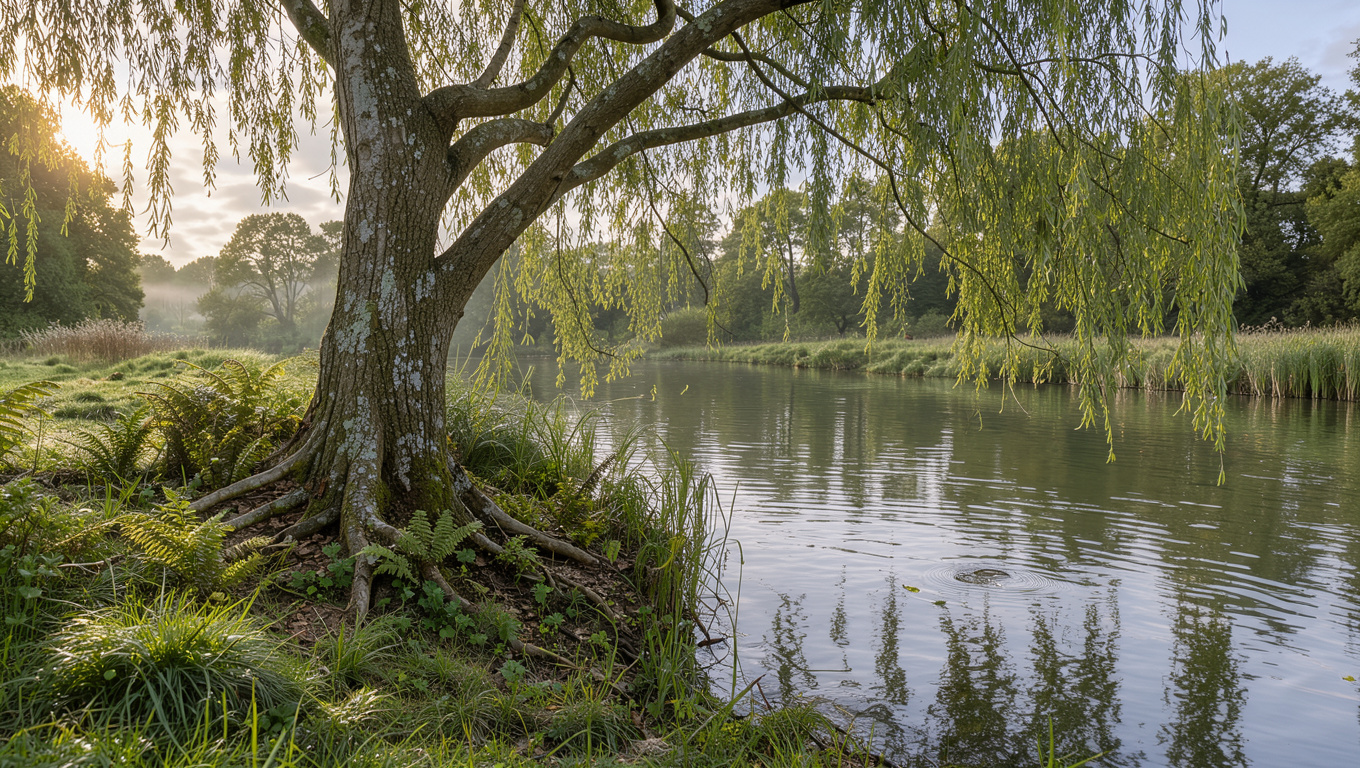
Plenty of people fall for a willow the moment they see one leaning over a pond, then discover later that its roots have strong opinions about nearby drains. White willow can reach 30m according to the Woodland Trust Shop (charity tree nursery), so the planting spot matters more than the price of the sapling.
Planting window: autumn to early spring when the ground is not frozen (Royal Horticultural Society (UK gardening authority)) · Grey willow height: 10m at maturity (Woodland Trust Shop (charity tree nursery)) · Drain distance: 10–15m, according to Ashridge Trees (UK tree nursery) · Planted coppice lifespan: 15–30 years (Biomass Connect (bioenergy crop information))
Quick snapshot
- Willows can be planted from autumn to early spring when the ground is not frozen (Royal Horticultural Society (UK gardening authority))
- Willows are fully hardy and can go into frost pockets (Royal Horticultural Society (UK gardening authority))
- Grey willow reaches 10m at maturity (Woodland Trust Shop (charity tree nursery))
- Safe distance from buildings: 5m under BS 5837:2005 (Hyndburn Borough Council (local authority tree guidance)) against 12m according to Garden UK (gardening publication)
- Weeping willow lifespan: 40–75 years according to Tree Service Near Me (UK tree-care firm)
- Bay willow’s native status and habitat: no source gathered (Hyndburn Borough Council (local authority tree guidance))
- Ashridge Trees published its drain-distance guide on 2025-10-16 (Ashridge Trees (UK tree nursery))
- Hyndburn Borough Council’s citation of BS 5837:2005 is dated 2024-05-01 (Hyndburn Borough Council (local authority tree guidance))
- The two dated guides give different drain distances, so their dates alone do not settle the question
- Measure distance to buildings and drains before buying a sapling (Woodland Trust (UK tree conservation charity))
- Water new trees regularly for two or three summers (Royal Horticultural Society (UK gardening authority)) (Woodland Trust (UK tree conservation charity))
Ten figures, one pattern: the numbers look exact, but they come from different publishers and disagree on the two distances that matter most to homeowners.
| Label | Value |
|---|---|
| Planting window | Autumn to early spring when the ground is not frozen (Royal Horticultural Society (UK gardening authority)) |
| Stake threshold | Trees taller than 90cm (Royal Horticultural Society (UK gardening authority)) |
| Watering new trees | Regularly for the first two or three summers (Royal Horticultural Society (UK gardening authority)) |
| Coppicing or pollarding month | April (Royal Horticultural Society (UK gardening authority)) |
| White willow eventual height | Up to about 25m (Trees-Online (UK tree retailer)) or 30m (Woodland Trust Shop (charity tree nursery)) |
| Grey willow mature height | 10m, growing about 60cm a year (Woodland Trust Shop (charity tree nursery)) |
| Full-sized willow from buildings | 12m according to Garden UK (gardening publication) |
| Full-sized willow from drains | 10–15m, depending on the guide (Ashridge Trees (UK tree nursery); Garden UK (gardening publication)) |
| White willow hardiness | RHS H6 rating, approx. −20°C to −15°C (Trees-Online (UK tree retailer)) |
| Coppiced willow lifespan | 15–30 years (Biomass Connect (bioenergy crop information)) |
What types of willow trees are found in the UK?
- White willow (Salix alba): up to about 25m as cited by Trees-Online (UK tree retailer), and 30m according to the Woodland Trust Shop (charity tree nursery), which also lists growth of 20–40cm a year.
- Grey willow (Salix cinerea): 10m at maturity, growing about 60cm a year (Woodland Trust Shop (charity tree nursery)).
- Weeping willow: 15–20m according to Allotment Planner (gardening reference site), while Garden UK (gardening publication) puts full-sized willows at 15–25m tall and almost as wide.
- Winter-colour willows: typically 1.2–2m tall and wide, even when cut back hard each year (Royal Horticultural Society winter-colour guide (UK gardening authority)).
Is bay willow native to the UK?
- Not confirmed here. None of the sources gathered for this guide states whether bay willow is native to the UK, so this guide does not make that claim.
Where does bay willow grow?
- No source in this research gives its habitat, so the answer stays open.
The implication: a species list that leaves bay willow’s status unanswered is a warning for buyers, so check any nursery label against a named national record before planting.
Where is the best place to plant a willow?
Willows favour damp ground and sites near water. The Royal Horticultural Society describes them as suited to deep, moist but well-drained soil in full sun (Royal Horticultural Society (UK gardening authority)).
- Full sun and deep, moist but well-drained soil suit willows, which dislike shade (Royal Horticultural Society (UK gardening authority)).
- Plant from autumn to early spring when the ground is not frozen (Royal Horticultural Society (UK gardening authority)).
- Avoid sites near building foundations or pipes, especially on shrinkable clay (Royal Horticultural Society (UK gardening authority)).
How close can a willow tree be to a house?
- Hyndburn Borough Council cites a 5m minimum from buildings under British Standard 5837:2005, and says that distance does not guarantee safety at closer range (Hyndburn Borough Council (local authority tree guidance)).
- According to Garden UK (gardening publication), full-sized willows need at least 12m from buildings and 15m from drains, and more on clay.
- According to Ashridge Trees (UK tree nursery), a willow should stand at least 10m from any drain, with 15m preferred.
Keep trees at least one metre from underground pipes, and check building foundations and underground services before planting (Woodland Trust (UK tree conservation charity)).
Woodland Trust (UK tree conservation charity)
Do willow trees have invasive roots?
- According to Roots Plants (nursery guide), willow root systems are quite sprawling, and the nursery advises against planting one next to a house or boundary fence (Roots Plants (nursery guide)).
- According to Allotment Planner (gardening reference site), the roots of the classic weeping willow aggressively seek drains and foundations.
The sources disagree on the exact figure, with Hyndburn Borough Council’s 5m (Hyndburn Borough Council (local authority tree guidance)) at one end and Garden UK’s 15m from drains (Garden UK (gardening publication)) at the other. They agree on direction: the biggest willows need the most room.
Planting steps
- Plant between autumn and early spring, when the ground is not frozen (Royal Horticultural Society (UK gardening authority)).
- Measure to buildings, drains and underground pipes before digging (Woodland Trust (UK tree conservation charity)).
- Stake trees taller than 90cm for the first few years (Royal Horticultural Society (UK gardening authority)).
- Water regularly for the first two or three summers (Royal Horticultural Society (UK gardening authority)).
Autumn planting gives roots time to settle over winter, and planting can continue until early spring while the ground is not frozen (Royal Horticultural Society (UK gardening authority)).
Royal Horticultural Society (UK gardening authority)
The implication: distance should be settled before species, because every source treats space as the first constraint on a willow.
What are the downsides of weeping willow trees?
Weeping willows win on looks, but the sources list costs that matter in an ordinary garden.
Do willow trees need a lot of water?
- Newly planted willows need regular watering for two or three summers (Royal Horticultural Society (UK gardening authority)).
- Established willows generally need no watering in moisture-retentive or wet soils (Royal Horticultural Society (UK gardening authority)).
- Willow grows well in damp areas, but no tree likes permanently wet ground (Woodland Trust (UK tree conservation charity)).
Upsides
- Fully hardy, so frost pockets and cold sites are not a barrier (Royal Horticultural Society (UK gardening authority)).
- Fast-growing and graceful, suited to larger gardens with damp soil (Royal Horticultural Society (UK gardening authority)).
Downsides
- Full-sized weeping willows reach 15–25m tall and almost as wide, according to Garden UK (gardening publication).
- Roots seek drains and foundations, according to Allotment Planner (gardening reference site).
- Dislikes shade and needs moist soil, which rules out dry plots (Royal Horticultural Society (UK gardening authority)).
A weeping willow asks for the most room on the plot, so it fits a large lawn far better than a narrow back garden.
The trade-off: the tree’s size and root habit set the limits, so the drawbacks depend on the site as much as the species.
How long is the lifespan of a willow tree?
Lifespan figures are where the sources are least consistent, so each number below is tied to a named type of willow.
- Planted coppice willow: 15–30 years (Biomass Connect (bioenergy crop information)).
- Weeping willow: 40–75 years according to Tree Service Near Me (UK tree-care firm).
- White willow: 80–100 years according to Tree Service Near Me (UK tree-care firm).
- White willow maturity: around 20–50 years, according to Trees-Online (UK tree retailer), which cites the RHS secondhand.
Commercial sites give conflicting lifespans, and a 100-year weeping willow figure has no usable link in this research, so this guide leaves it out. Read these ranges as planning estimates, not guarantees.
How long does a willow tree take to grow full size?
- White willow grows 20–40cm a year (Woodland Trust Shop (charity tree nursery)).
- Grey willow grows about 60cm a year and reaches 10m (Woodland Trust Shop (charity tree nursery)).
The pattern: the species that grow fastest are the ones whose size catches up with a small plot first.
What does a willow tree symbolize?
Symbolism is the one area where this research gathered no source, so this section does not state cultural meanings as fact.
What is the superstition about willow trees?
- None of the research names a specific superstition, so this guide states none.
- Symbolic meaning varies by tradition, so any cultural claim needs its own named source before publication.
Confirmed facts
- Willows are fully hardy and can be planted in frost pockets (Royal Horticultural Society (UK gardening authority)).
- Grey willow reaches 10m at maturity (Woodland Trust Shop (charity tree nursery)).
- Planted coppice willow lasts 15–30 years (Biomass Connect (bioenergy crop information)).
What’s unclear
- Symbolic meanings and superstitions: no source gathered.
- Bay willow’s UK native status and habitat: no source gathered.
- Safe planting distance from houses: 5m, 10m, 12m or 15m, depending on the source (Hyndburn Borough Council (local authority tree guidance); Ashridge Trees (UK tree nursery); Garden UK (gardening publication)).
- Market value of a full-grown willow tree: no source gathered.
What this means: the symbolic side of the willow stays open in this guide, so readers who want cultural history should look for a dedicated source before quoting it.
The “Willow Tree” search also returns figurine sculptures, and this guide stays with the living plant. For UK homeowners with a small plot, the choice is clear: measure to the nearest drain and building before buying, or accept a tree that outgrows the plot, as the 15–25m range for full-sized willows suggests (Garden UK (gardening publication)).
Frequently asked questions
Can you cut the top off a willow tree?
RHS guidance says pruning and pollarding should be done from autumn to early spring, with coppicing or pollarding best done in April (Royal Horticultural Society (UK gardening authority)). This research does not show how topping affects long-term health, so that effect remains unclear.
Which willow trees grow close to water?
Willows suit damp ground, according to the Royal Horticultural Society (UK gardening authority). The sources gathered here do not single out one species for waterside sites beyond that general guidance.
How do you identify a bay willow?
The research for this guide includes no identification details for bay willow, so this guide does not describe its features.
What is the difference between weeping willow and white willow?
Height is the clearest difference in these sources. Weeping willow reaches 15–20m according to Allotment Planner (gardening reference site), while white willow reaches 30m according to the Woodland Trust Shop (charity tree nursery).
How long do weeping willows live?
According to Tree Service Near Me (UK tree-care firm), weeping willow typically lives 40–75 years. A higher 100-year figure appears in another source, but the research for this guide has no usable link to it, so it is not used.

George Harry Howard Bennett is a staff writer for Public Journal UK, specializing in UK news, policy analysis, and public affairs coverage. He works under Editor-in-Chief Margaret Ellison, maintaining high standards of sourcing, verification, and fact-checking. Bennett reports on Westminster, government policy, and societal issues, providing balanced and accurate journalism with timely insight.