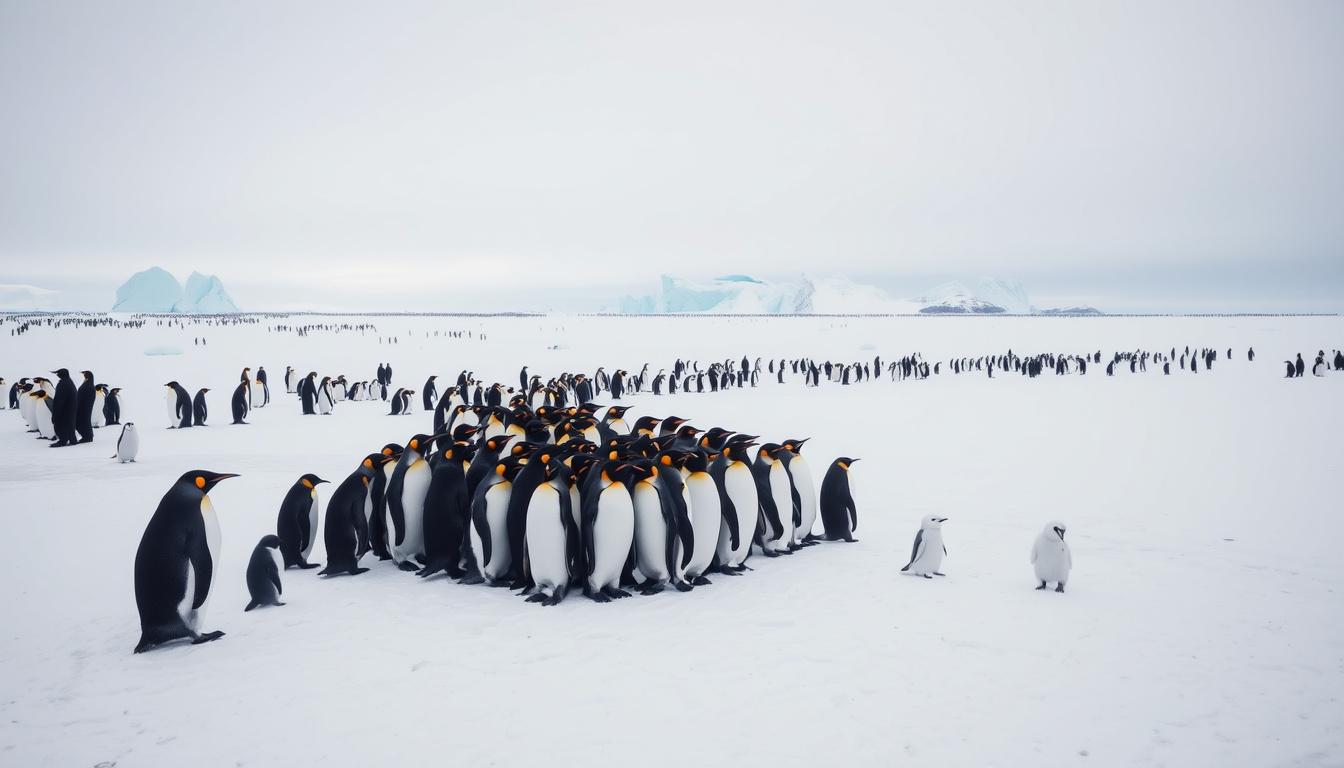
There’s a reason emperor penguins show up in nature documentaries more than almost any other Antarctic animal: they’re the only creatures that choose to breed in the dead of an Antarctic winter, when temperatures drop below -50°C and winds howl at over 100 km/h. What makes the planet’s largest penguin so extreme — how big they get, why climate change threatens them — explains why they’ve become an icon of climate vulnerability.
Height: Up to 1.3 m (4.3 ft) · Weight: Up to 45 kg (99 lb) · Lifespan: 15–20 years in the wild · Population: Approximately 600,000 individuals · Deepest dive: Over 500 m (1,640 ft)
Quick snapshot
- Largest penguin species (Britannica)
- Average height 1.3 m (4.3 ft) (Britannica)
- Weight up to 45 kg (99 lb) (Britannica)
- Distinct yellow-orange ear patches (Britannica)
- Exclusively Antarctica (U.S. Geological Survey)
- Breed on sea ice (U.S. Geological Survey)
- Colonies around the coast (U.S. Geological Survey)
- Some colonies inland on ice shelves (U.S. Geological Survey)
- Fish, squid, krill
- Dives up to 500 m (1,640 ft)
- Holds breath up to 20 minutes
- Hunts in groups
- Near Threatened (IUCN) – changing to Endangered in 2026
- Climate change threatens sea ice
- Some colonies declining
- Protected by Antarctic Treaty
Six key facts about emperor penguins, one pattern: their entire survival strategy is a single bet on ice. Everything about them — where they breed, when they fast, how deep they dive — is built around the seasonal cycle of Antarctic sea ice.
| Label | Value |
|---|---|
| Scientific Name | Aptenodytes forsteri |
| Height | Up to 1.3 m (4.3 ft) |
| Weight | Up to 45 kg (99 lb) |
| Lifespan | 15–20 years in the wild |
| Population | ~600,000 individuals |
| Conservation Status | Near Threatened (IUCN); Endangered from April 2026 |
What is special about emperor penguins?
Emperor penguins are the largest penguin species, with adults standing up to 1.3 m (4.3 ft) tall and weighing up to 45 kg (99 lb). Their breeding cycle is the most extreme in the bird world: they breed during the Antarctic winter, when temperatures can drop below -50°C with winds over 100 km/h (Britannica).
Males incubate eggs without eating for about 65 days, huddling together in groups of thousands to conserve warmth. They can dive deeper than 500 m (1,640 ft), holding their breath for up to 20 minutes while hunting (WWF UK).
The emperor’s entire biology is a tight budget of energy: it must rely on the sea ice as a platform for breeding, a fact that becomes terrifying when climate change reduces ice extent.
The implication: every physical and behavioral adaptation in the emperor penguin — from huddling to deep diving — is a direct response to the most extreme breeding conditions on Earth.
What is a sad fact about penguins?
The most sobering fact is the recent conservation downgrade. BirdLife International reported in April 2026 that the IUCN moved emperor penguins from Near Threatened to Endangered, a decision directly tied to climate change. In a key sector of Antarctica, populations declined by almost a quarter since 2009, and one colony has disappeared completely.
The U.S. Fish and Wildlife Service estimated about 61 breeding colonies along the Antarctic coastline, with a total population of 270,000 to 280,000 breeding pairs, or 625,000 to 650,000 individual birds (U.S. Fish and Wildlife Service). They project a 26% decline by 2050 under low-emissions scenarios and 47% under high-emissions scenarios.
The same ice that makes emperor penguins unique is the ice that’s melting. Their specialization is their vulnerability.
Which penguin is bigger, king or emperor?
Emperor penguins are larger than king penguins. Emperor penguins average 1.3 m in height, while king penguins reach about 0.9 m. Weight tells the same story: emperor penguins weigh up to 45 kg, while king penguins top out around 18 kg.
| Feature | Emperor Penguin | King Penguin |
|---|---|---|
| Average Height | 1.3 m (4.3 ft) | 0.9 m (3.0 ft) |
| Average Weight | Up to 45 kg (99 lb) | Up to 18 kg (40 lb) |
| Breeding Season | Antarctic winter | Sub-Antarctic spring |
| Habitat | Antarctic sea ice | Sub-Antarctic islands |
The size difference is a matter of survival strategy: emperor penguins breed on sea ice in the Antarctic winter, where larger body size helps retain heat during long fasting periods (Antarctic and Southern Ocean Coalition). King penguins, breeding on sub-Antarctic islands, face milder conditions and don’t need the same insulation.
The pattern: body size tracks environmental harshness — emperor penguins are built larger precisely because they must endure the coldest breeding conditions on Earth.
Are emperor penguins in Australia?
Emperor penguins live exclusively in Antarctica. They are not found in Australia or any other continent. While some vagrants may occasionally appear far from their range, there are no breeding populations outside Antarctica.
Where do emperor penguins live?
Their habitat is the sea ice surrounding Antarctic coasts, where they breed in colonies. The U.S. Geological Survey notes emperor penguins are dependent on sea ice, which serves as the platform for breeding, molting, and resting (U.S. Geological Survey).
What this means: the emperor penguin’s survival is geographically locked to Antarctica’s sea ice — no ice, no breeding ground, no species.
What do emperor penguins eat?
Emperor penguins have a carnivorous diet of fish, squid, and krill. Their main prey is the Antarctic silverfish, but they also take crustaceans and squid in abundance. They hunt by diving to depths of up to 500 m (1,640 ft), holding their breath for up to 20 minutes per dive.
Dive adaptations
Their bodies are adapted to extreme pressure and limited oxygen; their blood has a special hemoglobin that enables them to manage oxygen efficiently during deep dives. Emperor penguins have been observed diving for up to 20 minutes, using enhanced oxygen storage in their muscles and blood to stay under the ice while hunting.
Their survival depends on abundant prey, which in turn depends on a healthy marine ecosystem — a chain that climate change is already disrupting.
The catch: the emperor’s diving prowess is only as reliable as the ocean ecosystem that supports its prey — and that ecosystem is under pressure from warming waters.
Are emperor penguins friendly to humans?
Emperor penguins are curious but not domesticated. They may approach humans out of curiosity, but they are wild animals protected by strict regulations. The Antarctic Treaty and the Protocol on Environmental Protection prohibit any disturbance, touching, or close approach to wildlife (Protocol on Environmental Protection). Photography is allowed only from a safe distance to prevent stress.
Why can’t you take photos of penguins?
You can take photos, but you cannot approach them. The rule exists to protect breeding and nesting; a penguin that does not flee from a human is a penguin that may abandon its egg or chick.
Why can’t penguins be touched?
Penguins are vulnerable to human-introduced diseases. Strict regulations require people to keep a distance of at least five meters from wildlife, but emperor penguins are especially sensitive during the breeding season.
Why can’t you kneel in Antarctica?
Kneeling in Antarctica is prohibited because it can harm the fragile environment and induce stress in ground-nesting species like emperor penguins. It can also create trails that disturb the delicate soil and moss.
A respectful distance is not just a rule — it’s a survival requirement for a species already facing climate pressure.
What this means: human curiosity must be balanced against the species’ vulnerability — distance is a form of protection for a population already under threat.
Why do polar bears not eat penguins?
The simple answer is that they live at opposite ends of the Earth. Polar bears live in the Arctic, while emperor penguins are found in the Antarctic — the two never meet in the wild. Popular myth often places them together in popular culture, but biologically they have no overlap (WWF UK).
Do penguins engage in homosexuality?
Same-sex penguin pairs have been observed in captivity and in the wild, and some have successfully raised abandoned eggs. For emperor penguins, this is less documented but has been reported for several penguin species.
Can two male penguins raise a baby?
Yes, there are documented cases of two male penguins incubating eggs and raising chicks in captivity — a behavior that has been observed in various colonies.
What do penguins do every 20 minutes?
Penguins may feed every 20 minutes when hunting for their chicks, but it’s not a fixed rule. It depends on the availability of prey and the size of the colony.
en.wikipedia.org, wwf.org.uk, pew.org, english.aawsat.com, downloads.regulations.gov, sciencenews.org, whoi.edu
Frequently asked questions
How do emperor penguins stay warm in Antarctica?
Emperor penguins have several layers of protection: a thick layer of blubber, a dense layer of down, and a layer of oil on their feathers that repels water and traps warmth. They also huddle together in large groups, reducing heat loss by up to 50%.
How deep can emperor penguins dive?
Emperor penguins can dive to depths of over 500 m (1,640 ft), though most dives are much shallower. They can stay underwater for up to 20 minutes on a single breath.
How long do emperor penguins live?
Emperor penguins live 15–20 years in the wild, though some may live longer. This is a relatively long lifespan for a bird, reflecting their slow reproductive cycle.
Are emperor penguins endangered?
As of April 2026, the IUCN classifies emperor penguins as Endangered. The U.S. Fish and Wildlife Service listed them as threatened under the Endangered Species Act in October 2022, and the USFWS estimates the species could lose up to 47% of its population by 2050 under high-emissions scenarios.
Do emperor penguins migrate?
Emperor penguins are not migratory in the traditional sense, but they do move between breeding colonies and foraging grounds. They may travel over 150 km from their colony to the open ocean for food.
What is the scientific name of the emperor penguin?
The scientific name for the emperor penguin is Aptenodytes forsteri, honoring Johann Reinhold Forster, a naturalist on Captain Cook’s second voyage.
How do emperor penguins communicate?
Emperor penguins use a combination of visual displays and vocalizations to communicate. Each individual has a unique call, allowing adults and chicks to identify each other among thousands in a colony.
Related reading

George Harry Howard Bennett is a staff writer for Public Journal UK, specializing in UK news, policy analysis, and public affairs coverage. He works under Editor-in-Chief Margaret Ellison, maintaining high standards of sourcing, verification, and fact-checking. Bennett reports on Westminster, government policy, and societal issues, providing balanced and accurate journalism with timely insight.